Facts
On September 10, 1998, Police Constable Babubhai (PW-2) received a tip regarding the accused selling liquor. He allegedly called the accused to arrange a delivery near Sunrise Park, Ahmedabad
Source reference: para 2.1, 2.2When the accused arrived in a car, he realized it was a police trap and attempted to flee. The complainant (PW-1) and PW-2 tried to stop the vehicle by reaching inside; however, the accused allegedly dragged them for 30–40 meters, causing a clavicle fracture to the complainant
Source reference: para 2.2, 6.3The Trial Court acquitted the accused on April 20, 2000, of charges under Sections 307, 333, and 114 of the IPC
Source reference: para 1The State appealed this acquittal under Section 378 of the Cr.P.C.
Source reference: para 1Issues
1. Whether the prosecution proved the identity of the accused and the occurrence of the alleged assault beyond a reasonable doubt
Source reference: para 72. Whether the Trial Court's judgment of acquittal was patently perverse or based on a misreading of material evidence, justifying interference under Section 378 of the Cr.P.C.
Source reference: para 10, 11Law Applied
The court applied Section 378 of the Code of Criminal Procedure, 1973 (Cr.P.C.), governing appeals against acquittal
Source reference: para 1Substantive charges were considered under Sections 307 (attempt to murder), 333 (voluntarily causing grievous hurt to deter public servant from his duty), and 114 (abettor present when offence is committed) of the Indian Penal Code (IPC)
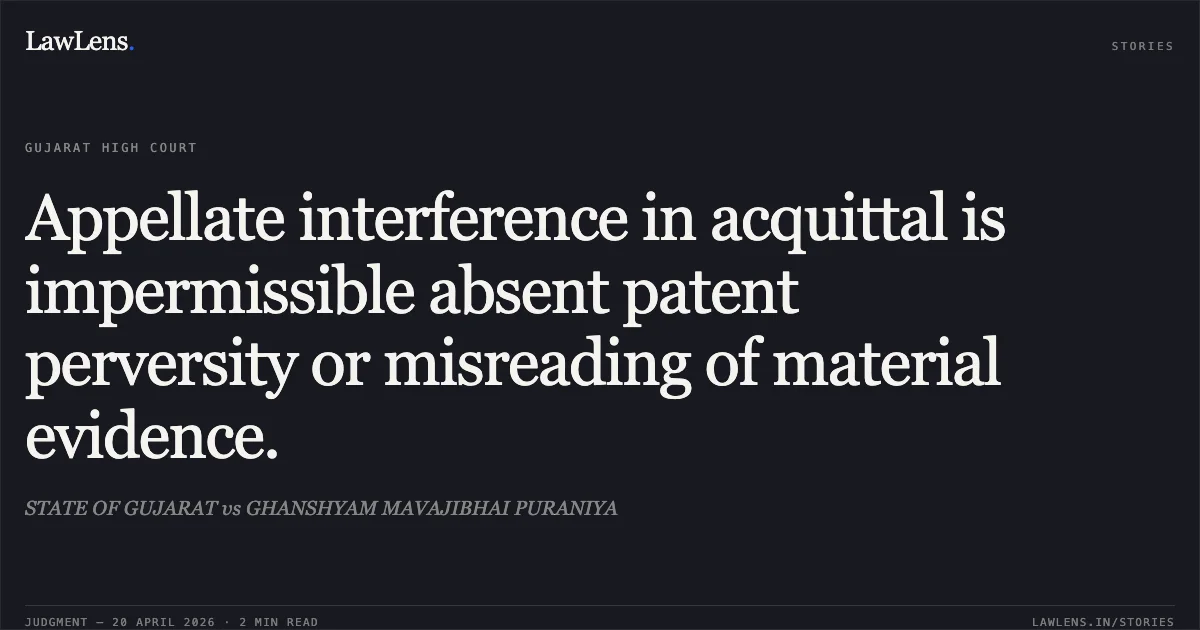
Source reference: para 1The court followed the legal standard for reversing acquittals as articulated in Constable 907 Surendra Singh v. State of Uttarakhand (2025) and Babu Sahebagouda Rudragoudar v. State of Karnataka (2024), which mandates that interference is only permissible if the judgment suffers from patent perversity, misreads evidence, or if only one view consistent with guilt is possible
Source reference: para 10Reasoning
Firstly, no call detail records (CDR) were produced to prove the accused owned or used the mobile number allegedly called by the police
Source reference: para 7(i)Secondly, the medical certificate (Exh. 14) and testimony of Dr. Harshit Shah (PW-3) revealed that the complainant reported the injury as a "road traffic accident" rather than an intentional assault
Source reference: para 7(ii), 7(iii)The court noted a lack of physical evidence: despite allegedly being dragged 30–40 meters, the complainant had no external abrasions, his clothes were not torn, and there were no tyre marks or bloodstains on his attire
Source reference: para 7(iii), 7(vi)the Investigating Officer (PW-11) failed to establish the ownership of the vehicle or the mobile phone
Source reference: para 7(vi)The court concluded that these inconsistencies and lapses in investigation created significant doubt regarding the prosecution's narrative, rendering the Trial Court’s decision to acquit a reasonable and plausible view
Source reference: para 7(vii), 9Holding
The High Court dismissed the appeal and confirmed the Trial Court’s judgment of acquittal
It held that the prosecution failed to prove the charges beyond a shadow of doubt and that the original judgment did not suffer from patent perversity
Source reference: para 9, 11The court ordered the bail bonds to be cancelled and the record and proceedings to be returned to the Trial Court
Source reference: para 12, 13Acts & Sections Cited
5 provisions across 2 statutes referred to in this judgment. Each provision opens on LawLens.
Code of Criminal Procedure, 19732
Indian Penal Code, 18603
Original Court PDF
STATE OF GUJARATvsGHANSHYAM MAVAJIBHAI PURANIYA
Click to open original judgment
Original judgment, available to read, download and summarize on LawLens.in