Facts
The petitioner, an Assistant Agriculture Director and member of the Bihar Agriculture Service, was accused in Darbhanga P.S. Case No. 86 of 2011 under Sections 7, 8 and 13(2) read with Section 13(1)(d) of the Prevention of Corruption Act, 1988, on allegations that ₹25,000 had been recovered from him pursuant to a demand for illegal gratification.
Source reference: p.3He was arrested and placed under suspension, which was subsequently revoked and then re-imposed.
Source reference: pp.3–4A departmental charge-memo dated 16 May 2011 containing three charges was issued, and an Inquiry Officer was appointed.
Source reference: p.4The petitioner participated in the inquiry, in which all charges were found proved, allegedly on the basis of documents relating to the criminal case and without substantive evidence.
Source reference: p.4After issuance of a second show-cause notice, the Disciplinary Authority dismissed him from service by Memo No. 88 dated 25 February 2022.
Source reference: p.4His review petition was rejected by Letter No. 335 dated 27 July 2022.
Source reference: pp.4–5During the writ proceedings, the petitioner filed I.A. No. 1 of 2023 challenging the charge-memo on the ground that it did not comply with Rule 17(3) of the Bihar Government Servant (Classification, Control and Appeal) Rules, 2005, particularly because the list of witnesses was not supplied.
Source reference: p.5Issues
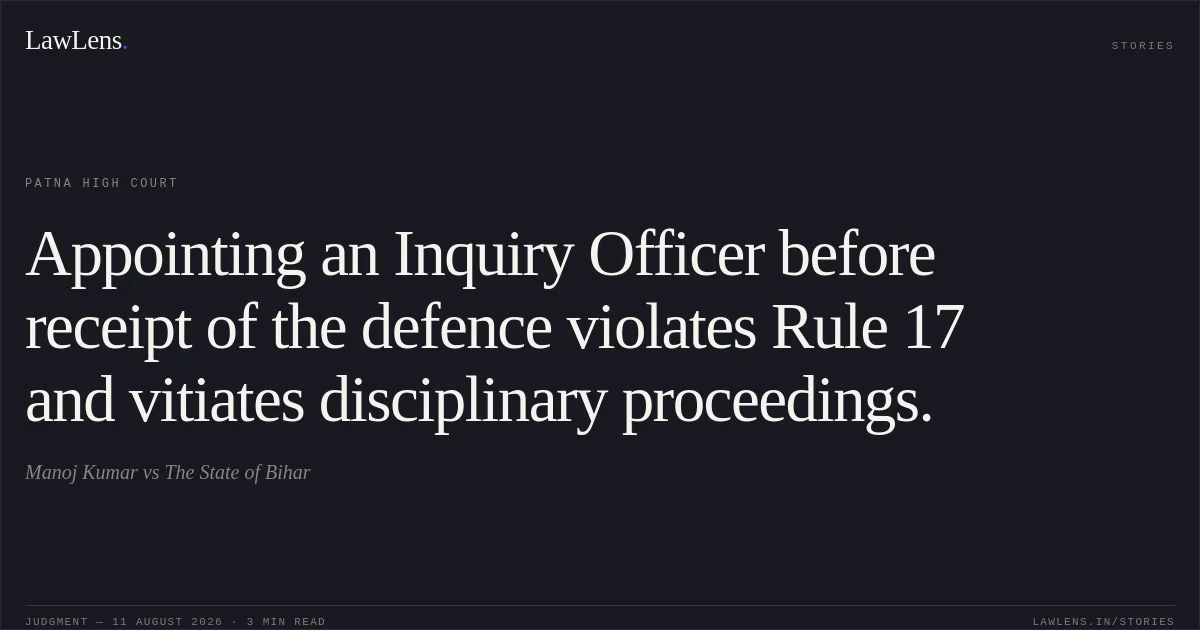
Whether the charge-memo was issued in violation of the mandatory procedure prescribed under Rule 17(3) and Rule 17(4) of the Bihar CCA Rules, 2005, when the Inquiry Officer was appointed before the petitioner submitted his written statement of defence and the petitioner was directed to file the written statement before the Inquiry Officer.
Source reference: pp.7–10Whether the inquiry report, dismissal order and review order could be sustained when the foundational charge-memo itself was procedurally defective.
Source reference: pp.10–11Whether the departmental proceeding could be remanded for a fresh decision, notwithstanding the petitioner’s objection based on Srikant Singh v. State of Bihar, LPA No. 58 of 2024.
Source reference: pp.11–12Law Applied
The Court primarily applied Rule 17(3)–(6) of the Bihar Government Servant (Classification, Control and Appeal) Rules, 2005.
Source reference: pp.7–9These provisions require the Disciplinary Authority to frame definite and distinct articles of charge, provide a statement of imputations containing relevant facts, and furnish lists of documents and witnesses proposed to sustain each charge.
Source reference: pp.7–9The charged employee must be supplied these materials and required to submit a written statement of defence, after which the Disciplinary Authority may conduct the inquiry itself or appoint an Inquiry Officer.
Source reference: pp.7–10The Disciplinary Authority must thereafter forward the charge, imputations, defence statement, witness statements, relevant documents and the order appointing the Presenting Officer to the Inquiry Officer.
Source reference: p.8The Court also applied the principles of judicial review in disciplinary matters, particularly review for procedural irregularity, violation of natural justice and disproportionate punishment.
Source reference: p.6Srikant Singh v. State of Bihar was distinguished because that case concerned a retired employee and the operation of Rule 43B of the Bihar Pension Rules, 1957, circumstances absent in the present case.
Source reference: pp.11–12Reasoning
The Court found that the charge-memo itself disclosed a breach of the statutory procedure: the Inquiry Officer had been appointed before the petitioner was called upon to submit his written statement of defence, and the charge-memo directed him to submit that statement before the Inquiry Officer rather than first before the Disciplinary Authority.
Source reference: p.10This sequence was inconsistent with Rule 17(3)–(5), which contemplates consideration of the defence statement before the decision to conduct or delegate the inquiry.
Source reference: p.10The Court therefore treated the defect as affecting the foundation of the proceeding, not as a curable irregularity in a later stage of the inquiry.
Source reference: p.10Consequently, the inquiry report and all orders founded upon the defective charge-memo could not be sustained.
Source reference: pp.10–11The Court rejected the petitioner’s objection to remand, holding that Rule 43B of the Bihar Pension Rules was not applicable because he had not reached superannuation.
Source reference: p.12Holding
The writ petition was allowed.
I.A. No. 1 of 2023 was allowed, and the challenge to the charge-memo was treated as part of the writ petition.
Source reference: p.10The Court quashed the charge-memo dated 16 May 2011, the inquiry report dated 19 December 2018, the dismissal order dated 25 February 2022, and the review order dated 27 July 2022.
Source reference: p.11The matter was remanded to the Disciplinary Authority for a fresh decision and proceedings in accordance with law.
Source reference: p.12Pending such further proceedings, the respondents were directed to accept the petitioner’s joining with all consequential benefits.
Source reference: p.12Acts & Sections Cited
3 provisions across 1 statute referred to in this judgment. Each provision opens on LawLens.
Prevention of Corruption Act, 19883
Original Court PDF
Manoj KumarvsThe State of Bihar
Click to open original judgment
Original judgment, available to read, download and summarize on LawLens.in