01Facts
The writ petitions challenged the Central Government Industrial Tribunal’s order dated 2 June 2023 in EPF Appeal No. 9 of 2012, by which the matter was remanded for a fresh enquiry under Section 7A of the Employees’ Provident Funds and Miscellaneous Provisions Act, 1952 (“EPF Act”) regarding alleged non-enrolment of approximately 800 workers for the period January 1993 to December 1996.
¶ 1, 8–9Bally Jute Company Ltd. had taken over the establishment from Birla Corporation Ltd. on 9 April 1997; therefore, the disputed period related to the previous management.
¶ 2The complaint was made in 2009 and 2011 by Birbal Ray, describing himself as General Secretary of the “Bally Jute Company Ltd. Shramik Sangathan”.
¶ 4, 16The management contended that the concerned persons were apprentices/learners excluded from the definition of “employee” under Section 2(f)(ii) of the EPF Act and the certified standing orders, and that the complaint was grossly delayed and unsupported by adequate records or particulars.
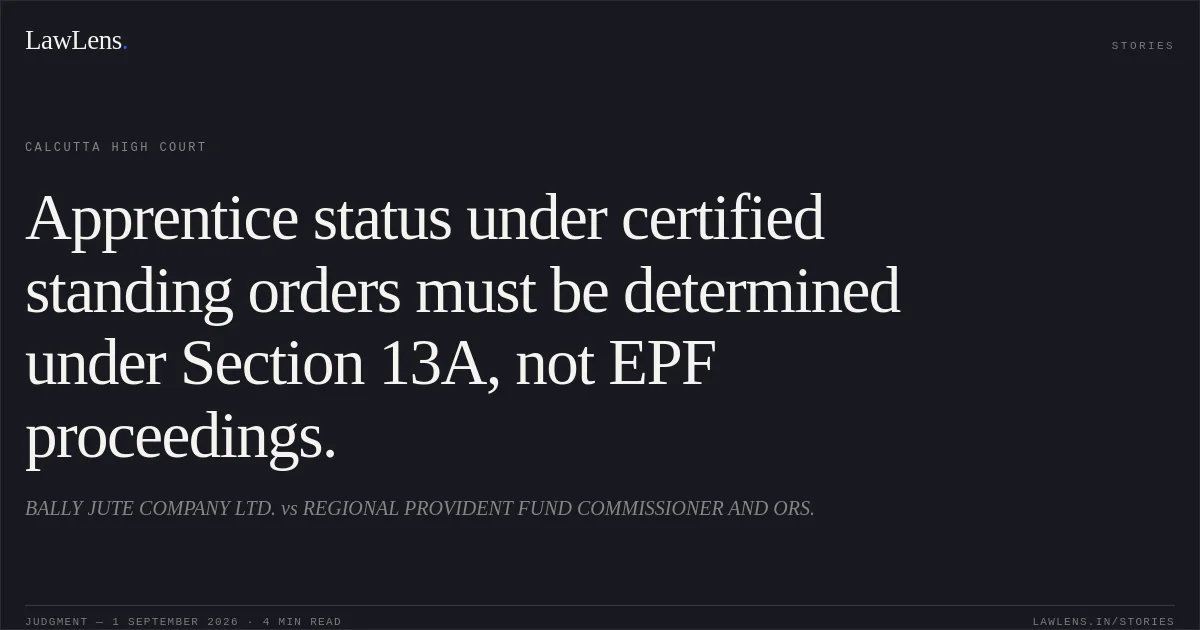
¶ 5, 12, 25The Section 7A authority, by order dated 24 May 2012, held that the status of the alleged workers as apprentices or employees had to be determined under the Industrial Employment (Standing Orders) Act, 1946, particularly Section 13A, and declined to determine provident-fund dues in the absence of such determination and supporting evidence.
¶ 7, 23, 25, 3402Issues
i.Whether the Tribunal was justified in remanding the matter for a fresh Section 7A enquiry without properly considering the evidence, the prior reasoned order, and the fact that the status of the alleged workers had to be determined under the Standing Orders Act.
¶ 8, 29, 35–37ii.Whether persons engaged as apprentices or learners under the establishment’s certified standing orders were “employees” eligible for provident-fund benefits under Section 2(f)(ii) of the EPF Act.
¶ 12(a), 34iii.Whether the complaint and subsequent proceedings were liable to fail on account of the complainant’s lack of legal standing, the alleged unregistered status of the trade union, and the extraordinary delay in initiating proceedings.
¶ 10, 12(d), 14(i)–(ii)iv.Whether the fresh proceedings could impose liability on Bally Jute Company Ltd. or Birla Corporation Ltd. for the period preceding the transfer of the establishment, having regard to Section 17B of the EPF Act.
¶ 17–2103Law Applied
The Court applied Section 2(f)(ii) of the EPF Act, under which an apprentice engaged under the Apprentices Act, 1961 or under the standing orders of the establishment is excluded from the definition of “employee”.
¶ 34It relied on Section 7A concerning determination of provident-fund dues and recognised that a disputed question concerning the interpretation or application of certified standing orders falls within the jurisdiction contemplated by Section 13A of the Industrial Employment (Standing Orders) Act, 1946.
¶ 25, 34Section 17B of the EPF Act makes the transferor and transferee jointly and severally liable for dues relating to the period preceding transfer, subject to the statutory limitation on the transferee’s liability to the value of the assets transferred.
¶ 18–19The Court further relied on Regional Provident Fund Commissioner, Mangalore v. Central Arecanut & Coca Marketing & Processing Co-operative Society Ltd., (2006) 2 SCC 381, on the exclusion of apprentices; Himachal Pradesh State Forest Corporation v. Regional Provident Fund Commissioner, (2008) 5 SCC 756, on the requirement that Section 7A proceedings be initiated within a reasonable period and on the prejudice caused by stale claims; and B. Srinivasa Reddy v. Karnataka Urban Water Supply & Drainage Board Employees’ Association, (2006) 11 SCC 731, on the absence of legal rights and locus standi of an unregistered or cancelled trade union.
¶ 12(a), 12(c), 14(i)–(ii)Provisions in the judgment · 7
Employees’ Provident Funds And Miscellaneous Provisions Act, 1952 Section 2Section 7ASection 7BSection 7ISection 17B
Industrial Employment (Standing Orders) Act, 1946 Section 13A
Trade Unions Act, 1926 Section 2
04Reasoning
The Court found that the Section 7A authority had undertaken an evidentiary assessment, considered the wage slips, employment and provident-fund records, representations of recognised unions, and the absence of contemporaneous objections, and had given a reasoned explanation for declining to determine dues at that stage.
¶ 30–34Since the central dispute was whether the workers were apprentices/learners under the certified standing orders, the EPF authority correctly directed the parties to obtain a determination from the competent authority under the Standing Orders Act before seeking computation of provident-fund dues.
¶ 34–35The Tribunal, while ordering remand, failed to address this operative direction and improperly disregarded the evidence and findings recorded by the Section 7A authority.
¶ 35–37The Court also noted the substantial delay—more than a decade after the alleged non-enrolment period—and the resulting difficulty in producing records, while observing that the complaint was unsupported by adequate particulars regarding the workers, periods of employment, wages, and alleged dues.
¶ 5, 12, 25, 33–34Although the petitioners also challenged the complainant’s locus standi and relied on Section 17B concerning transfer liability, the decisive basis of the judgment was the Tribunal’s failure to respect the proper statutory forum and the reasoned findings of the Section 7A authority.
¶ 37–3905Holding
The Court held that the Tribunal’s order dated 2 June 2023 remanding the matter for a fresh Section 7A enquiry was contrary to law and was therefore quashed and set aside.
¶ 38The parties were directed to proceed in accordance with the Section 7A authority’s order dated 24 May 2012 by approaching the appropriate authority under the Industrial Employment (Standing Orders) Act, 1946 for determination of the workers’ status as learners/apprentices.
¶ 39Both writ petitions—WPA 18750 of 2023 and WPA 22721 of 2023—were allowed; connected applications were disposed of and interim orders, if any, were vacated.
¶ 40–42Original Court PDF
BALLY JUTE COMPANY LTD.vsREGIONAL PROVIDENT FUND COMMISSIONER AND ORS.
Click to open original judgment
Original judgment, available to read, download and summarize on LawLens.in