01Facts
The DDA invited tenders for LIG and EWS housing in Narela and Rohini, divided into Group-I and Group-II works.
¶ 2Letters of award dated 18.04.2013 were issued to the Respondent and agreements were executed on 25.04.2013.
¶ 3Clause 9.1.2 applied the minimum cement content under CPWD Specifications 2009 and IS:456, which permit 330–500 kg/cum.
¶ 5–6, 28Clause 9.1.3 prescribed a minimum of 360 kg/cum for "any grade RCC," and specified 410 kg/cum (M-25) and 428 kg/cum (M-35) as recovery thresholds.
¶ 5, 30The Respondent flagged this inconsistency at two pre-bid meetings; the DDA replied that the "NIT provision shall prevail."
¶ 7On DDA's instructions, the Respondent used 410 kg/cum of cement in M-30 concrete and claimed payment for the excess above 330 kg/cum; the DDA refused.
¶ 8, 13The Tribunal (S.R. Pandey, P.S. Chadha, K.K. Varma, JJ.) rejected the DDA's jurisdictional objection under Clause 8.2.
¶ 10–11Applying contra proferentem against the DDA as drafter, the Tribunal held that 330 kg/cum applied to all grades, rejected the M-25 claim, and awarded Rs. 3,16,78,614 for M-30 excess cement up to 30.06.2015, plus Rs. 6/kg for later consumption and a refund of recoveries.
¶ 12–13The DDA challenged both awards under Section 34 of the Act.
¶ 102Issues
i.1. Whether the Tribunal's holding that 330 kg/cum is the minimum cement content for M-30 concrete, based on a supposed inconsistency between Clauses 9.1.2 and 9.1.3, is a plausible contractual interpretation or is patently illegal.
¶ 30–38ii.2. Whether the Tribunal could award payment for cement consumed in excess of the baseline for M-30 concrete when the Agreement provides no such entitlement and the claim was not founded on quantum meruit.
¶ 39–51iii.3. Whether the Tribunal's interpretation of Clauses 9.1.2 and 9.1.3 as regards M-25 and M-35 warrants interference under Section 34.
¶ 3503Law Applied
Section 34 of the Arbitration and Conciliation Act, 1996 provides that an award is reviewed only within its limited grounds, and an award that ignores express contractual stipulations or rewrites the contract is patently illegal.
¶ 24, 47Under Section 28(2), an arbitral tribunal may decide ex aequo et bono only where the parties expressly authorise it, so equity cannot justify an award.
¶ 43Following South East Asia Marine Engineering and Construction Ltd. (SEAMEC) v. Oil India Ltd. (2020) 5 SCC 164, a contract must be read as a whole and harmoniously, and an interpretation defeating its express wording is not a possible one.
¶ 25Following GMR Ambala Chandigarh Expressways Pvt. Ltd. v. NHAI (O.M.P. (COMM) 480/2020), neither a court nor a tribunal may add to or subtract from commercial contracts or supply casus omissus.
¶ 26A tribunal is a creature of the contract and must operate within its four corners.
¶ 47In a lump-sum contract, parties are bound by their bargain.
¶ 48The contra proferentem rule, applied by the Tribunal, operates only where a real ambiguity exists.
¶ 12, 32, 38The Respondent's claims invoked Sections 70 and 73 of the Indian Contract Act, 1872, but these were not pleaded or adopted in the awards.
¶ 17, 23, 42CPWD Specifications, paras. 5.8.4.1–5.8.4.2, permit cement content between 330 and 500 kg/cum, to be fixed through design mix.
¶ 15, 44Provisions in the judgment · 4 · Linked ones open on LawLens
Arbitration and Conciliation Act, 1996 Section 34Section 28
Indian Contract Act, 1872 Section 70Section 73
04Reasoning
The Court first reaffirmed that interpretation of contract is for the Tribunal and that a plausible view cannot be disturbed under Section 34.
¶ 24, 35The Court upheld the Tribunal's treatment of M-25 and M-35, since Clause 9.1.2 refers to those grades and the Tribunal's view of the inconsistency was plausible.
¶ 35On M-30, the Court found the Tribunal erred because Clause 9.1.2 does not mention M-30, while Clause 9.1.3 expressly covers "any grade of RCC" and fixes 360 kg/cum.
¶ 36–37No ambiguity therefore existed for M-30, so resort to contra proferentem was unwarranted, and the Tribunal overrode the express term.
¶ 38The absence of a recovery threshold for M-30 only bars the DDA from recovering deficits. It does not create a corresponding right for the contractor to be paid for excess consumption.
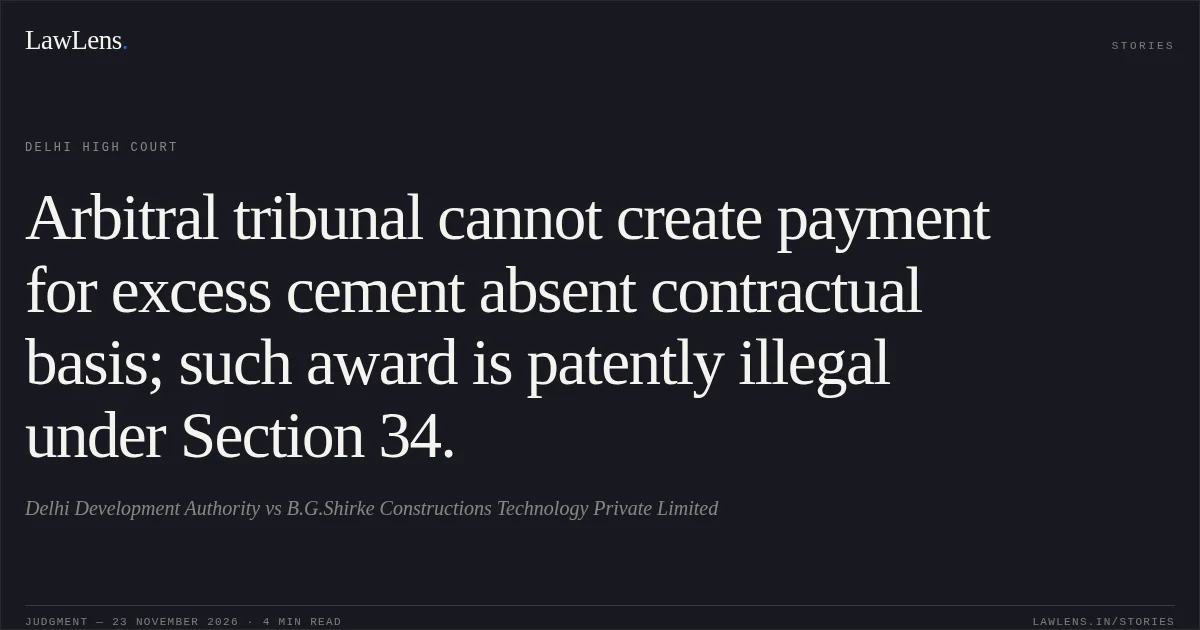
¶ 41Because the claim was not based on quantum meruit and no contractual clause authorised the payment, the Tribunal's award rested on fairness, which Section 28(2) prohibits.
¶ 42–43The 410 kg/cum requirement fell within the CPWD range, so the Respondent should have priced for it.
¶ 44–45The Tribunal's use of the Rs. 6/kg recovery rate in reverse, to pay for excess consumption, had no contractual basis.
¶ 46Since the DDA's hands were not tied to a fixed baseline, a design-mix quantity could be fixed within the prescribed limits.
¶ 50The M-30 award was not a contest between plausible interpretations but a creation of an entitlement with no contractual or legal foundation, making it patently illegal.
¶ 5105Holding
The Tribunal's interpretation fixing 330 kg/cum as the minimum for M-30 and its award of payment for excess M-30 cement are patently illegal and cannot be sustained.
¶ 38, 51Both awards dated 22.05.2017 are set aside insofar as they: (a) hold that 330 kg/cum is the minimum cement content for M-30; (b) award Rs. 3,16,78,614 for M-30 excess cement up to 30.06.2015; (c) direct payment at Rs. 6/kg from 01.07.2015; (d) direct refund of M-30 cement recoveries founded on the same erroneous reciprocal entitlement; and (e) award consequential interest on those reliefs. The Tribunal's findings on M-25 and M-35, and all other findings, remain undisturbed. Both petitions are allowed in these terms, with no order as to costs.
¶ 53–55Original Court PDF
Delhi Development AuthorityvsB.G.Shirke Constructions Technology Private Limited
Click to open original judgment
Original judgment, available to read, download and summarize on LawLens.in