Facts
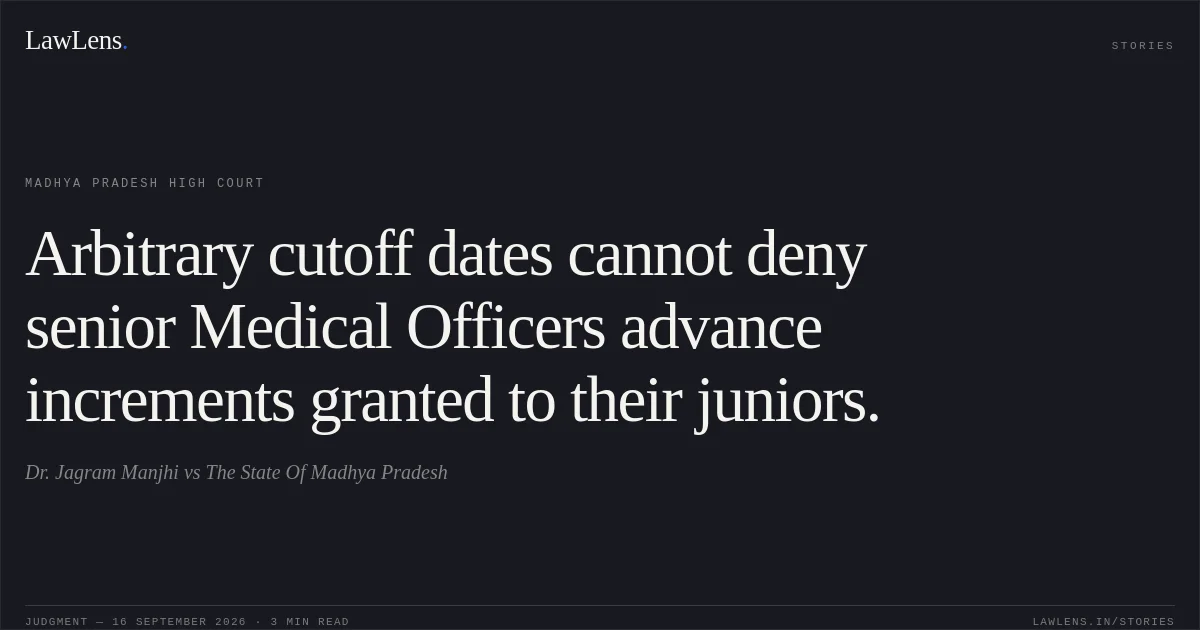
The petitioners, serving Medical Officers, challenged the cut-off date of 1 January 2014 contained in the State’s Circular dated 23 April 2015.
Source reference: p.1The circular granted three advance increments to Medical Officers possessing postgraduate degrees and two advance increments to those possessing postgraduate diplomas, but only where they had been selected through the Madhya Pradesh Public Service Commission after the cut-off date.
Source reference: p.1The petitioners sought quashing of the cut-off date and extension of the circular’s benefits from their respective dates of joining, including arrears and consequential benefits.
Source reference: p.1They relied on the decision in Dr. Ritesh Kansal v. State of Madhya Pradesh, W.P. No. 8391 of 2015, decided on 19 June 2026, concerning the same controversy.
Source reference: p.1The State conceded that the present case was identical to that earlier case.
Source reference: p.2Issues
Whether the cut-off date of 1 January 2014 prescribed in the Circular dated 23 April 2015 was arbitrary and discriminatory, particularly when similarly qualified Medical Officers appointed after that date received advance increments while the petitioners did not?
Source reference: pp.1–2; p.8Whether the petitioners were entitled to the benefit of three or two advance increments, according to their postgraduate degree or diploma, from the date of joining, along with consequential monetary benefits?
Source reference: p.1; p.8Whether the decision in Dr. Ritesh Kansal applied to the petitioners mutatis mutandis?
Source reference: p.2; p.9Law Applied
The Court exercised jurisdiction under Article 226 of the Constitution of India.
Source reference: p.1It applied the constitutional principle of equality and non-arbitrariness under Articles 14 and 16, holding that similarly situated employees cannot be subjected to an unjustified distinction based solely on an artificial cut-off date.
Source reference: pp.4–5The Court relied on the rule that a senior employee should not receive lower pay than a junior employee in the same cadre and that pay may be stepped up to remove such anomaly, as recognised in Er. Gurcharan Singh Grewal v. Punjab State Electricity Board, (2009) 3 SCC 94, and Commissioner & Secretary to Government of Haryana v. Ram Sarup Ganda, (2011) 15 SCC 772.
Source reference: pp.4–5It also considered authorities recognising pay stepping-up where a senior and junior hold the same post or cadre but the junior receives higher pay, including Pallab Kanti Chattopadhyay v. Union of India, Virender Parshad v. State of Haryana, and Government of NCT of Delhi v. Vandana Panwar.
Source reference: pp.5–8Reasoning
The Court noted that the petitioners and Medical Officers appointed after 1 January 2014 belonged to the same service and cadre, were selected through the same MPPSC process, and possessed equivalent recognised postgraduate qualifications.
Source reference: pp.2–4The only basis for denying the petitioners advance increments was that their appointments preceded the specified date.
Source reference: pp.2–4The State did not disclose any rational or legally defensible basis for fixing 1 January 2014 as the cut-off date.
Source reference: p.8The resulting anomaly was that junior Medical Officers appointed after that date received higher salaries than the petitioners.
Source reference: pp.2–4Applying the principle that a senior cannot be paid less than a junior and that pay must be stepped up to remove such an anomaly, the Court followed its earlier decision in Dr. Ritesh Kansal, which had quashed the same cut-off date and directed extension of the advance-increment benefits to similarly placed Medical Officers.
Source reference: pp.2, 8–9Since the State expressly accepted that the present case was identical, no separate factual or legal examination was required.
Source reference: p.2Holding
The petition was disposed of on the same terms and conditions as the judgment in Dr. Ritesh Kansal v. State of Madhya Pradesh, with that judgment applying mutatis mutandis to the petitioners.
Consequently, the petitioners were entitled to the benefit of the Circular dated 23 April 2015, including the applicable advance increments for holding postgraduate degrees or diplomas, together with consequential benefits such as arrears and revised salary.
Source reference: p.9The directions and time-limit contained in the earlier judgment were made applicable to the present case.
Source reference: p.9Original Court PDF
Dr. Jagram ManjhivsThe State Of Madhya Pradesh
Click to open original judgment
Original judgment, available to read, download and summarize on LawLens.in