01Facts
The petitioner was arrayed as A4 in Crime No. 577 of 2024 for offences under Sections 8(c) r/w 20(b)(ii)(B), 22(c), 25 and 29(1) of the NDPS Act, 1985.
p. 2 · ¶ 2The prosecution alleged possession of 700 grams of methamphetamine and 6.600 kg of ganja, a commercial quantity.
p. 2 · ¶ 2She was arrested and remanded to judicial custody by the Principal Special Judge (EC and NDPS Act), Chennai, by order dated 16.12.2024.
p. 2 · ¶ 2After her bail petitions were dismissed, she filed this petition under Section 528 BNSS to set aside the remand order.
p. 1 · p. 5 · ¶ 4.4Her sole contention was that the grounds of arrest were not furnished to her in writing.
p. 6 · ¶ 6The arrest memo stated only that she was arrested for illegal possession of contraband, and this was communicated to her relatives.
p. 6 · ¶ 6The arrest memos were in template form and recorded that the grounds of arrest had been explained orally.
p. 9 · ¶ 11The prosecution contended that she was apprehended in conscious possession, not on a co-accused's confession, that she was orally informed of the reasons for arrest, and that she suffered no demonstrable prejudice.
p. 4 · ¶ 4–4.1 · p. 5 · ¶ 4.402Issues
i.1. Whether the non-furnishing of written grounds of arrest, with service of only an arrest memo containing generic reasons, violates Article 22(1) of the Constitution and Section 47(1) BNSS, and whether it vitiates the arrest and the consequential remand.
p. 6 · ¶ 6 · p. 7 · ¶ 7–8 · p. 8 · ¶ 10ii.2. Whether the template statement in the arrest memo that grounds were orally explained, or the petitioner's awareness of the allegations, satisfies the requirement of communicating grounds of arrest.
p. 9 · ¶ 11iii.3. Whether the petitioner must demonstrate prejudice, and whether the belated challenge defeats relief, in light of the prosecution's reliance on Sri Darshan and Karan Singh. (Issue framed by the parties; the Court did not expressly rule on the prejudice test.)
p. 5 · ¶ 4.2–4.3 · p. 6 · ¶ 4.403Law Applied
The Court relied on Article 22(1) of the Constitution and Section 47(1) BNSS, which together require that the grounds of arrest be communicated to the arrested person.
p. 3 · ¶ 3.1 · p. 8 · ¶ 10The Court distinguished "reasons for arrest," which are generic and applicable to any arrestee (preventing further offences, ensuring investigation, preventing tampering or inducement), from "grounds of arrest," which must set out the specific factual basis for arrest and be communicated in writing.
pp. 6–7 · ¶ 7–8An arrest memo recording names, FIR particulars, time, place, and arresting officer is procedural only and does not constitute communication of grounds.
pp. 7–8 · ¶ 9Prabir Purkayastha v. State (NCT of Delhi), 2024 INSC 414, holds that failure to furnish written grounds vitiates the arrest and remand.
p. 8 · ¶ 10Vihaan Kumar v. State of Haryana, 2025 INSC 162, was relied upon.
p. 8 · ¶ 10Mihir Rajesh Shah v. State of Maharashtra, 2025 INSC 1288, requires written grounds in a language the arrestee understands.
p. 9 · ¶ 10Karan Singh v. State (NCT of Delhi) (Del. HC, 23.01.2026) and State of Karnataka v. Sri Darshan, 2025 SCC OnLine SC 1702, apply a prejudice-oriented test and were cited by the respondent but not adopted in the reasoning.
pp. 4–5 · ¶ 4.2–4.3 · no citationProvisions in the judgment · 8 · Linked ones open on LawLens
Bharatiya Nagarik Suraksha Sanhita, 2023 Section 528Section 47
Narcotic Drugs and Psychotropic Substances Act, 1985 Section 8Section 20Section 22Section 25Section 29
Code of Criminal Procedure, 1973 Section 50
04Reasoning
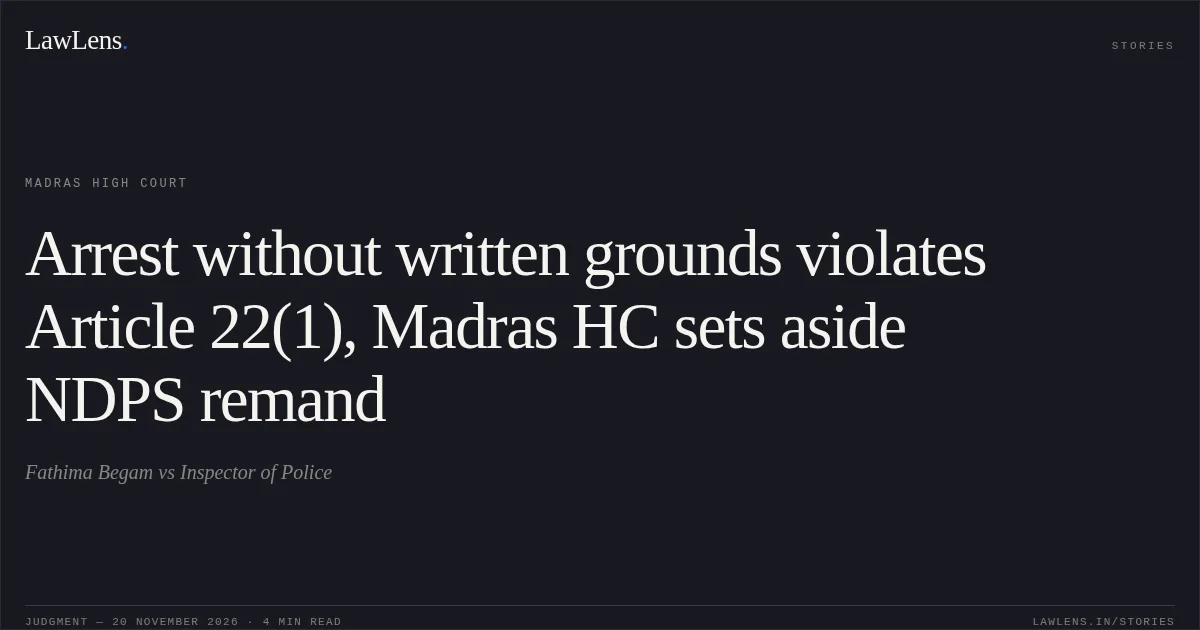
The Court found that the arrest memo served on the petitioner contained only the particulars of arrest and generic reasons. Under Prabir Purkayastha and the subsequent decisions, such material does not satisfy Article 22(1).
p. 6 · ¶ 6 · pp. 8–9 · ¶ 10The prosecution's claim that grounds were orally explained did not cure the defect. The arrest memos were template documents, and an oral explanation recorded in a standard form is not written communication of grounds.
p. 9 · ¶ 11The prosecution's factual position that the petitioner was found in conscious possession, and her knowledge of the allegations, did not alter this analysis, because the constitutional requirement is written communication of specific grounds, not awareness of the general charge.
pp. 7–8 · ¶ 8–10The Court did not expressly address the prejudice test or the delay in filing the petition. Its reasoning rests on the non-compliance itself, which it treated as sufficient to vitiate the arrest and remand.
05Holding
The Court held that the failure to furnish written grounds of arrest violated Article 22(1) and rendered the remand unsustainable.
p. 9 · ¶ 11The remand order dated 16.12.2024 in Crime No. 577 of 2024 is set aside. The petitioner is to deposit Rs.25,000 as non-refundable deposit with the Tamil Nadu Mediation and Conciliation Centre and is to be released on bail on executing a bond for Rs.25,000 with two sureties of a like sum, one a blood relative, to the satisfaction of the Special Court. Bail conditions include: sureties to affix photographs and left thumb impressions; daily reporting to the respondent police at 10:30 a.m. until further orders; no absconding; no tampering with evidence or witnesses; and breach to be dealt with under P.K. Shaji v. State of Kerala. The order further provides that a fresh FIR may be registered under "Section 229A IPC" if the petitioner absconds. The Criminal Original Petition is allowed.
p. 9 · ¶ 11 · p. 10 · ¶ 12 · pp. 10–11 · ¶ 12 · p. 11 · ¶ 12(f) · p. 11 · ¶ 13Original Court PDF
Fathima BegamvsInspector of Police
Click to open original judgment
Original judgment, available to read, download and summarize on LawLens.in