01Facts
The deceased, Ramamoorthi, was allegedly struck by a Maxi Mini Cab Van (TN-65-AB-1680) on 02.01.2021 at about 5.30 a.m. while standing near a tea shop at NSK Street, Rameswaram.
p. 2 · ¶ 2.1He was hospitalised, underwent treatment, and died on 21.04.2021. No post-mortem was conducted because of COVID-19 restrictions, and the body was buried.
p. 2 · ¶ 2.1The claimants filed M.C.O.P. No. 2114 of 2022 on 25.11.2022, claiming Rs. 25,00,000 with interest at 7.5%.
p. 2 · ¶ 2.1 · p. 5 · ¶ 8.1The insurer denied the manner of accident and the causal link between the accident and death.
pp. 2–3 · ¶ 2.2The claimants examined P.W.1 and marked Exs. P1–P12; the respondents adduced no evidence.
p. 3 · ¶ 2.3The Tribunal fixed negligence on the driver, held that the death resulted from the accident injuries, and awarded Rs. 16,44,553, including loss of income of Rs. 4,80,000 (one-fifth deducted for personal expenses), medical bills of Rs. 8,49,553, and consortium and other heads.
p. 3 · ¶ 3.1The insurer appealed, contending limitation under Section 166(3) as amended, absence of nexus between accident and death, absence of post-mortem, and inadequate deduction for personal expenses.
p. 4 · ¶ 4.1–4.2The claimants did not appear.
p. 4 · ¶ 502Issues
i.1. Whether the claim petition was barred by limitation.
p. 5 · ¶ 7(i) · ¶ 8ii.2. Whether the death of the deceased was the result of the injuries sustained in the accident.
p. 5 · ¶ 7(ii) · ¶ 9iii.3. Whether the compensation awarded by the Tribunal requires modification.
p. 5 · ¶ 7(iii) · ¶ 1003Law Applied
The amended limitation under Section 166(3) of the Motor Vehicle Act, effective 01.04.2022, cannot be applied retrospectively to a policy already in force before the amendment, relying on Malaravan v. Parveen Travels (2023 ACJ 2062) and Assistant Manager v. Susila (C.R.P. No. 973 of 2025).
p. 5 · ¶ 8.1The Supreme Court's exclusion of the COVID-19 period from limitation computation.
pp. 5–6 · ¶ 8.2An injury which accelerates or aggravates a condition so that death ensues earlier is a cause of death, drawn from Words and Phrases and K.S. Narayan Reddy's Forensic Medicine, and the Division Bench decision in 2026 MHC 2066.
pp. 6–7 · ¶ 8.2–8.4The "but-for" and "directly traceable" tests from Pegney v. Pointers Transport and Ratanlal & Dhirajlal's Law of Torts.
pp. 7–8 · ¶ 8.5–8.7In Ramathal v. Managing Director, Cheran Transport Corporation ((2003) 10 SCC 53), the Supreme Court held that a death after prolonged treatment may be attributable to accident injuries absent contrary evidence.
pp. 8–9 · ¶ 9.1The Madras High Court decisions in Abdul Rahim v. Sundaresan (2010 (1) TN MAC 205) and United India Insurance v. M. Elangovan (AIR Online 2018 Mad 785), which collected the authorities in Govind Singh, Kumar Mohamed Rafique, New India Assurance v. Shakuntla Bai, Usha Jhingran, Klaus Mittelbachert and Vidhyawati: death attributable to accident injuries without an intervening cause is compensable, and absence of post-mortem is not fatal to the claim.
pp. 9–11 · ¶ 9.2–9.4 · pp. 11–13 · ¶ 9.5–9.6.2Sarla Verma (2009) 6 SCC 121, as approved in Pranay Sethi and Ved Kanwar v. Babulal (SLP(C) Nos. 5776–5777 of 2023), which fix a one-third deduction for personal expenses where the deceased was married and a multiplier of 5 for age 68.
pp. 15–16 · ¶ 10.4–10.5Provisions in the judgment · 3 · Linked ones open on LawLens
Motor Vehicles Act, 1988 Section 173Section 166
Indian Penal Code, 1860 Section 302
04Reasoning
On limitation, the Court held that the policy predated the 01.04.2022 amendment, so the new limitation period could not apply retrospectively. It added that even after excluding the COVID-19 period, the petition was not time-barred.
pp. 5–6 · ¶ 8.1–8.3On causation, the Court found the deceased had sustained multiple injuries and was under continuous treatment at several hospitals until death at Meenakshi Mission Hospital. Although the medical records showed some date inconsistencies, the Court held they established a continuous chain of treatment.
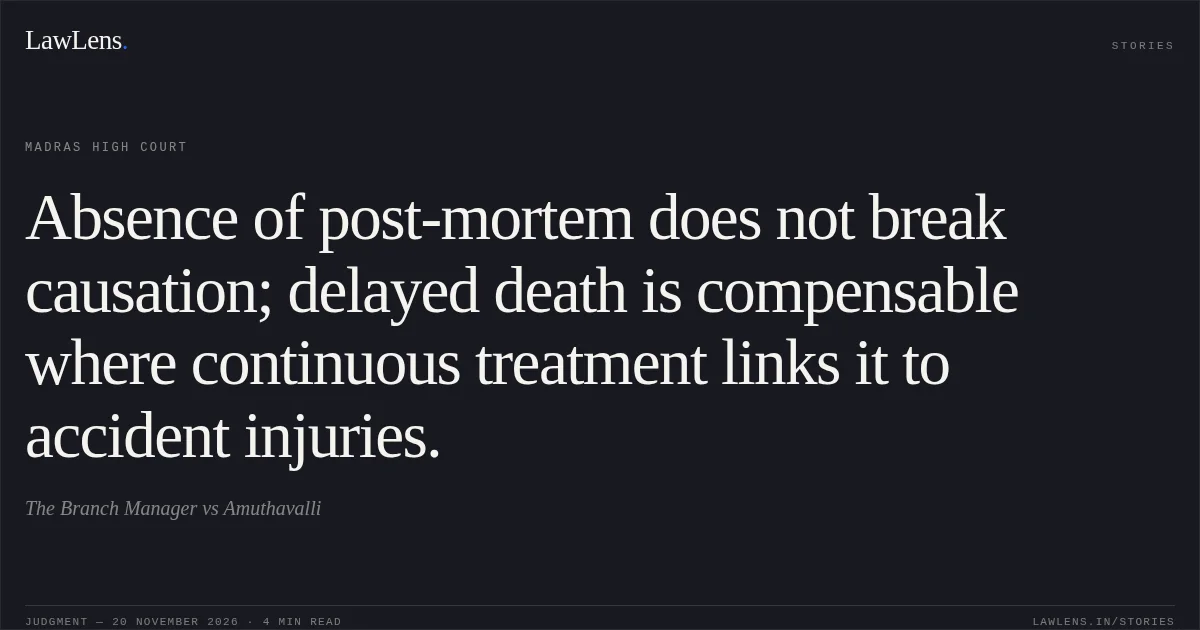
p. 13 · ¶ 9.1The Court held that the absence of a post-mortem report could not by itself break the causal connection, given the COVID-19 restrictions.
p. 14 · ¶ 9.2The insurer led no contrary medical evidence showing an independent or intervening cause. The mere survival for about three and a half months did not sever the link.
p. 14 · ¶ 9.3The Court accepted the Tribunal's notional income of Rs. 10,000 per month, as no acceptable income proof was produced for the 68-year-old watchman.
p. 15 · ¶ 10.2–10.3The Court held that the one-fifth deduction was wrong. Only the first claimant (the wife) was shown to be dependent, and the other claimants were married and living separately without proof of dependency. Applying Ved Kanwar, the Court deducted one-third for personal expenses and a multiplier of 5, giving Rs. 10,000 × 2/3 × 12 × 5 = Rs. 4,00,000.
pp. 15–16 · ¶ 10.4 · p. 16 · ¶ 10.5On liability, the Court found no ground to disturb the Tribunal's fixing of negligence on the driver and the insurer's liability under the policy.
p. 17 · ¶ 10.705Holding
The claim was not barred by limitation, since the amended Section 166(3) period does not apply to a pre-amendment policy and the COVID-19 period is excluded.
pp. 5–6 · ¶ 8.1–8.3The death was attributable to the accident injuries, as no intervening cause was shown and the absence of a post-mortem was not fatal.
p. 14 · ¶ 9.3–9.4Quantum required modification. Loss of dependency was reduced from Rs. 4,80,000 to Rs. 4,00,000, and funeral expenses were enhanced from Rs. 15,000 to Rs. 20,000. The total award was reduced from Rs. 16,44,553 to Rs. 15,69,553.
p. 17 · ¶ 10.6, 11.1 · p. 18 · ¶ 12.2The appeal was partly allowed with no order as to costs. The insurer must deposit Rs. 15,69,553, less any amount already deposited, with 7.5% interest from the date of the claim petition, within eight weeks of receipt of the judgment. The first claimant may withdraw the amount in accordance with law, and any excess deposit may be withdrawn by the insurer.
pp. 18–19 · ¶ 12.1–12.5Original Court PDF
The Branch ManagervsAmuthavalli
Click to open original judgment
Original judgment, available to read, download and summarize on LawLens.in