01Facts
On 21.11.2020, the claimant, riding a motorcycle with a pillion rider, was struck by a Mahindra LGV insured with the appellant. He sustained injuries to the right shoulder, right knee and right ankle, with multiple fractures and several surgeries.
¶ 8.1 · p. 2He claimed Rs.25,00,000 before the Motor Accident Claims Tribunal, Tirunelveli (M.C.O.P. No. 181 of 2021).
p. 2The insurer denied the manner of accident, negligence, liability and quantum, but led no oral or documentary evidence.
p. 3The Tribunal awarded Rs.19,46,102 with 7.5% interest from the date of petition, including Rs.17,66,016 under loss of earning power.
p. 3A Medical Board assessed permanent disability at 73%, which was undisputed.
¶ 5.1, 8.1The claimant was engaged in a retail vessel business.
¶ 5.1The insurer appealed under Section 173 of the Motor Vehicle Act, 1988.
p. 1 · ¶ 3.2The judgment adopts a monthly income of Rs.12,600 and a multiplier of 16 in its recalculation but does not expressly record the source of that income figure or the basis for the multiplier.
¶ 8.302Issues
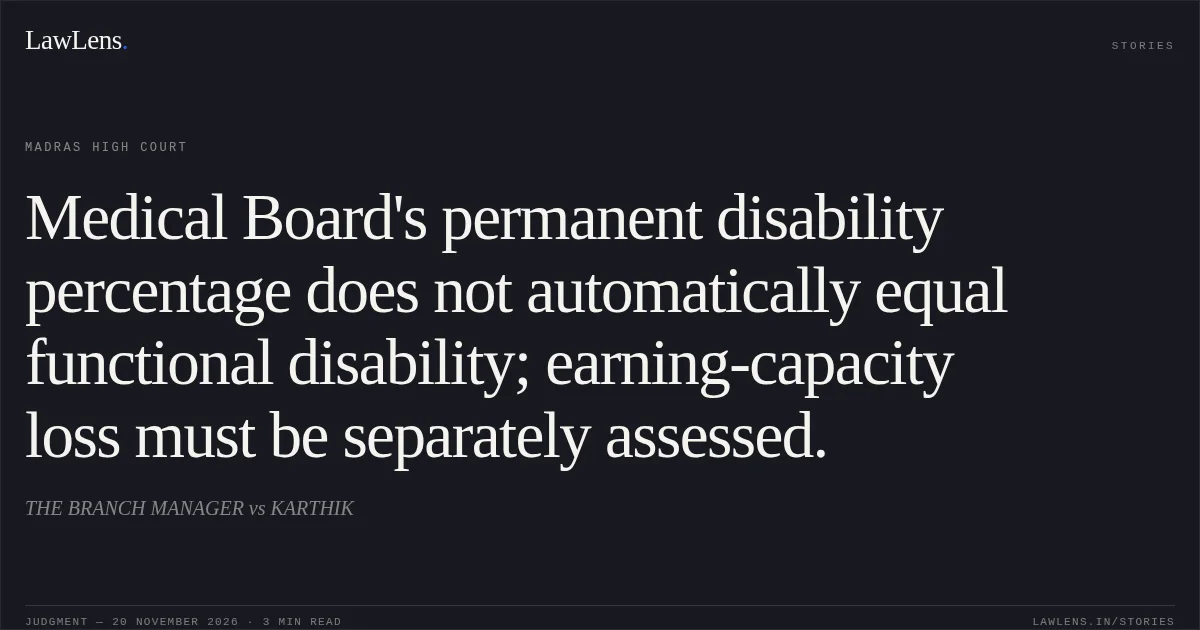
i.1. Whether the Tribunal was justified in treating the Medical Board's 73% permanent disability as the functional disability for computing loss of future earning capacity, such that the compensation requires interference?
¶ 7 · ¶ 4.1, 5.1ii.2. Whether the other heads of compensation awarded by the Tribunal are excessive and require reduction?
¶ 4.1 · ¶ 8.403Law Applied
Section 173 of the Motor Vehicle Act, 1988, which provides the appellate forum against the award.
p. 1The principle from Raj Kumar v. Ajay Kumar, (2011) 1 SCC 343, that permanent disability (a medical assessment) is distinct from functional disability (its effect on earning capacity). The Court must determine whether, and to what extent, the disability affected the claimant's earning capacity, having regard to his avocation, and then apply an appropriate multiplier to the percentage of functional disability to compute loss of future earning capacity.
¶ 8.1 · ¶ 8.2The general standard that compensation under non-pecuniary and other heads is to be "just and reasonable".
¶ 8.4Provisions in the judgment · 1 · Linked ones open on LawLens
Motor Vehicles Act, 1988 Section 173
04Reasoning
The Court accepted that the Medical Board's 73% figure was undisputed but held that it could not be treated as functional disability without considering the claimant's avocation and the extent to which the injuries affected his earning capacity.
¶ 8.1Applying Raj Kumar, the Court found that the Tribunal did not justify treating the entire 73% as functional disability, and, having regard to the nature of the injuries and the claimant's retail vessel business, fixed functional disability at 40%.
¶ 8.3The loss of earning capacity was recomputed as Rs.12,600 × 12 × 16 × 40% = Rs.9,67,680.
¶ 8.3The Court found the Tribunal's awards under medical expenses, attendant charges, pain and suffering, loss of amenities, transport and extra nourishment to be just and reasonable and declined to interfere with them.
¶ 8.4The reasoning on the 40% figure is brief and does not explain the basis for that percentage beyond the injuries and avocation, and the income and multiplier are adopted without detailed derivation.
¶ 8.305Holding
The Court held that the Tribunal erred in equating permanent disability (73%) with functional disability, and that functional disability should be taken at 40%.
¶ 8.3, 8.4Only the loss-of-earning-power head is reduced; the remaining heads are confirmed. The appeal is partly allowed, and the award is modified from Rs.19,46,102 to Rs.11,47,766, carrying 7.5% interest from the date of the claim petition. The insurer must deposit the modified amount with interest within eight weeks, after which the claimant may withdraw it. The insurer may withdraw any excess already deposited. No order as to costs.
¶ 9, 10.2, 10.4–10.6 · ¶ 9.1Original Court PDF
THE BRANCH MANAGERvsKARTHIK
Click to open original judgment
Original judgment, available to read, download and summarize on LawLens.in