01Facts
On 02.12.2018, the claimant and a friend were standing near Kadambamaram Temple when a two-wheeler carrying another friend as pillion was struck by the offending vehicle, allegedly driven rashly and negligently by the first respondent's driver.
p. 2The claimant sustained facial injuries and loss of vision in the left eye, and an FIR was registered against the offending vehicle's driver.
pp. 2–3The claimant filed a claim under Section 166 of the Motor Vehicles Act, 1988 for Rs. 2,00,000.
p. 2The insurer of the offending vehicle disputed liability, alleging negligence by the claimant's side and non-maintainability; the insurer of the two-wheeler contended the offending driver was negligent.
p. 3The claimant examined P.Ws.1–2 and marked Exs. P1–P8 and Ex. C1 (Disability Certificate); R.W.1 was examined and Exs. R1–R2 were marked.
p. 3The Tribunal apportioned negligence at 90% (offending driver) and 10% (two-wheeler rider) and awarded Rs. 14,93,080, including Rs. 12,70,080 for permanent disability/loss of future earning capacity.
p. 4The insurer appealed, contending excessive negligence apportionment against the insured driver, that a higher share should fall on the rider given three persons on the two-wheeler, and that the future earning capacity award was excessive.
pp. 4–5The claimant, a painter, argued the multiplier method was justified.
p. 502Issues
i.1. Whether the Tribunal was justified in fixing 90% negligence on the offending vehicle's driver and 10% on the two-wheeler rider.
p. 6 · ¶ 7(i) · p. 6 · ¶ 8.2ii.2. Whether the compensation awarded by the Tribunal requires interference.
p. 6 · ¶ 7(ii) · pp. 7–8 · ¶ 9.1–9.403Law Applied
The Court's jurisdiction arises under Section 173 of the Motor Vehicles Act, 1988.
p. 1Compensation is claimed under Section 166 of the Motor Vehicles Act, 1988.
p. 2 · ¶ 2.1On quantum, the Court relied on Raj Kumar v. Ajay Kumar, (2011) 1 SCC 343, which holds that the court must determine whether the injury has affected the claimant's earning capacity and, if so, to what extent; future loss of earning capacity is then computed by applying the appropriate multiplier to the percentage of functional disability.
p. 7 · ¶ 9.2On negligence, the Court applied the principle that, absent contrary evidence, the Tribunal's apportionment based on the oral and documentary record will not be disturbed.
p. 6 · ¶ 8.2Provisions in the judgment · 2 · Linked ones open on LawLens
Motor Vehicles Act, 1988 Section 173Section 166
04Reasoning
On negligence, the Court found the insurer adduced no contrary evidence establishing that the entire fault lay with the two-wheeler rider.
p. 6 · ¶ 8.1–8.2Since the Tribunal's 90:10 finding rested on P.Ws.1–2 and Ex. P1, the Court confirmed it.
p. 6 · ¶ 8.1–8.2On quantum, the Court accepted that the claimant suffered facial injuries and impaired vision in the left eye, but held there was no evidence of complete loss of vision or complete incapacity to pursue his avocation.
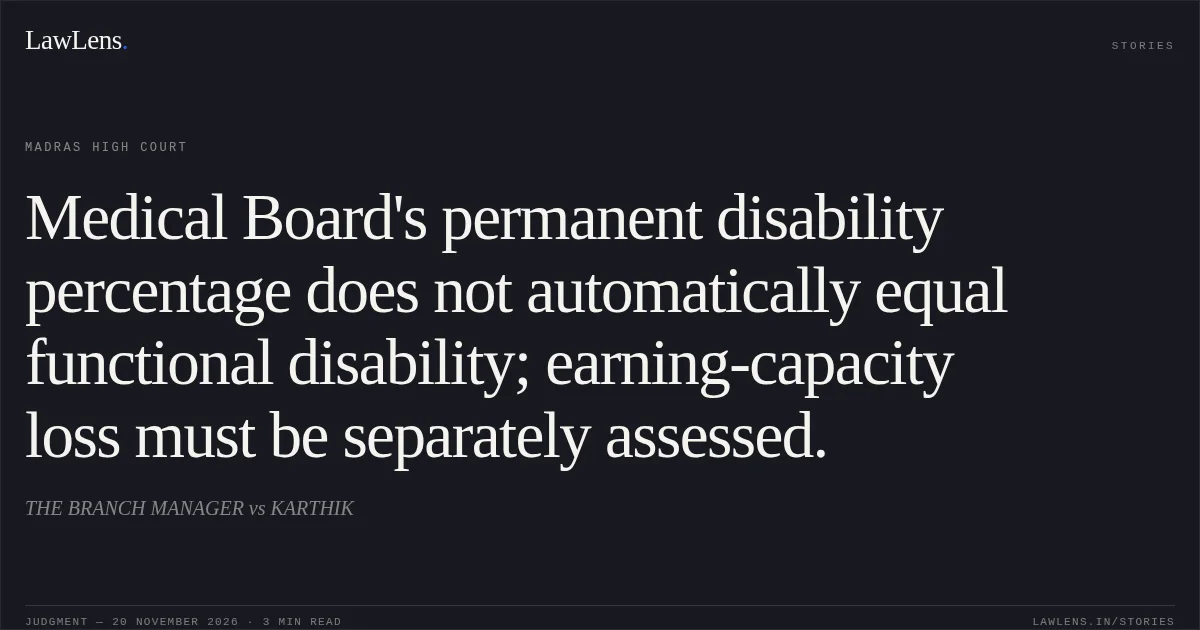
p. 7 · ¶ 9.1, 9.3The Court concluded that permanent disability could not automatically be treated as functional disability causing total loss of earning capacity, and therefore set aside the multiplier-based award of Rs. 12,70,080.
p. 7 · ¶ 9.3 · p. 8 · ¶ 9.4In its place, the Court assessed permanent disability at 30% and awarded Rs. 3,00,000 at Rs. 10,000 per percentage point.
p. 8 · ¶ 9.4The Court further awarded Rs. 1,00,000 each for loss of amenities and loss of convenience, Rs. 70,000 for future medical expenses, and enhanced attendant charges from Rs. 7,000 to Rs. 25,000.
p. 8 · ¶ 9.4Pain and suffering (Rs. 2,00,000), extra nourishment (Rs. 10,000), medical expenses (Rs. 1,500) and transportation (Rs. 5,000) were confirmed.
pp. 8–9 · ¶ 10The Court then applied a 10% deduction for contributory negligence.
p. 9 · ¶ 1005Holding
The Court held that the 90:10 negligence apportionment was justified on the record, absent contrary evidence.
p. 6 · ¶ 8.2The multiplier-based future earning capacity award was set aside because the record did not establish complete loss of vision or incapacity; a 30% permanent disability was assessed instead.
pp. 7–8 · ¶ 9.3–9.4The award was reduced from Rs. 14,93,080 to Rs. 7,30,350 (Rs. 8,11,500 less 10% contributory negligence), with interest at 7.5% per annum from the date of the claim petition.
p. 9 · ¶ 11.2 · p. 9 · ¶ 10The insurer was directed to deposit the amount with accrued interest within eight weeks, after which the claimant may withdraw it, and any excess deposit may be withdrawn by the insurer.
p. 10 · ¶ 11.3–11.4No order as to costs. The connected C.M.P. was closed.
p. 10Original Court PDF
The Branch ManagervsSakthivel
Click to open original judgment
Original judgment, available to read, download and summarize on LawLens.in