01Facts
On 11.06.2018, the claimant, riding a motorcycle on the Maduravoyal By-Pass service road, was struck by a lorry (Reg. No. TN 73-L 8455) and sustained injuries across his body.
p. 2He claimed compensation under Section 166 of the Motor Vehicles Act, 1988, against the lorry owner (R1) and its insurer (R2, National Insurance Co. Ltd.).
p. 2R1 was set ex parte; R2 denied the manner of accident and led no evidence.
pp. 2–3The Tribunal found the driver of the lorry negligent.
p. 6The claimant was admitted as an inpatient from 11.06.2018 to 15.09.2018 (97 days), with surgery on the day of the accident, and again from 11.02.2019 to 12.03.2019 (30 days), with surgery on 06.03.2019.
p. 6The Medical Board, Government Stanley Hospital, assessed permanent disability at 70% due to right lower-limb injury, with no mention of functional disability (Ex.C1).
pp. 6–7The claimant, a leather factory worker earning Rs.18,000 per month (Ex.P18), admitted in cross-examination that he continued in the same employment.
p. 3 · pp. 6–7The Tribunal applied the percentage method (Rs.5,000 per percentage point) and awarded Rs.8,74,000 in total.
pp. 3–4The claimant appealed under Section 173 for enhancement.
p. 1 · p. 402Issues
i.1. Whether the Tribunal erred in adopting the percentage method, rather than the multiplier method, to compensate the 70% permanent disability in the absence of proof of functional disability or loss of earning capacity.
pp. 4–5 · pp. 6–7ii.2. Whether the per-percentage rate for disability compensation (Rs.5,000) required enhancement in view of the nature of injuries and the year of accident.
p. 7iii.3. Whether the awards under loss of income, attendant charges, pain and suffering, extra nourishment and transportation were meagre and required enhancement.
pp. 4–5 · p. 803Law Applied
The Court proceeded under Section 166 and Section 173 of the Motor Vehicles Act, 1988, which govern compensation claims and appeals.
p. 1The Court relied on Dinesh Singh v. Bajaj Allianz General Insurance Co. Ltd. (cited by the appellant) for the proposition that compensation for permanent disability must consider its impact on employment or profession.
pp. 4–5The Court relied on Sandeep Khanuja v. Atul Dande (cited by the appellant) for the principle that the nature of injury and permanent disablement, and their effect on earning capacity, are relevant factors, and that the multiplier method is the accepted means of ensuring just compensation.
pp. 4–5The Court applied Raj Kumar v. Ajay Kumar [2010 INSC 703], which holds that the multiplier method must be adopted wherever there is functional disability arising from permanent or partial permanent disability.
p. 7The Court applied the Madras High Court decision in The United India Insurance Co. Ltd. v. G. Vijayakumar (CMA No. 3005 of 2024, dated 14.07.2025), which fixed Rs.8,000 per percentage of disability for a 2018 accident.
p. 7Provisions in the judgment · 2 · Linked ones open on LawLens
Motor Vehicles Act, 1988 Section 173Section 166
04Reasoning
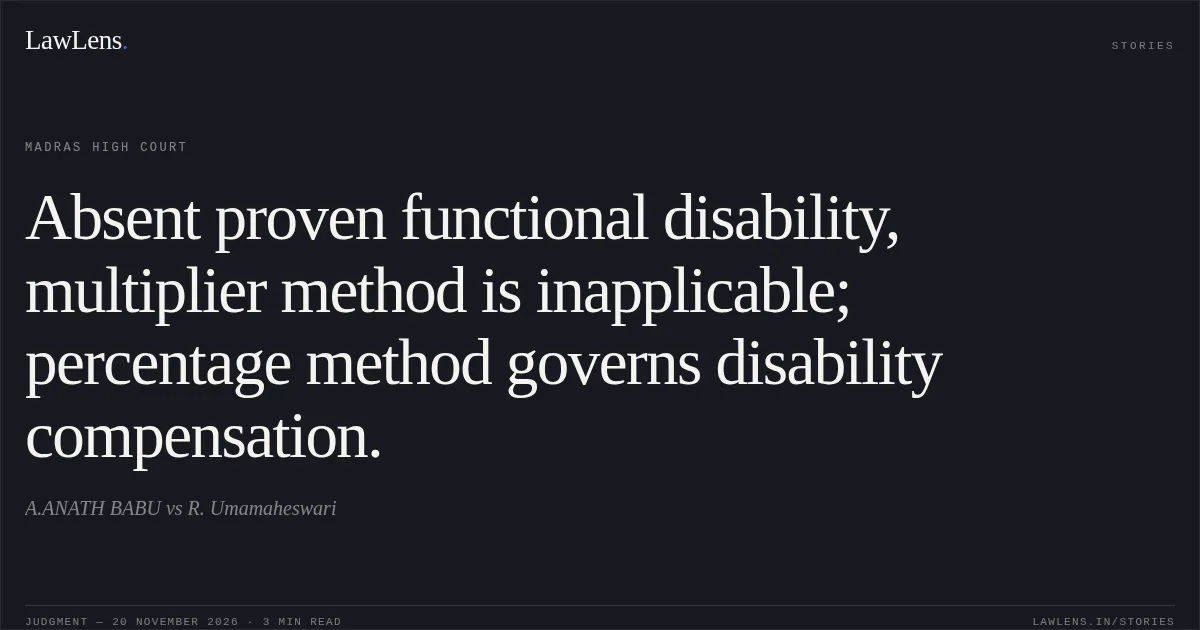
The Court first rejected the appellant's plea for the multiplier method. Because Ex.C1 records no functional disability and the claimant admitted he was still working in the same job, there was no proof of loss of earning capacity. Under Raj Kumar, the multiplier method was therefore not mandatory, and the Tribunal's percentage method was upheld.
p. 7The Court held that the Tribunal's rate of Rs.5,000 per percentage point was low for a 2018 accident involving a 70% disability, multiple surgeries and prolonged hospitalisation. Applying G. Vijayakumar, it raised the rate to Rs.8,000 per percentage point, yielding Rs.5,60,000 under the disability head. On the other heads, the Court found the Tribunal's Rs.18,000 monthly income supported by Ex.P18, and that the 127 inpatient days across two spells, plus one month for resumption of work, justified ten months' loss of income (Rs.1,80,000). It found the remaining awards (attendant charges, pain and suffering, extra nourishment and transport) reasonable and unaltered.
pp. 7–805Holding
The percentage method was correctly adopted because no functional disability or loss of earning capacity was proved, and the multiplier method under Raj Kumar was therefore inapplicable. The disability award required enhancement to Rs.8,000 per percentage point.
p. 7The appeal was allowed in part. Compensation was enhanced from Rs.8,74,000 to Rs.10,84,000, with interest at 7.5% p.a. from the claim petition date until realisation. The Court directed R2 to deposit the balance, less the amount already deposited, within six weeks of receipt of the order. The claimant is not entitled to interest for the 210-day default period, as ordered in CMP No. 9288 of 2024. No costs were awarded.
pp. 8–9Original Court PDF
A.ANATH BABUvsR. Umamaheswari
Click to open original judgment
Original judgment, available to read, download and summarize on LawLens.in