01Facts
On 05.10.2020, the claimant was riding his motorcycle near the Malayandhalli Flyover on the Krishnagiri–Dharmapuri National Highway when a Toyota Etios car, driven rashly and negligently, collided with it. He sustained injuries across his body.
¶ 3 · p. 2The first respondent (owner) remained ex parte. The second respondent (insurer) denied the manner of accident in its counter statement.
¶ 4–5 · p. 2The claimant examined himself as P.W.1 and marked Exs.P1–P8; the Medical Board disability certificate was marked as Ex.C1. The insurer led no evidence.
¶ 6 · p. 3The Tribunal held the driver negligent, fixed liability on the owner and insurer, and assessed permanent disability at 30%. Absent proof of loss of earning capacity, it applied the percentage method at Rs.4,000 per percentage point (Rs.1,20,000). It awarded Rs.2,46,709 in total across all heads.
¶ 7 · pp. 3–4The claimant appealed under Section 173 of the Motor Vehicles Act, 1988, seeking enhancement.
¶ 1, 8 · p. 2, 4The claimant was about 44 years old, working as a Customer Care Executive/BPO employee at ALLSEC Co. Ltd., Bangalore, claiming Rs.25,000 per month, and underwent two days of inpatient treatment.
¶ 15–16 · pp. 6–702Issues
i.1. Whether the Tribunal was justified in reducing the permanent disability assessed by the Medical Board at 40% to 30% without assigning reasons.
¶ 9, 13 · pp. 4–5ii.2. Whether the percentage method, rather than the multiplier method, was proper for assessing compensation for permanent disability in the absence of proof of functional disability or loss of earning capacity.
¶ 9, 12, 14 · pp. 4–6iii.3. Whether the Rs.4,000 per percentage rate adopted by the Tribunal was inadequate for a 2020 accident.
¶ 15 · p. 6iv.4. Whether the awards under the heads of loss of income during treatment, pain and suffering, and extra nourishment require enhancement.
¶ 9, 16 · pp. 4, 6–703Law Applied
The Court operated under Sections 166 and 173 of the Motor Vehicles Act, 1988, which govern the claim for compensation and the appeal for its enhancement.
¶ 1–2 · p. 2 · ¶ 18 · p. 8Permanent disability compensation was assessed under the percentage method, which the Court treated as permissible where there is no proof of functional disability or loss of earning capacity.
¶ 14–15 · pp. 5–6Where the claimant's income is not proved, the Court applied a notional income figure, reflecting the year of accident, and awarded loss of income for the period of treatment on that basis.
¶ 16 · pp. 6–7Compensation under the non-pecuniary heads (pain and suffering, extra nourishment) was assessed on a discretionary, reasonableness basis.
¶ 15–16 · pp. 6–7No judicial precedent is cited in the judgment.
Provisions in the judgment · 2 · Linked ones open on LawLens
Motor Vehicles Act, 1988 Section 173Section 166
04Reasoning
The Court found no dispute on negligence and accepted the Medical Board's findings in Ex.C1 that the claimant had permanent restriction of right hand, wrist, and elbow movement, supported by discharge summaries Exs.P3 and P4 showing a right forearm fracture and difficulty lifting objects overhead.
¶ 13–14 · pp. 5–6Although Ex.C1 records 40% disability, the Court adopted the Tribunal's 30% figure without expressly reconciling the two. It reasoned that the claimant had not established functional disability, so the percentage method applied and the 30% award was reasonable.
¶ 14 · p. 6The Court did not address the Tribunal's reduction of the Medical Board's assessment in detail.
¶ 13 · pp. 5–6The Court enhanced the per-percentage rate from Rs.4,000 to Rs.9,000, citing the claimant's age of about 44 years, his employment, and the accident year (2020). This yielded Rs.2,70,000 (Rs.9,000 × 30%).
¶ 15 · p. 6For loss of income, the Court fixed a notional monthly income of Rs.16,000, in the absence of proof of the claimed Rs.25,000, and awarded four months' loss for treatment (Rs.64,000). This is internally inconsistent with the finding of only two days' inpatient treatment in the same paragraph.
¶ 16 · pp. 6–7The Court enhanced pain and suffering from Rs.25,000 to Rs.40,000 and extra nourishment from Rs.10,000 to Rs.20,000, while upholding transport expenses (Rs.15,000), damage to clothes (Rs.5,000), and medical expenses (Rs.71,709).
¶ 16–17 · pp. 6–805Holding
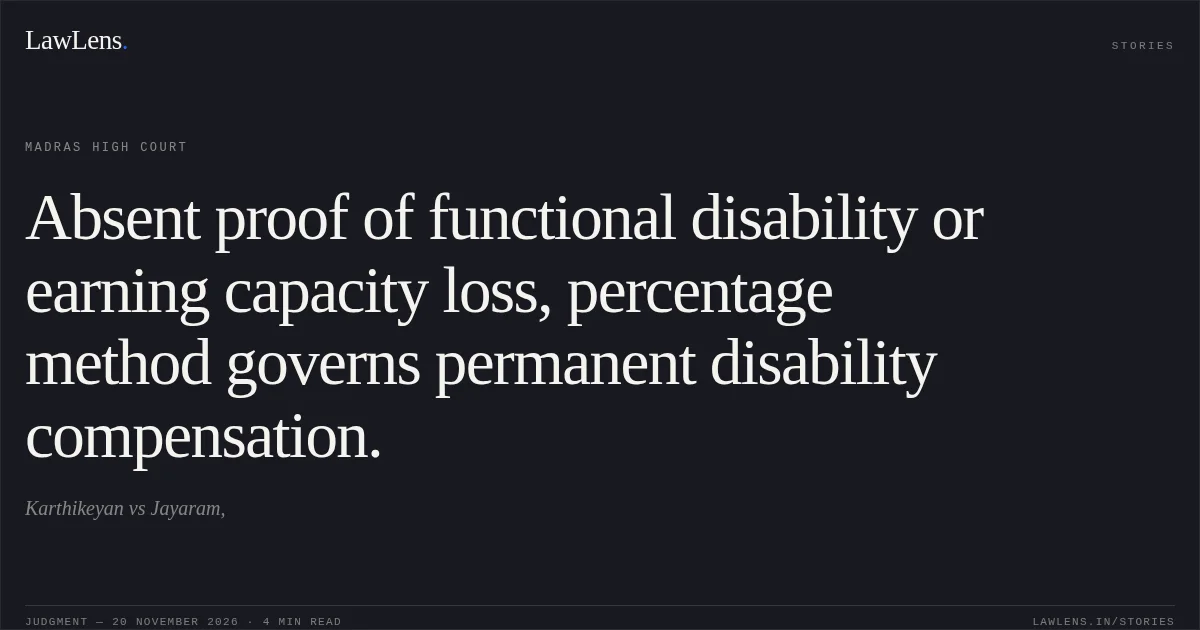
The Court held that the percentage method was appropriate in the absence of proof of functional disability or loss of earning capacity, and enhanced the per-percentage rate to Rs.9,000, fixing permanent disability compensation at Rs.2,70,000 on the 30% assessment.
¶ 14–15 · p. 6, 7It also awarded loss of income during treatment of Rs.64,000 on a notional income of Rs.16,000 per month for four months.
¶ 16 · pp. 6–7It enhanced pain and suffering to Rs.40,000 and extra nourishment to Rs.20,000.
¶ 16–17 · pp. 7–8The total compensation was revised from Rs.2,46,709 to Rs.4,86,000, with interest at 7.5% per annum from the date of claim petition until deposit, excluding any default period.
¶ 17–18(ii) · pp. 8–9The Appeal was partly allowed. The second respondent (insurer) was directed to deposit the enhanced award within six weeks (less any amount already deposited) in M.C.O.P. No. 1220 of 2020, with the claimant permitted to withdraw it on application. The Tribunal's directions on disbursement remain unaltered, and there is no order as to costs.
¶ 18(i)–(vii) · pp. 8–9Original Court PDF
KarthikeyanvsJayaram,
Click to open original judgment
Original judgment, available to read, download and summarize on LawLens.in