Facts
Raj Kumar joined Indian Oil Corporation Ltd. (“IOC”) in 1975 as a Khalasi, was promoted as a Chargeman in 1991, and was posted at the Shakur Basti Terminal.
Source reference: para. 2After an earlier suspension in 1995, he was again suspended and charge-sheeted on 9 August 1997 for alleged misconduct on 7 July 1997, including tampering with the attendance register, unauthorisedly marking attendance for an overtime shift, forcibly taking a tanker’s gate pass, obstructing its exit, and assaulting an IOC employee.
Source reference: p. 2; para. 3The departmental enquiry found the charges proved, and the disciplinary authority dismissed him from service on 3 October 1998.
Source reference: p. 2; para. 4Following earlier writ proceedings, the dispute was referred to the Labour Court to determine whether his termination was just, fair, and legal.
Source reference: p. 2; para. 6The Labour Court upheld the enquiry findings but, considering Raj Kumar’s 23 years of service and disability acquired during service, substituted dismissal with removal from service and granted retiral benefits.
Source reference: p. 3; para. 8IOC challenged that award under Article 226 of the Constitution.
Source reference: para. 9Issues
Whether the Labour Court was justified under Section 11A of the Industrial Disputes Act, 1947, in substituting the punishment of dismissal with removal from service and granting retiral benefits despite the proved misconduct.
Source reference: p. 4; paras. 14–15Whether the Labour Court’s exercise of discretion was arbitrary, perverse, or otherwise amenable to interference in the High Court’s supervisory jurisdiction under Article 226 of the Constitution.
Source reference: p. 4; paras. 16–17Law Applied
The Court applied Section 11A of the Industrial Disputes Act, 1947, which empowers a Labour Court or Tribunal, where dismissal or discharge is found unjustified, to set aside the punishment and impose a lesser punishment appropriate to the circumstances.
Source reference: para. 14This discretion must be exercised judiciously, with regard to the nature and degree of the proved misconduct and the proportionality of the punishment.
Source reference: para. 15Under Article 226 of the Constitution, the High Court exercises supervisory rather than appellate jurisdiction and will not re-appreciate evidence or substitute its own view unless the Tribunal’s decision is arbitrary, perverse, or otherwise unsustainable; a plausible view ordinarily warrants no interference.
Source reference: para. 16The respondent’s cited authorities—Karnataka State Road Transport v. B.M. Patil and Ram Kishan v. Union of India—were noted by the Court, but the decision principally rested on Section 11A and the limited scope of Article 226 review.
Source reference: para. 11Reasoning
The Labour Court did not disturb the departmental enquiry or the findings that the misconduct had been proved; its intervention was confined to the quantum of punishment.
Source reference: p. 4; para. 17In exercising its Section 11A jurisdiction, the Labour Court considered Raj Kumar’s 23 years of service, the disability acquired during employment, and the nature of the misconduct in the relevant charge-sheet.
Source reference: p. 5; para. 18The High Court held that these were relevant circumstances for assessing proportionality and that the Labour Court’s decision to replace dismissal with removal accompanied by retiral benefits was a plausible exercise of statutory discretion.
Source reference: paras. 18–20Since the award was neither arbitrary nor perverse, the High Court declined to substitute its own assessment merely because another view on punishment might have been possible.
Source reference: paras. 20–21Holding
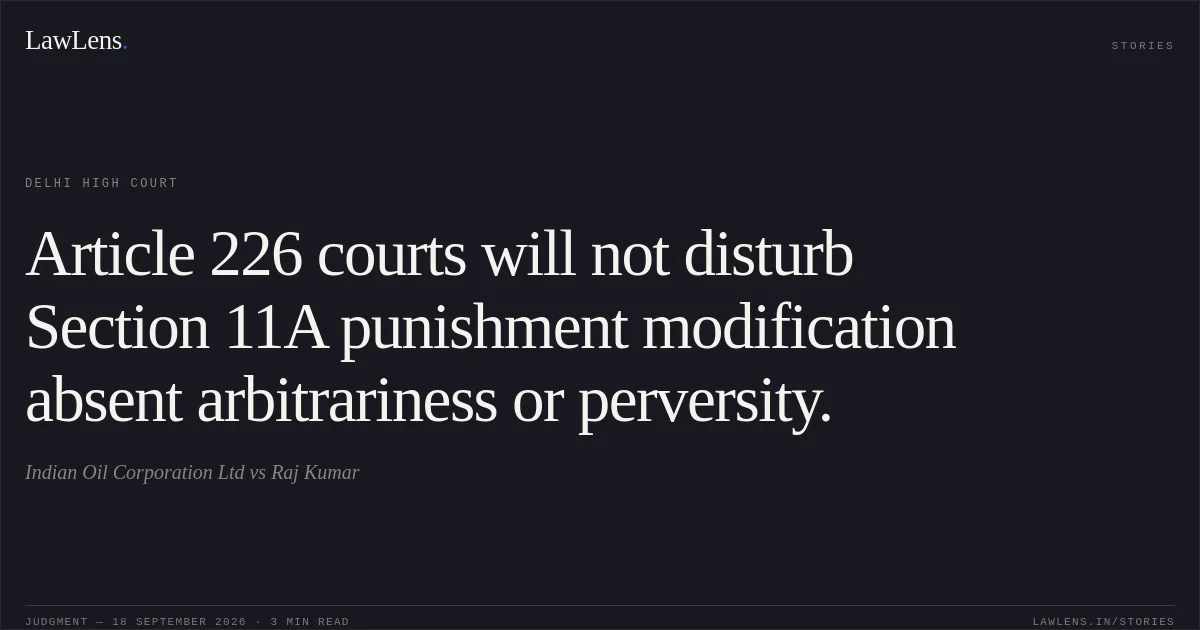
The High Court held that the Labour Court validly exercised its power under Section 11A of the Industrial Disputes Act, 1947, and that its modification of the punishment from dismissal to removal from service with retiral benefits was neither arbitrary nor perverse.
Finding no ground for interference under Article 226, the Court dismissed IOC’s writ petition and upheld the impugned award dated 15 April 2010.
Source reference: para. 22Acts & Sections Cited
1 provisions across 1 statute referred to in this judgment. Linked provisions open on LawLens.
Industrial Disputes Act, 19471
Original Court PDF
Indian Oil Corporation LtdvsRaj Kumar
Click to open original judgment
Original judgment, available to read, download and summarize on LawLens.in