Facts
Respondent No. 1 owned and promoted the “Down Town, Sarojini Nagar, New Delhi” project, while Respondent No. 2, NBCC, acted as the implementing agency and conducted the bulk-sale e-auction of commercial units.
Source reference: paras. 4–5The Petitioner emerged as the successful bidder in the e-auction held on 22 July 2024, was allotted 598 retail and office units through an allotment letter dated 31 August 2024, and subsequently executed an Agreement for Sale dated 6 March 2025.
Source reference: para. 5Disputes arose regarding alleged defaults in payment. The Petitioner asserted that substantial sums had been paid and that the Respondents’ failure to execute conveyance deeds and reconcile accounts affected its ability to make further payments, whereas the Respondents alleged repeated defaults despite demands and notices.
Source reference: paras. 6–7Respondent No. 2 issued a termination notice dated 8 April 2026 and thereafter a Notice Inviting Offer dated 7 May 2026 for re-auction of the units.
Source reference: paras. 8–9The Petitioner’s earlier writ petition challenging substantially the same actions was withdrawn on 29 May 2026 after liberty to submit a representation; the present writ petition was filed on 1 June 2026.
Source reference: paras. 10–11, 31–32During the proceedings, the subsequent auction had been conducted and third-party rights had arisen in respect of ten units; the Petitioner did not press its challenge concerning those units.
Source reference: paras. 18–19Issues
Whether the writ petition ought to be entertained under Article 226 of the Constitution, having regard to the nature of the surviving controversy?
Source reference: para. 15(i)Whether the surviving dispute concerning termination of the allotment was essentially contractual, involved disputed questions of fact, and was therefore not amenable to adjudication in writ jurisdiction?
Source reference: para. 15(ii)Whether the Petitioner was entitled to restoration of the terminated allotment and consequential reliefs?
Source reference: paras. 15(iii), 20–26Law Applied
Article 226 confers a discretionary and extraordinary public-law remedy, principally intended to ensure legality and fairness in the discharge of statutory or public duties; the mere involvement of the State or its instrumentality does not convert every contractual dispute into a public-law controversy.
Source reference: paras. 21, 24–26Writ jurisdiction is ordinarily inappropriate for adjudicating purely commercial contractual disputes involving disputed questions of fact, reciprocal contractual obligations, accounts, payment defaults, and the evidentiary examination of performance.
Source reference: paras. 23, 27–28The Court relied upon the principle recognised in State of Gujarat v. Meghji Pethraj Shah Charitable Trust, (1994) 3 SCC 552, that contractual disputes involving disputed questions of fact should generally not be entertained in writ proceedings, particularly where an alternative contractual or ordinary legal remedy exists.
Source reference: para. 13.4The discretionary jurisdiction under Article 226 may also be declined where a petitioner repeatedly invokes writ jurisdiction concerning substantially the same cause of action or fails to make complete and candid disclosure.
Source reference: paras. 30–34Reasoning
The Court held that the challenge to the re-auction notice had substantially become infructuous because the auction had concluded and third-party rights had intervened; moreover, the affected purchasers were not parties and the Petitioner did not press relief concerning the units already sold.
Source reference: paras. 18–19The surviving dispute concerned the alleged wrongful termination of a commercial allotment and required determination of whether the Petitioner had complied with the payment schedule, whether the Respondents had failed to execute conveyance deeds, whether accounts required reconciliation or adjustment, and whether termination was contractually justified.
Source reference: paras. 20, 23, 27–28These matters arose from reciprocal obligations under the Agreement for Sale and tender documents, involved seriously disputed facts and rival claims of performance, and did not involve the exercise of a statutory power affecting public-law rights.
Source reference: paras. 24–28The Court further noted that the Petitioner had previously challenged the same termination notice and re-auction notice in W.P.(C) No. 7184/2026, withdrew that petition, and shortly thereafter instituted the present proceedings, which also militated against the exercise of discretionary writ jurisdiction.
Source reference: paras. 30–34Consequently, the Court declined to adjudicate the merits of the termination, Respondent No. 2’s authority, payment computations, account reconciliation, conveyance deeds, or related contractual claims.
Source reference: para. 35Holding
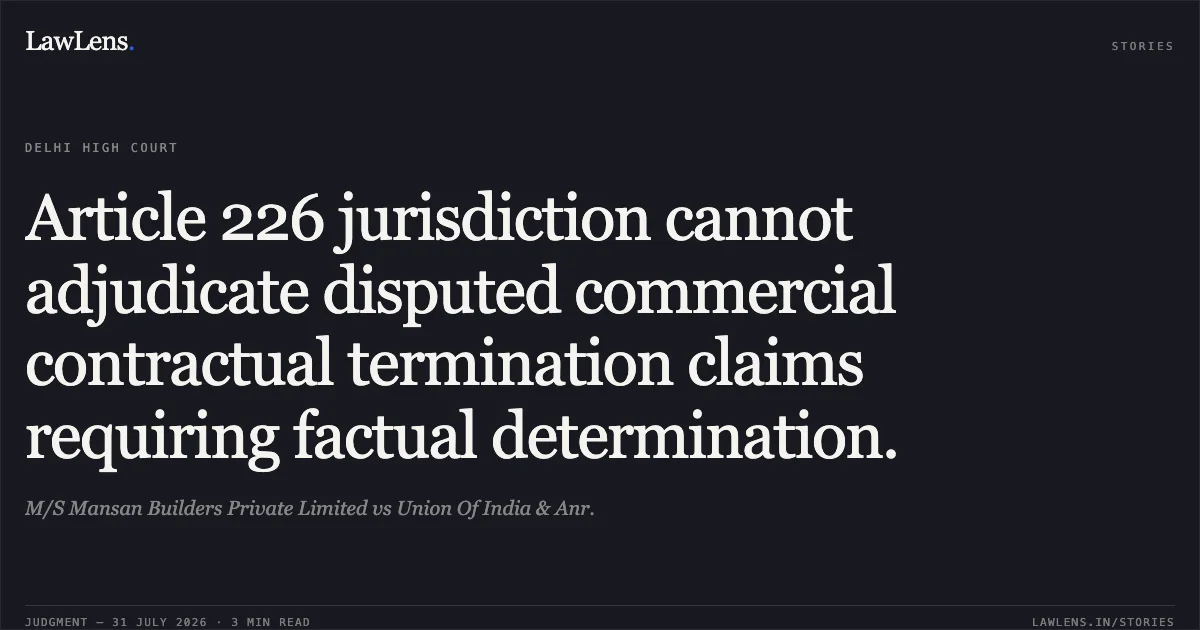
The Court held that the surviving controversy was a private-law, commercial contractual dispute involving disputed questions of fact and was not suitable for adjudication under Article 226.
The challenge to the re-auction notice was not examined on merits insofar as third-party rights had intervened.
Source reference: paras. 18–19The writ petition was dismissed, with liberty to the Petitioner to pursue such remedies as may be available in law; all rights and contentions on the merits of the contractual disputes were expressly left open, and the pending applications were closed.
Source reference: paras. 36–39Original Court PDF
M/S Mansan Builders Private LimitedvsUnion Of India & Anr.
Click to open original judgment
Original judgment, available to read, download and summarize on LawLens.in