Facts
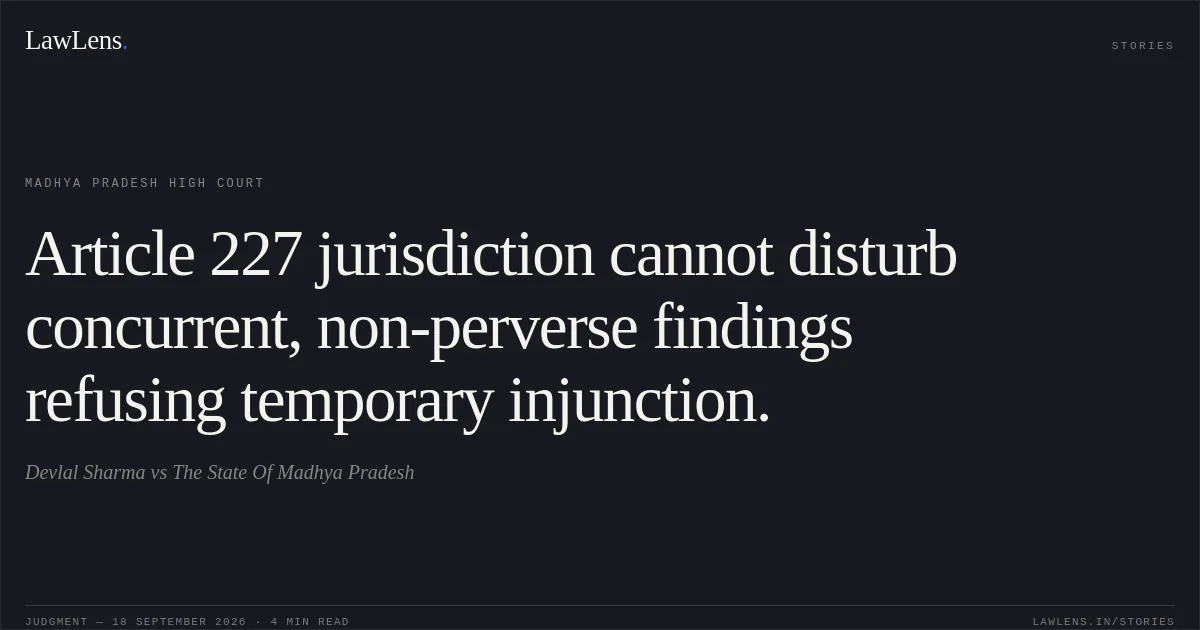
The petitioner challenged, under Article 227 of the Constitution, the rejection of his application under Order XXXIX Rules 1 and 2 of the Code of Civil Procedure, 1908, and the dismissal of his appeal under Order XLIII Rule 1(r) CPC.
Source reference: paras. 1–2The petitioner claimed rights over the disputed agricultural land on the basis of a registered Will dated 27 July 1999 executed by his uncle, late Harvilas Sharma, who had allegedly been granted bhumiswami rights under the Madhya Pradesh agricultural land statute of 1984 by order dated 20 April 1992.
Source reference: para. 3After Harvilas Sharma’s death, the petitioner sought mutation and challenged the revenue orders by which the land was directed to be recorded in the name of the State Government.
Source reference: para. 3The petitioner thereafter instituted a civil suit seeking declaration and permanent injunction and sought temporary protection against dispossession.
Source reference: para. 4The Trial Court rejected the injunction application, finding that Harvilas Sharma’s eligibility for bhumiswami rights was prima facie doubtful because he held interests in other agricultural lands and that the petitioner had not established present possession over the suit land.
Source reference: paras. 4, 11The First Appellate Court affirmed those findings, additionally observing that the petitioner had not disclosed material facts concerning other heirs and had failed to establish possession through subsequent revenue entries.
Source reference: paras. 12–13Issues
1. Whether the petitioner established a prima facie case, balance of convenience, and likelihood of irreparable injury warranting temporary injunction under Order XXXIX Rules 1 and 2 CPC?
Source reference: paras. 11–142. Whether the petitioner’s failure to disclose material facts concerning the deceased’s other heirs and the alleged interests in other lands disentitled him from equitable relief?
Source reference: paras. 12, 14–163. Whether the concurrent findings of the Trial Court and First Appellate Court refusing temporary injunction warranted interference under Article 227 of the Constitution?
Source reference: paras. 17–194. Whether the courts below were justified in treating the alleged grant of bhumiswami rights and the petitioner’s possession as insufficiently established at the interlocutory stage, without finally deciding the title dispute?
Source reference: paras. 11–13, 20Law Applied
The Court applied Order XXXIX Rules 1 and 2 CPC, under which temporary injunction requires a prima facie case, balance of convenience, and the likelihood of irreparable injury; because injunction is an equitable relief, the applicant must also approach the court with clean hands.
Source reference: para. 14It considered Sections 2(a), 3 and 7 of the Madhya Pradesh agricultural land statute of 1984, particularly the eligibility requirements concerning an “agricultural labourer” and “landless person”.
Source reference: paras. 7, 11The Court further applied the principle that litigants must disclose all material facts and that suppression of material facts disentitles them to relief, as stated in Bhaskar Laxman Jadhav v. Karamveer Kakasaheb Wagh Education Society, (2013) 11 SCC 531.
Source reference: paras. 15–16Under Wander Ltd. v. Antox India P. Ltd., 1990 Supp SCC 727, an appellate court should not substitute its discretion for that of the Trial Court unless the discretion was arbitrary, capricious, perverse, or contrary to settled principles.
Source reference: para. 17In exercise of Article 227 jurisdiction, interference with concurrent factual findings is justified only where the findings are perverse, as recognised in Skyline Education Institute (India) Pvt. Ltd. v. S.L. Vaswani, (2010) 2 SCC 142.
Source reference: para. 18Reasoning
The Court held that the petitioner failed to establish a prima facie case because the Will itself disclosed that Harvilas Sharma had interests in several other agricultural holdings, raising a prima facie question regarding his eligibility as a landless person under the 1984 statute.
Source reference: paras. 11–12This finding was only interlocutory and did not finally determine the validity of the 1992 grant; that issue was left for trial.
Source reference: paras. 11–12, 20The petitioner also failed to demonstrate present possession: while he relied on a crop entry for 2018–19, the subsequent 2020–21 Khasra did not contain a corresponding crop entry, and the suit had been filed in 2022.
Source reference: para. 13Further, the petitioner had not adequately pleaded the status of other surviving heirs and had asserted a one-fourth share without disclosing material succession facts, thereby failing to approach the court with clean hands.
Source reference: para. 12Since the Trial Court and First Appellate Court had applied the correct principles and recorded concurrent findings that prima facie case, balance of convenience, and irreparable injury were absent, the High Court found no perversity or jurisdictional error warranting Article 227 interference.
Source reference: paras. 14–18Holding
The High Court dismissed the miscellaneous petition and upheld the Trial Court’s order dated 16 December 2025 rejecting temporary injunction and the First Appellate Court’s order dated 2 March 2026 dismissing the appeal.
It held that the petitioner was not entitled to interim equitable relief because he failed to establish a prima facie right or possession and had suppressed material facts.
Source reference: paras. 13–16The Court clarified that its observations, and those of the courts below, were confined to the interlocutory injunction proceedings and would not influence the Trial Court’s final adjudication of the pending suit on its merits.
Source reference: para. 20Pending applications, if any, were closed.
Source reference: para. 21Acts & Sections Cited
3 provisions across 1 statute referred to in this judgment. Linked provisions open on LawLens.
the Act of 1984 (alias, unresolved)3
Original Court PDF
Devlal SharmavsThe State Of Madhya Pradesh
Click to open original judgment
Original judgment, available to read, download and summarize on LawLens.in