Facts
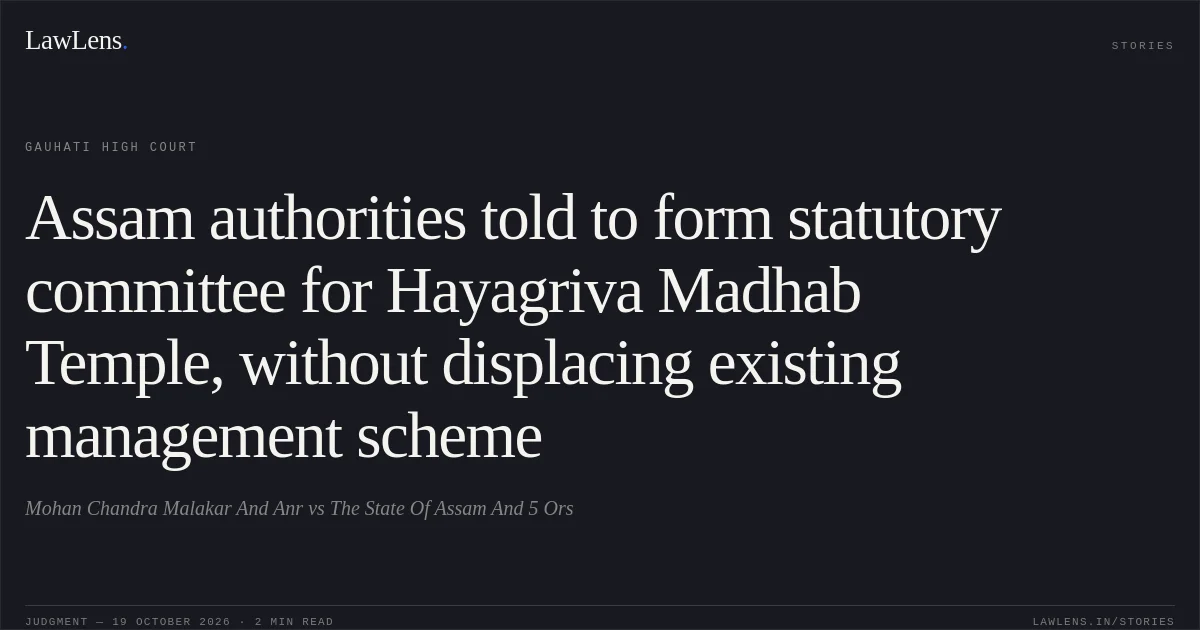
The petitioners, local residents of Hajo, challenged the Deputy Commissioner’s orders dated 24.04.2013 and 25.03.2014, which declined to constitute a Managing Committee for the Hayagriva Madhab Temple under Section 25-A of the Assam State Acquisition of Lands Belonging to Religious or Charitable Institutions of Public Nature Act, 1959, relying on the Civil Court’s existing management scheme.
Source reference: para. 2–3, 13; p. 3–4, 9That scheme originated in a decree dated 09.11.1908 in Title Suit No. 3 of 1904 and was subsequently settled by the High Court in 1917.
Source reference: para. 11; p. 8–9The petitioners sought constitution of the statutory committee and proper administration of the temple and its endowments.
Source reference: para. 3; p. 4Issues
1. Whether the Civil Court’s existing management scheme dispensed with the statutory obligation to constitute a Managing Committee under Section 25-A for the temple, which received a Government annuity.
Source reference: para. 4, 10, 14; p. 4, 8–92. Whether a committee constituted under Section 25-A would supersede the existing scheme or assume general control over the temple’s management.
Source reference: para. 4, 7–9; p. 4, 6–8Law Applied
Section 2(h) of the 1959 Act includes public temples within the definition of “Religious or Charitable Institutions of Public Nature”.
Source reference: para. 5; p. 5Section 25-A requires a Managing Committee for such an institution, comprising the specified officials and elected members, to control the utilisation of annuity and verify the institution’s proper maintenance.
Source reference: para. 6; p. 5In Riju Prasad Sarma v. State of Assam, (2015) 9 SCC 461, the Supreme Court held that the committee’s authority under Section 25-A is limited to control over annuity and other Government grants and verification of related accounts; it does not confer unrestricted management powers or displace customary rights.
Source reference: para. 8; p. 6–8The statutory committee’s limited role does not, without more, transfer the institution’s entire management to that committee.
Source reference: para. 7, 9; p. 6, 8Reasoning
The Court found that the Hajo temple was a public religious institution receiving a Government annuity, bringing it within Section 25-A.
Source reference: para. 10; p. 8Applying Riju Prasad Sarma, the Court distinguished the statutory committee’s limited financial and verification functions from the broader management governed by the Civil Court’s scheme.
Source reference: para. 14–16; p. 9–10The existence of that scheme therefore did not excuse the authorities from constituting the statutory committee, while the committee’s constitution would not itself displace the scheme or lawful customary rights.
Source reference: para. 14–16; p. 9–10Holding
The Court held that the authorities were required to constitute a Managing Committee under Section 25-A notwithstanding the subsisting Civil Court scheme.
It interfered with the impugned orders to the extent that they declined to take steps to constitute the committee and directed the respondent authorities, particularly the District Commissioner, Kamrup, to constitute it within one month of receiving a certified copy of the order.
Source reference: para. 17–18; p. 10–11The earlier scheme remains operative to the extent legally in force, unless modified or set aside by a competent court; any inconsistency with a mandatory statutory provision is resolved in favour of the Act to that extent.
Source reference: para. 18; p. 11The PIL was disposed of.
Source reference: para. 19; p. 11Acts & Sections Cited
1 provisions across 1 statute referred to in this judgment. Each provision opens on LawLens.
Assam State Acquisition of Lands Belonging to Religious or Charitable Institution of Public Nature Act, 19591
Original Court PDF
Mohan Chandra Malakar And AnrvsThe State Of Assam And 5 Ors
Click to open original judgment
Original judgment, available to read, download and summarize on LawLens.in