Facts
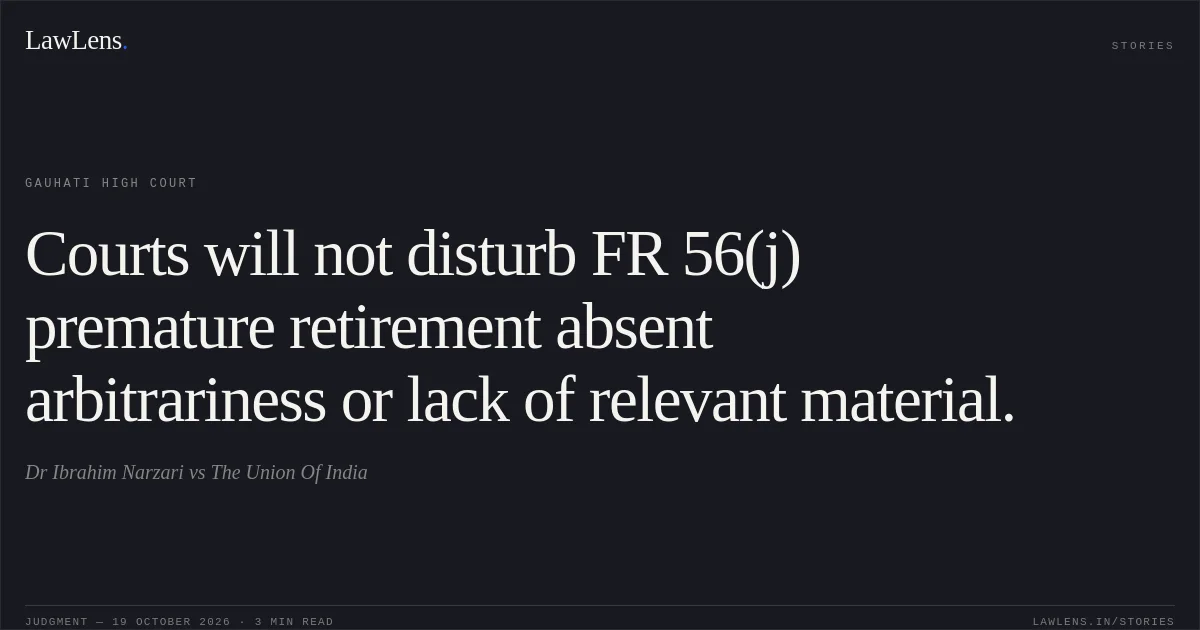
The petitioner, a CRPF medical officer, challenged a notice dated 11 November 2025 directing his premature retirement after he attained 50 years of age, under Fundamental Rule 56(j), the applicable pension rules and the DoPT Office Memorandum dated 28 August 2020.
Source reference: paras. 2, 8His service record included favourable APAR gradings, promotions and commendations, as well as a disciplinary penalty, an assessment of doubtful integrity, a warning, a communication of displeasure and medical records relating to his fitness for duty.
Source reference: paras. 5–8His case was considered by the CRPF Internal Screening Committee and the Ministry of Home Affairs Administrative Review Committee; the recommendation was approved by the competent authority.
Source reference: paras. 8, 20He sought to set aside the notice, arguing that the authorities had not properly assessed his service record as a whole or followed the prescribed procedure.
Source reference: paras. 10–19Issues
1. Whether the decision to retire the petitioner prematurely under Fundamental Rule 56(j) was arbitrary, perverse, unsupported by relevant material or otherwise unlawful.
Source reference: paras. 30–32, 49, 522. Whether the reviewing authorities properly considered the petitioner’s service record as a whole and complied with the applicable DoPT Office Memorandum.
Source reference: paras. 35–46, 47, 513. Whether the pendency of the petitioner’s representation dated 17 December 2025 rendered the retirement notice unlawful.
Source reference: paras. 27, 51Law Applied
Fundamental Rule 56(j) permits the appropriate authority to retire a government servant in public interest, subject to its prescribed conditions and notice requirements; the power is not punitive and must rest on relevant material bearing on continued retention in service.
Source reference: paras. 31–33Judicial review is limited, but may be exercised where the decision is mala fide, arbitrary, perverse, based on no relevant material, or affected by non-application of mind.
Source reference: paras. 32, 37, 48Under the DoPT Office Memorandum dated 28 August 2020, the review committee must consider the employee’s entire service record, including relevant personal and work records, and apply the criteria appropriate to the basis for review.
Source reference: paras. 44–46Nand Kumar Verma v. State of Jharkhand, (2012) 3 SCC 580, Brij Mohan Singh Chopra v. State of Punjab, AIR 1987 SC 948, and Hans Raj v. State of Punjab, (1985) 1 SCC 134, support an overall assessment of the service record, including due regard to later performance.
Source reference: paras. 35, 39M.S. Bindra v. Union of India, AIR 1998 SC 3058, establishes that a doubtful-integrity assessment must have a rational basis and cannot rest on mere suspicion.
Source reference: paras. 37–38The Court also relied on Sushil Sharma v. Union of India, 2026 INSC 809, concerning the limited scope of judicial review of premature-retirement decisions.
Source reference: paras. 26, 48Reasoning
The Court considered the favourable and adverse material together, including the petitioner’s APARs, commendations, disciplinary penalty, doubtful-integrity assessment, warning, communication of displeasure and medical record.
Source reference: paras. 40–43It held that the penalty could be considered as part of the service record, but could not alone justify premature retirement; similarly, favourable entries did not confer an absolute right to remain in service.
Source reference: paras. 41–42The record showed review by the two committees and approval by the competent authority, and the Court found no sufficient basis to conclude that relevant material had been disregarded or that the decision was arbitrary, perverse, mala fide or procedurally unlawful.
Source reference: paras. 47–49, 51–52The petitioner’s personal and family hardship did not, by itself, invalidate the decision, and the pending representation did not make the notice unlawful.
Source reference: paras. 50–51Holding
The Court found no sufficient ground to interfere with the notice dated 11 November 2025 and dismissed the writ petition.
The dismissal did not preclude the respondent authority from considering and deciding the petitioner’s representation dated 17 December 2025 on its merits and in accordance with law.
Source reference: para. 53Original Court PDF
Dr Ibrahim NarzarivsThe Union Of India
Click to open original judgment
Original judgment, available to read, download and summarize on LawLens.in