Facts
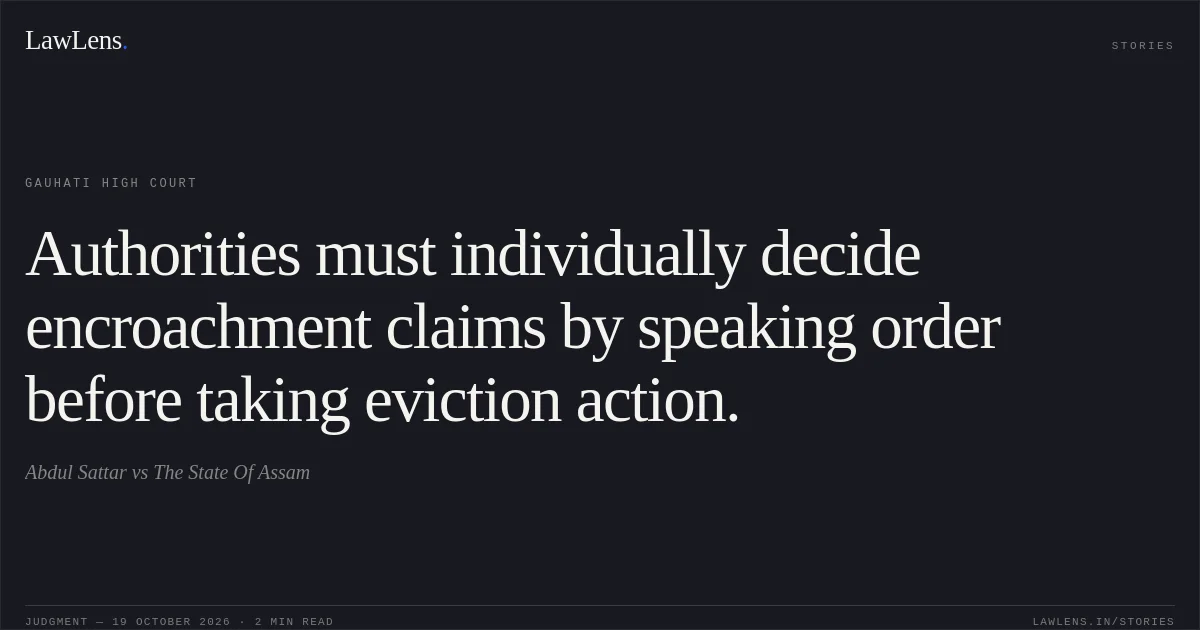
The fifteen petitioners challenged notices dated 6 August 2026 issued by the Circle Officer, North Lakhimpur Revenue Circle, alleging their unauthorised occupation of Government land at 9/6 Koilamari Revenue Village.
Source reference: para. 2, 4–6The notices required them to submit supporting documents and attend a hearing, warning that eviction proceedings could follow if they were found to be encroachers.
Source reference: para. 2, 4–6The petitioners argued that they had long occupied small plots and that their claims required individual consideration.
Source reference: para. 7At the hearing of the writ petition, their counsel stated that the petitioners had submitted individual replies with supporting documents and that a hearing had taken place.
Source reference: para. 12, 16Issues
Whether the notices issued under Rule 18 of the Settlement Rules were procedurally invalid for failing to provide prior notice and an opportunity to present the occupants’ claims.
Source reference: para. 9–11Whether the authorities were required to consider each petitioner’s representation and supporting documents individually and issue a speaking order before taking further action.
Source reference: para. 15–16Law Applied
Rule 18(2) of the Settlement Rules, framed under the Assam Land and Revenue Regulation, 1886, permits ejection in specified cases where no bona fide claim of right is involved; Rule 18(3)(a) provides for notice and an opportunity to vacate in other cases.
Source reference: para. 9In Md. Salak Uddin v. State of Assam, the Gauhati High Court held that an authority cannot unilaterally determine whether a bona fide claim exists without giving the occupant an opportunity to be heard.
Source reference: para. 10Jagpal Singh v. State of Punjab, (2011) 11 SCC 396, addresses protection of common village lands from encroachment.
Source reference: para. 5, 10In Abdul Khaleque v. State of Assam, 2026 INSC 140, the Supreme Court accepted an encroachment-removal process that included scrutiny of documents, a speaking order, and notice to vacate before removal.
Source reference: para. 13–14Taken together, these authorities require fair consideration of an occupant’s claim before eviction action is taken.
Source reference: no citationReasoning
The Court found no procedural infirmity in the notices insofar as they gave the petitioners prior notice and an opportunity to submit documents and be heard.
Source reference: para. 11However, the notices did not dispense with the authority’s obligation to determine each petitioner’s claim fairly.
Source reference: para. 15–16Since the petitioners had submitted individual representations and supporting documents, the Circle Officer had to consider each representation and the accompanying material, determine the individual’s status in relation to the land, and provide reasons in a speaking order before taking further action.
Source reference: para. 15–16Holding
The Court did not quash the notices.
It directed the authority to decide each petitioner’s representation by an individual speaking order and communicate that order to the petitioner.
Source reference: para. 16–17Further action under the law may be taken only after each noticee’s status has been determined in that manner.
Source reference: para. 16–17The writ petition was disposed of without an order as to costs.
Source reference: para. 16–17Original Court PDF
Abdul SattarvsThe State Of Assam
Click to open original judgment
Original judgment, available to read, download and summarize on LawLens.in