Facts
The petitioner, a former government employee terminated following an FIR in 2022, challenged a preventive detention order issued by the District Magistrate, Anantnag, on April 26, 2025
Source reference: para. 03-04, 06The detention was based on a police dossier alleging the petitioner’s involvement in terror-related activities and associations with militants prejudicial to State security
Source reference: para. 05, 07Specifically, the authorities cited three FIRs from 2016, 2017, and 2022
Source reference: para. 06-07Although the petitioner had been granted bail by a Special NIA Court in April 2024 regarding the 2022 FIR, he was taken into preventive custody in April 2025
Source reference: para. 03, 06, 11The petitioner argued that the detention was baseless, noting his family's history as victims of terrorism and the lack of any bail violations
Source reference: para. 10-11Issues
1. Whether the grounds for detention, largely based on stale incidents and a case where bail was judicially granted, provided a valid basis for "subjective satisfaction" under the Public Safety Act
Source reference: para. 15-172. Whether the failure of the police to seek cancellation of bail before resorting to preventive detention renders the detention order illegal
Source reference: para. 19-20Law Applied
The court applied the Jammu & Kashmir Public Safety Act, 1978, which governs preventive detention to maintain State security
Source reference: para. 03-04It relied on the principle that preventive detention cannot be used as a substitute for the ordinary criminal justice system or as "punitive punishment in advance" when a regular court has already exercised its discretion to grant bail
Source reference: para. 19The court also applied the doctrine of "remoteness," established in Indian jurisprudence, which dictates that stale incidents (past FIRs) cannot form the basis for immediate preventive necessity
Source reference: para. 16Reasoning
The Court observed that the grounds of detention were a verbatim reproduction of the police dossier, indicating a lack of independent application of mind by the Magistrate
Source reference: para. 14It found that the 2016 and 2017 FIRs were too remote to justify detention in 2025
Source reference: para. 15-16Regarding the 2022 FIR, the Court noted that the petitioner had earned bail from a Special NIA Court in 2024, yet the police had never moved to cancel said bail for any alleged subsequent misconduct
Source reference: para. 18-19The Court reasoned that if the petitioner truly posed a security threat after his release on bail, the proper legal recourse was to approach the NIA Court for bail cancellation
Source reference: para. 19By bypassing this and issuing a detention order a year after the bail was granted, the authorities exercised their jurisdiction illegally, essentially punishing the petitioner without a trial
Source reference: para. 19-20Holding
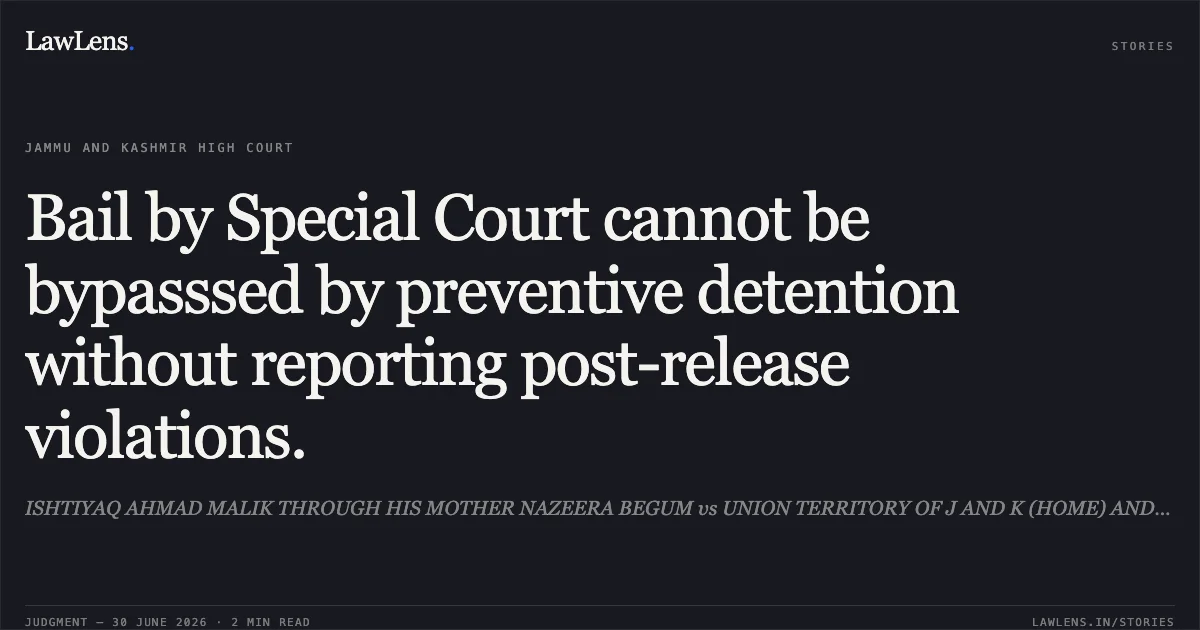
The Court answered that the detention was illegal as it lacked a fresh or proximate factual basis and bypassed the judicial process of the NIA Court
The Court allowed the petition, quashed detention order No. 09/DMA/PSA/DET/2025, and directed the immediate release of the petitioner from custody
Source reference: para. 21-22Acts & Sections Cited
5 provisions across 2 statutes referred to in this judgment. Each provision opens on LawLens.
Arms Act, 19592
Unlawful Activities (Prevention) Act, 19673
Original Court PDF
ISHTIYAQ AHMAD MALIK THROUGH HIS MOTHER NAZEERA BEGUMvsUNION TERRITORY OF J AND K (HOME) AND ORS
Click to open original judgment
Original judgment, available to read, download and summarize on LawLens.in