Facts
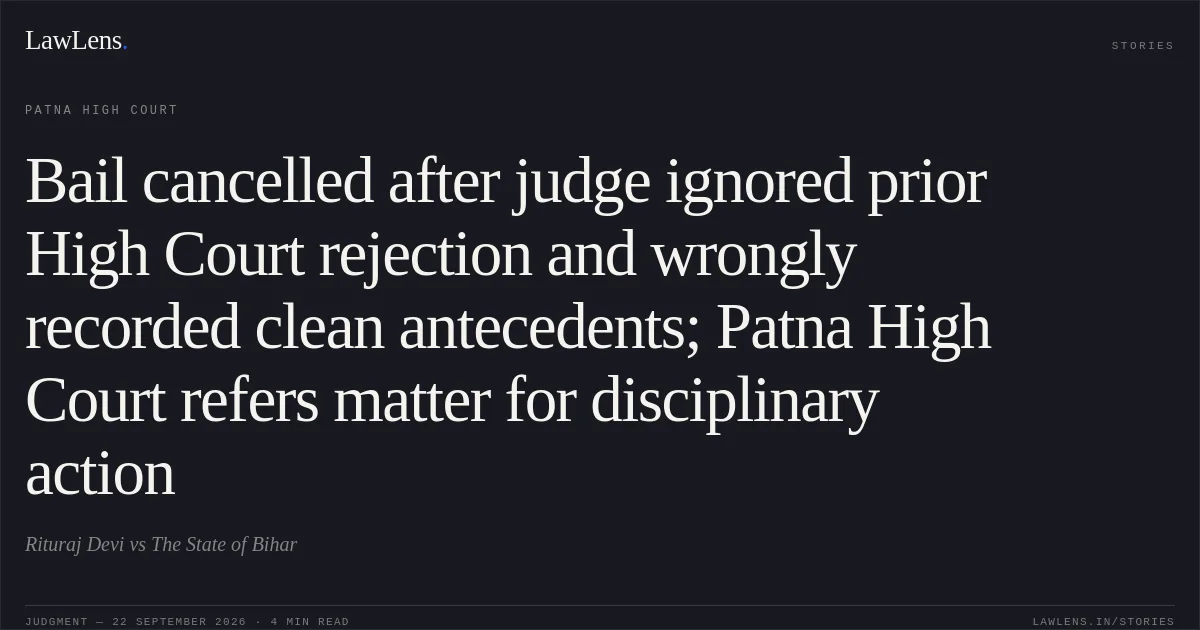
The petitioner-informant, widow of the deceased Manoj Mandal, sought cancellation of the regular bail granted to Tunna Yadav @ Tuntun Yadav by the District & Additional Sessions Judge-III, Naugachia, in a murder case arising from Ismailpur P.S. Case No. 6 of 2024.
Source reference: paras. 2–3The prosecution alleged that, on 24 January 2024, the accused surrounded Manoj Mandal in a weekly market and that Tunna Yadav fired a country-made pistol at his temple, causing his death; the post-mortem examination corroborated death from a firearm injury.
Source reference: paras. 2–3The accused’s earlier regular-bail application had been rejected by a Coordinate Bench of the High Court on 23 August 2024 because of the direct allegation of firing and the supporting medical evidence.
Source reference: para. 4During the trial, three eyewitnesses, including the informant, the deceased’s son, and the deceased’s brother, supported the prosecution case; the deceased’s son also stated that the accused persons had threatened him for giving evidence.
Source reference: para. 5Despite the earlier rejection, the Trial Court granted bail on 21 February 2026, principally relying on the period of custody, the framing of charge, and an observation that the accused had no criminal history.
Source reference: para. 6The petitioner contended that the accused in fact had eight criminal cases recorded in paragraph 29 of the case diary, including another murder case involving firearms.
Source reference: paras. 8, 13Issues
Whether the Trial Court could grant bail on substantially the same material after a Coordinate Bench of the High Court had rejected the accused’s earlier bail application, without recording a substantial change in circumstances or addressing the reasons for the earlier rejection?
Source reference: paras. 16, 19, 21–22Whether the Trial Court’s erroneous finding that the accused had no criminal history, despite the antecedents recorded in the case diary, rendered the bail order perverse and liable to be annulled?
Source reference: paras. 8, 24–25Whether the accused was entitled to bail on the ground of parity with a co-accused who had been granted bail despite having no specific overt act attributed to him?
Source reference: paras. 10, 27Whether subsequent misuse of bail or other supervening circumstances were necessary for cancellation where the original bail order itself was illegal, perverse, or based on irrelevant considerations?
Source reference: paras. 17–18, 28Law Applied
The Court exercised jurisdiction under Section 483(3) of the BNSS, 2023, concerning cancellation of bail.
Source reference: paras. 1, 16It distinguished between cancellation of a validly granted bail because of post-release misconduct or supervening circumstances, which requires cogent and overwhelming circumstances under Dolat Ram v. State of Haryana, and annulment of a legally infirm bail order, which may be set aside where it is perverse, ignores material evidence, proceeds on an erroneous premise, or is granted on untenable grounds.
Source reference: paras. 17–18Under Kalyan Chandra Sarkar v. Rajesh Ranjan, Captain Buddhikota Subha Rao, and Mohseen v. State of U.P., a successive bail court must consider the reasons for the earlier rejection and identify a substantial change in circumstances or fresh grounds before taking a different view.
Source reference: paras. 7, 19, 22Deepak Yadav v. State of U.P. recognizes ignoring the accused’s criminal history and granting bail despite the serious nature of the charges as grounds for interference.
Source reference: paras. 8, 18The Court also relied on Neeru Yadav, Puran, Mahipal, Ajwar, and Sri Darshan for the principles that perverse bail orders may be annulled even without subsequent misuse of liberty, and that parity is not mechanical but depends on the accused’s specific role.
Source reference: paras. 17–18, 27–28The seriousness of the alleged offences under Sections 302 and 307 IPC and Section 27 of the Arms Act was also relevant to the bail assessment.
Source reference: paras. 1, 23, 26Reasoning
The High Court held that the Trial Court failed to engage with the Coordinate Bench’s earlier rejection of bail, which was based on the specific allegation that Tunna Yadav had fired the fatal shot and on corroborating medical evidence.
Source reference: paras. 4, 22The Trial Court identified no substantial change in circumstances; the mere length of custody, framing of charge, and examination of three witnesses did not justify departing from the earlier decision, particularly in a serious firearm-murder case where the eyewitnesses had supported the prosecution.
Source reference: paras. 22–23, 26The finding that the accused had no criminal history was demonstrably contrary to paragraph 29 of the case diary and was internally inconsistent with the Trial Court’s own observation that criminal cases were pending against the parties.
Source reference: para. 24This amounted to ignoring material evidence and rendered the order perverse.
Source reference: para. 24The Court further held that the co-accused’s bail could not establish parity because no specific overt act was attributed to that co-accused, whereas Tunna Yadav was alleged to have fired the fatal shot; moreover, the Coordinate Bench had rejected his bail after the co-accused had already been granted bail.
Source reference: para. 27Since the defect lay in the original bail order itself, proof of subsequent misuse of bail was unnecessary.
Source reference: paras. 18, 28Holding
The High Court allowed the application under Section 483(3) BNSS and held that the Trial Court’s order dated 21 February 2026 was perverse, legally unsustainable, and passed without proper application of judicial mind.
The bail order was set aside, the accused’s bail bonds were cancelled, and he was directed to surrender before the Trial Court within three weeks; failing surrender, the Senior Superintendent of Police, Bhagalpur, was directed to secure his arrest in accordance with law.
Source reference: para. 31The Trial Court was directed to conclude the trial expeditiously, without being influenced by the observations in the bail-cancellation judgment.
Source reference: paras. 32–33The High Court also directed that the judgment and case records be placed before the Chief Justice for consideration of appropriate action concerning the concerned District & Additional Sessions Judge.
Source reference: para. 34Acts & Sections Cited
11 provisions across 3 statutes referred to in this judgment. Each provision opens on LawLens.
Bharatiya Nagarik Suraksha Sanhita, 20231
Indian Penal Code, 1860
Arms Act, 19591
Original Court PDF
Rituraj DevivsThe State of Bihar
Click to open original judgment
Original judgment, available to read, download and summarize on LawLens.in