01Facts
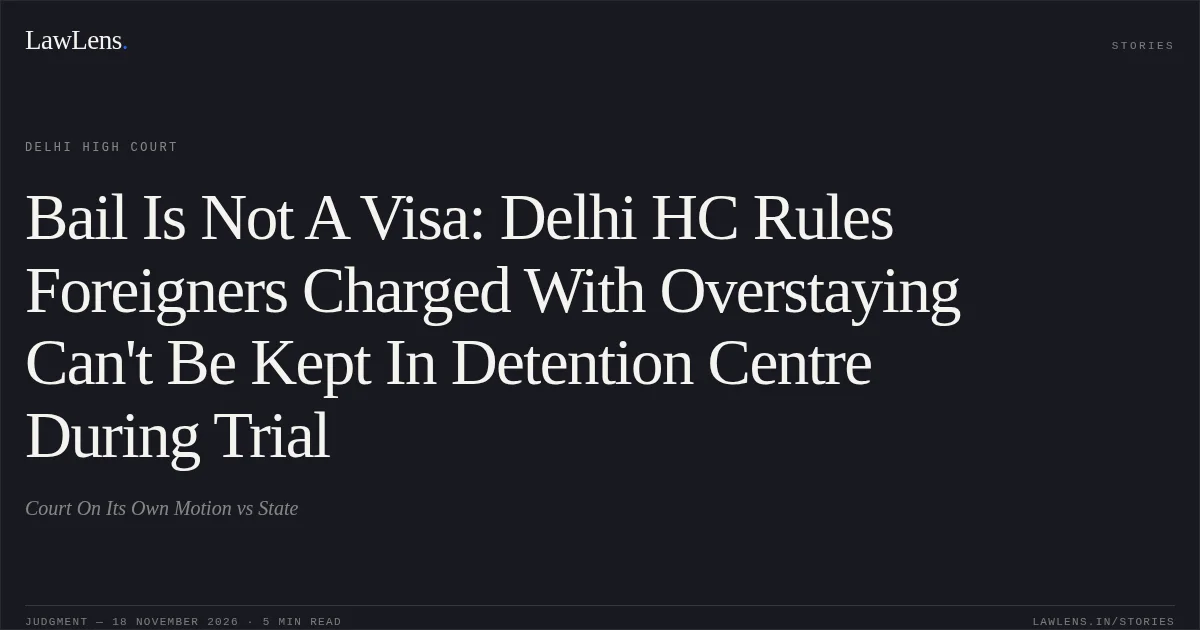
A Metropolitan Magistrate (MM-04, South District, Saket Courts) was hearing the bail application of a Nigerian national accused under Section 14 of the Foreigners Act, 1946 ("1946 Act") arising out of FIR No. 267/2021, PS Tigri.
¶ 2The accused had entered India in 2016 on a three-month tourist visa and remained after its expiry.
¶ 3His counsel argued entitlement to bail and undertook to seek a visa extension, relying on Omokhosio v. State.
¶ 4The State relied on Babul Khan v. State of Karnataka to argue that a foreign national granted bail should be kept in a detention centre.
¶ 5The Magistrate referred three questions of law to this Court under Section 395(2) read with Section 482 Cr.P.C.
¶ 1Mr. Harsh Prabhakar was appointed Amicus Curiae.
¶ 6The 1946 Act was repealed by the Immigration and Foreigners Act, 2025 ("2025 Act"), whose s.23 replicates the penalty under s.14 of the 1946 Act, with compounding under s.25.
¶ 8–11The Immigration and Foreigners Order, 2025 requires holding centres for restricting the movement of foreigners.
¶ 12–17The MHA Circular dated 10.12.2025 (SOP) lays down the procedure for visa processing for foreigners facing criminal trial.
¶ 19–20The FRRO affidavit dated 17.07.2026 states that such foreigners are ineligible for X-Misc. Visa and may instead seek compounding under s.25.
¶ 21–22The Single Judge in Efrance Namatende (2023) quashed an observation-home bail condition.
¶ 32In Emechere Maduabuchkwu (2023 DHC) it was held that a court cannot direct detention in a detention centre while granting bail.
¶ 3302Issues
i.1. Whether granting bail to a foreign national accused of overstaying under s.14 of the 1946 Act amounts to legalising his future stay without a valid visa, and whether a bail order can operate as a substitute for a visa.
¶ 1 (Q.1) · ¶ 39ii.2. Whether foreign nationals accused under s.14 of the 1946 Act, particularly where overstay is admitted, must be treated differently from other criminal accused.
¶ 1 (Q.2) · ¶ 44iii.3. Whether, on grant of bail to a foreign national, a court may impose conditions, including detention in a detention centre until completion of trial.
¶ 1 (Q.3) · ¶ 5003Law Applied
Section 14 of the 1946 Act penalises remaining beyond the visa period, and its successor, s.23 of the 2025 Act, applies the same penalty.
¶ 9–10The Central Government's powers under s.3, including s.3(2)(g) on arrest, detention or confinement, of the 1946 Act and Paragraph 11 of the Foreigners Order, 1948, are independent of the power to grant bail.
¶ 13, 35, 41Under s.7 of the 2025 Act and Paragraph 8 of the Immigration and Foreigners Order, 2025, the Central Government's executive powers over foreigners are likewise independent of the power to grant bail.
¶ 13, 35, 41Section 25 of the 2025 Act provides for compounding of the offence.
¶ 23, 47The MHA SOP dated 10.12.2025 governs visa processing for foreigners facing criminal trial.
¶ 19–20Under Article 21, foreign nationals are protected, and the right to bail cannot be circumscribed merely because the accused is a foreigner, though special conditions may be imposed.
¶ 26, 37Louis De Raedt (SC), Lambert Kroger (Del.), H.B. Chaturvedi (Del.) and Sagynbek Toktobolotov (All.) are relied upon as precedents.
¶ 25Frank Vitus v. NCB (SC 2025) is relied upon on s.3(2)(g) of the 1946 Act.
¶ 34–35Aizaz Kilicheva (Del.) is relied upon as a precedent.
¶ 36Union of India v. Chidiebere Kingsley Nawchara (SC 2026) lays down the principles governing bail for foreigners.
¶ 37Karnataka and Kerala High Court decisions in Junia Erastus Mayemba, Tshibambula Jennifer Kabantobelu, Freddy Tshimanga Kanyama and Farhan Hussain permit exit or compounding instead of prolonged prosecution.
¶ 27–31, 49Provisions in the judgment · 13 · Linked ones open on LawLens
Code of Criminal Procedure, 1973 Section 482
Immigration and Foreigners Act, 2025 10 provisions
Section 2Section 3Section 7Section 11Section 17Section 19Section 21Section 23Section 24Section 25Citizenship Act, 1955 Section 2
Bharatiya Nagarik Suraksha Sanhita, 2023 Section 360
04Reasoning
The Court separated two questions: liability for past contravention, which is tried in the criminal case, and future stay, which is governed by executive power.
¶ 40–42Because a s.14/s.23 accused is tried for past overstay, bail addresses only the trial, so it does not legitimise future stay or substitute for a visa.
¶ 40–42The Central Government may exercise its executive powers (residence at a specified place, movement restrictions, reporting) independently of bail, citing the "vast menu of options" in Emechere Maduabuchkwu.
¶ 41On Q.2, the Court held that such accused must not be treated differently in bail. The Court relied on Article 21 and the principle that foreign nationals may be released on bail subject to appropriate conditions, but not detention in a detention centre during trial.
¶ 46The availability of s.25 compounding and the FRRO's stated position that X-Misc. Visa is unavailable for such accused make bail unnecessary in some cases.
¶ 22, 47–48 · ¶ 49On Q.3, the Court held that bail conditions must be reasonable, proportionate and capable of compliance.
¶ 37(iv)Conditions may cover residence, movement and reporting, given the gravity of the offence and the risk of evading trial.
¶ 51Confinement to a detention centre is an executive measure under s.3(2)(g) of the 1946 Act or Paragraph 8 of the 2025 Order, and a criminal court cannot impose it as a bail condition because it would defeat the bail order.
¶ 51 · see also para. 3305Holding
Grant of bail does not legalise a foreign national's future stay or act as a substitute for a visa; future stay is for the Central Government under s.3 of the 1946 Act or s.7 of the 2025 Act.
¶ 42–43Foreign nationals accused under s.14 of the 1946 Act, or s.23 of the 2025 Act, are not to be treated differently from other accused in bail matters; the answer to Q.2 is "No".
¶ 45–46Bail may carry reasonable conditions on residence, movement and reporting. A condition requiring detention in a detention centre until the trial ends cannot be imposed by a court, as it would frustrate the bail order; such detention is for the Central Government.
¶ 51The Reference is answered and disposed of accordingly, and a copy is to be sent to MM-04, South District, Saket Courts.
¶ 52, 54Original Court PDF
Court On Its Own MotionvsState
Click to open original judgment
Original judgment, available to read, download and summarize on LawLens.in