Facts
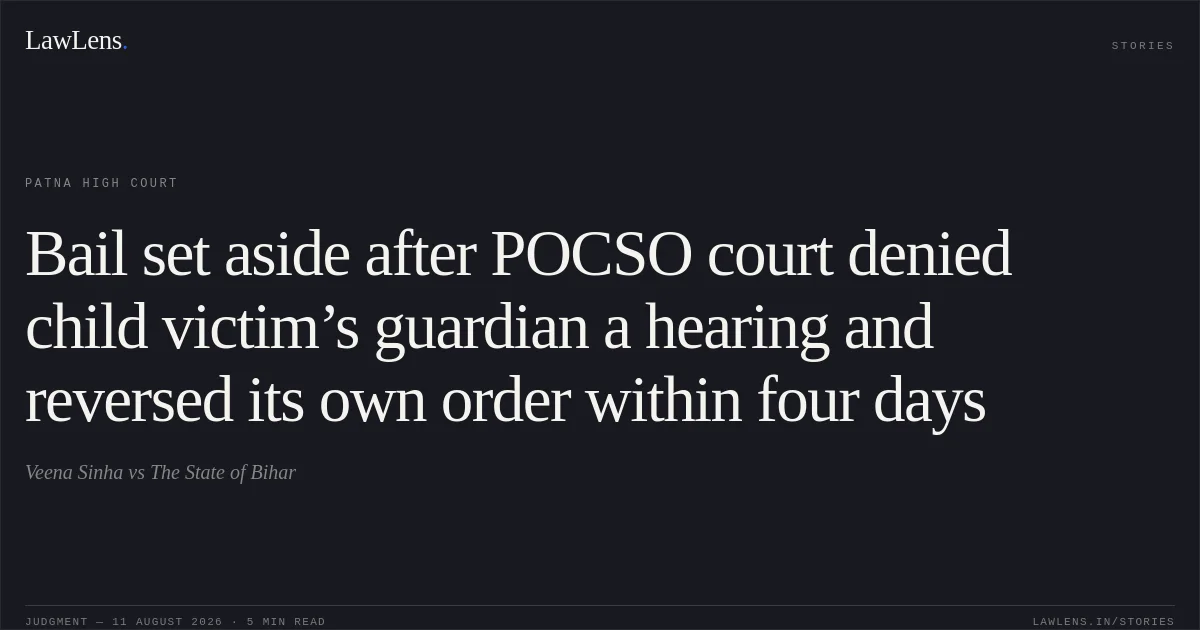
The petitioner, Veena Sinha, mother and guardian of a 14-year-old child and the informant, lodged Mahila P.S. Case No. 09 of 2025 alleging that the accused persons forcibly entered the victim’s room, attempted to sexually assault and disrobe her, and assaulted her and the petitioner with weapons. The case was registered under Sections 74, 76, 115(2), 126(2), 351(2), 351(3) and 3(5) of the Bharatiya Nyaya Sanhita, 2023, and Section 8 of the POCSO Act.
Source reference: p.2–3The victim’s and other witnesses’ statements supported the prosecution case, an injury report was placed on record, and a charge-sheet was submitted while investigation remained pending. The Special Judge, POCSO Act, Khagaria rejected the accused persons’ anticipatory-bail application on 15 July 2025, recording the existence of specific allegations, supporting witness statements, the victim’s injury report and the gravity of the offences. Four days later, on 19 July 2025, the same accused surrendered and were granted regular bail on the same day. The order stated that no offence under the POCSO Act appeared to be made out and relied, inter alia, on the alleged civil/tenancy dispute and the fact that the victim’s injuries were simple. Neither order recorded notice to, or appearance on behalf of, the petitioner or the victim. The petitioner therefore sought cancellation or setting aside of the bail order under Section 483(3) of the BNSS, contending that it was passed without hearing the victim, effectively reviewed the earlier anticipatory-bail order, and involved an impermissible merits determination at the bail stage.
Source reference: p.3–12Issues
1. Whether the regular-bail order dated 19 July 2025 was vitiated because it was passed without notice to or hearing of the petitioner, who was the informant and guardian of the child victim in a POCSO case.
Source reference: para. 21; pp.16–202. Whether the Special Judge could grant regular bail, on the same material and within four days of rejecting anticipatory bail, without any intervening change in circumstances apart from the accused’s surrender and the prosecutor’s concession.
Source reference: para. 21; pp.20–223. Whether the Special Judge could record at the stage of bail that no charge under the POCSO Act appeared to be made out.
Source reference: para. 21; pp.22–23Law Applied
The Court applied Section 483(3) of the BNSS concerning the superior court’s power in relation to bail, Section 8 of the POCSO Act concerning sexual assault, and Sections 29 and 30 of the POCSO Act embodying statutory presumptions relevant to trial.
Source reference: no citationIt held, relying on Jagjeet Singh v. Ashish Mishra @ Monu, (2022) 9 SCC 321, that a victim has a meaningful right to participate and be heard at every crucial stage of criminal proceedings, including bail, and that the POCSO statutory scheme and Rules protect the child victim’s right, through the parent or guardian, to be informed of proceedings and to engage counsel.
Source reference: para. 23The Court distinguished cancellation of bail for post-grant misconduct from setting aside an illegal or perverse bail order at inception; under Dolat Ram v. State of Haryana, (1995) 1 SCC 349, and Neeru Yadav v. State of U.P., (2014) 16 SCC 508, supervening misconduct is relevant to ordinary cancellation, whereas Puran v. Rambilas, (2001) 6 SCC 338, Mahipal v. Rajesh Kumar, (2020) 2 SCC 118, Deepak Yadav v. State of U.P., (2022) 8 SCC 559, Ajwar v. Waseem, (2024) 10 SCC 768, and State of Karnataka v. Sri Darshan, 2025 SCC OnLine SC 1702, establish that a perverse, legally infirm or non-speaking bail order may be set aside notwithstanding the absence of subsequent misuse of liberty.
Source reference: para. 22; paras. 30–31The Court also relied on Kalyan Chandra Sarkar for the principle that a successive bail application requires a genuine change in circumstances, and Kanwar Singh Meena v. State of Rajasthan, (2012) 12 SCC 180, for the rule that a bail court must avoid a detailed examination of evidence or findings tantamount to acquittal.
Source reference: paras. 26, 28Reasoning
The Court found that the bail order was passed on the very day of surrender, without any recorded notice to or appearance by the informant or the victim’s guardian, leaving no practical opportunity for her to participate. The accused’s assertion that an advocate from the informant’s counsel’s office had appeared was rejected because it was not borne out by the judicial orders, and an earlier vakalatnama in the main case did not establish appearance at the same-day bail hearing.
Source reference: para. 25The Court further held that the Special Judge had adopted diametrically opposite conclusions on identical material within four days: on 15 July, the case diary and witness statements were treated as supporting the prosecution, whereas on 19 July the Court concluded that no POCSO charge appeared to be made out. Surrender was merely a procedural prerequisite for regular bail, not a changed circumstance, and the prosecutor’s concession could not substitute the Court’s independent judicial assessment. The reliance on the victim’s simple injuries was also legally irrelevant to Section 8 POCSO, since physical injury is not an ingredient of sexual assault. By concluding that no POCSO offence was made out, the Special Judge effectively conducted a mini-trial and pre-judged the issue of charge, despite supporting statements of the victim and witnesses and the statutory presumptions under Sections 29 and 30. The alleged civil dispute, counter-case and plea of false implication were matters for a properly constituted bail hearing and trial, but could not cure the denial of the victim’s hearing or justify a conclusive finding at the bail stage.
Source reference: paras. 26–29Holding
The High Court allowed the application and set aside the order dated 19 July 2025 granting regular bail to Opposite Parties Nos. 2 to 5, holding that the order was vitiated by denial of the victim’s right to be heard, impermissible review of the earlier anticipatory-bail order, irrelevant considerations, and non-application of judicial mind.
The accused persons’ bail bonds were cancelled, and they were directed to surrender before the court below within two weeks, failing which the Superintendent of Police, Khagaria, was directed to take steps for their custody. The Court permitted them to seek fresh regular bail after surrender, to be decided afresh on merits after due notice to and hearing of the petitioner, uninfluenced by either prior bail order or the High Court’s observations. The trial court was directed to proceed expeditiously, without being influenced by the judgment’s observations on the merits.
Source reference: paras. 32–34, 36Acts & Sections Cited
11 provisions across 3 statutes referred to in this judgment. Each provision opens on LawLens.
Bharatiya Nagarik Suraksha Sanhita, 20231
Bharatiya Nyaya Sanhita, 20236
Protection of Children from Sexual Offences Act, 20124
Original Court PDF
Veena SinhavsThe State of Bihar
Click to open original judgment
Original judgment, available to read, download and summarize on LawLens.in