Facts
The appellant, a juvenile, was accused of rape and circulating a viral video of the act under Section 65(1) of the B.N.S. and various sections of the POCSO Act.
Source reference: para. 2Upon assessment, the Juvenile Justice Board found the appellant to be a juvenile who was mature enough to understand the consequences of his actions, leading to the transfer of his case to the Children’s Court.
Source reference: para. 3The District and Additional Sessions Judge-I-cum-Special Judge Juvenile Court, Begusarai, rejected his bail application on February 17, 2025, citing the appellant's physical and mental maturity, lack of discipline, bad company, and the potential for moral or psychological danger if released.
Source reference: para. 1The appellant challenged this order, noting he had no criminal antecedents and had been in custody since July 16, 2024.
Source reference: para. 7-9Issues
1. Whether the seriousness of the offence and the maturity of the juvenile are valid grounds to deny bail under Section 12 of the Juvenile Justice (Care and Protection of Children) Act, 2015?
Source reference: para. 12, 162. Whether there was sufficient material to invoke the exceptions provided in the proviso to Section 12(1) of the J.J. Act to deny the appellant bail?
Source reference: para. 31-32Law Applied
The court primarily applied Section 12 of the Juvenile Justice (Care and Protection of Children) Act, 2015, which mandates that a juvenile shall be released on bail notwithstanding the CrPC, unless the release brings him into association with known criminals, exposes him to danger, or defeats the ends of justice.
Source reference: para. 11The "best interest of the child" and "family responsibility" principles under Section 3 of the J.J. Act.
Source reference: para. 22, 26Precedents including Juvenile in Conflict with Law v. State of Rajasthan (2024 SCC OnLine SC 5297) and Lalu Kumar @ Lal Babu v. State of Bihar (2019 (6) BLJ 2016) were used to establish that gravity of the offence is irrelevant to juvenile bail and that denial must be based on objective material, not conjectures.
Source reference: para. 13, 16, 18Reasoning
The Court observed that the lower court erroneously relied on the "seriousness of the offence" and the "maturity of the juvenile," which are not recognized grounds for denying bail under Section 12 of the J.J. Act.
Source reference: para. 16, 32The High Court scrutinized the Social Investigation Report, finding that the appellant and his family had no criminal antecedents.
Source reference: para. 7, 32The Court reasoned that the lower court’s finding regarding "moral, physical, or psychological danger" lacked any evidentiary basis or specific material facts.
Source reference: para. 32The Court interpreted "ends of justice" in the context of juvenile welfare, noting that institutionalization is a measure of last resort and the family is the primary institution for reformation.
Source reference: para. 21, 26The court found that poverty should be addressed through government welfare rather than continued detention.
Source reference: para. 33Holding
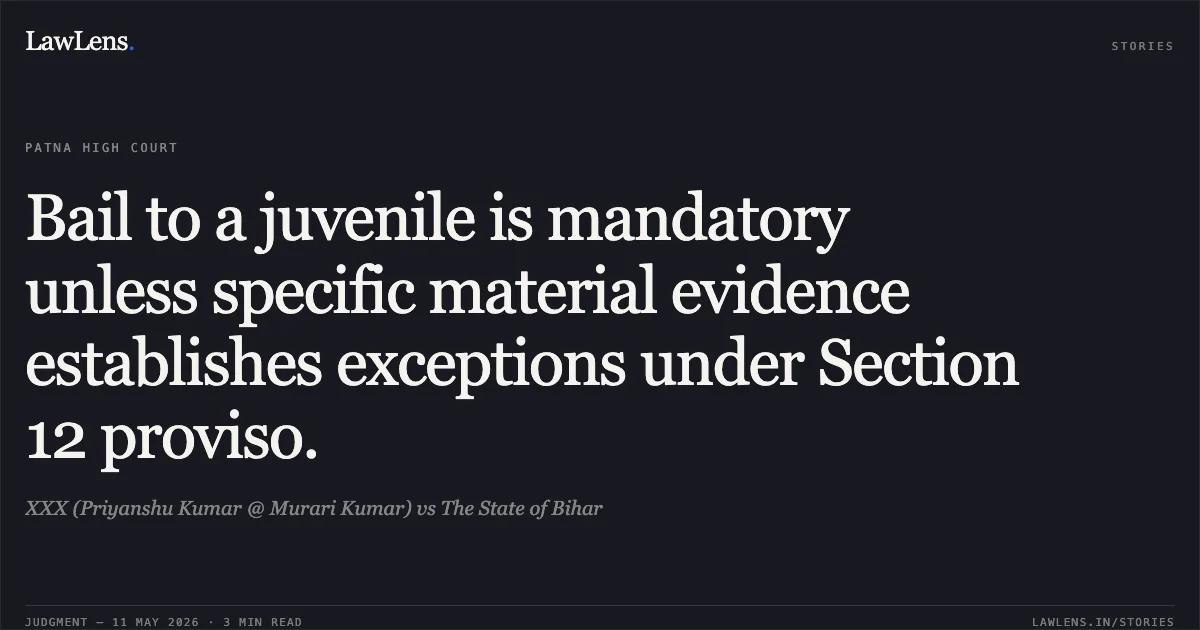
Bail for a juvenile is the rule and the exceptions must be strictly proved by material on record, which was absent here.
The Court allowed the appeal and set aside the impugned order, directing the appellant's release on a bond of Rs. 10,000/- with an undertaking from his father to ensure his supervision.
Source reference: para. 34-35Additionally, the Court issued specific directions to the District Legal Services Authority and the District Magistrate to assist the appellant’s impoverished family with welfare schemes and livelihood opportunities to facilitate his rehabilitation.
Source reference: para. 36Acts & Sections Cited
10 provisions across 3 statutes referred to in this judgment. Each provision opens on LawLens.
Bharatiya Nyaya Sanhita, 20231
Protection of Children from Sexual Offences Act, 20124
Juvenile Justice (Care and Protection of Children) Act, 2015.5
Original Court PDF
XXX (Priyanshu Kumar @ Murari Kumar)vsThe State of Bihar
Click to open original judgment
Original judgment, available to read, download and summarize on LawLens.in