01Facts
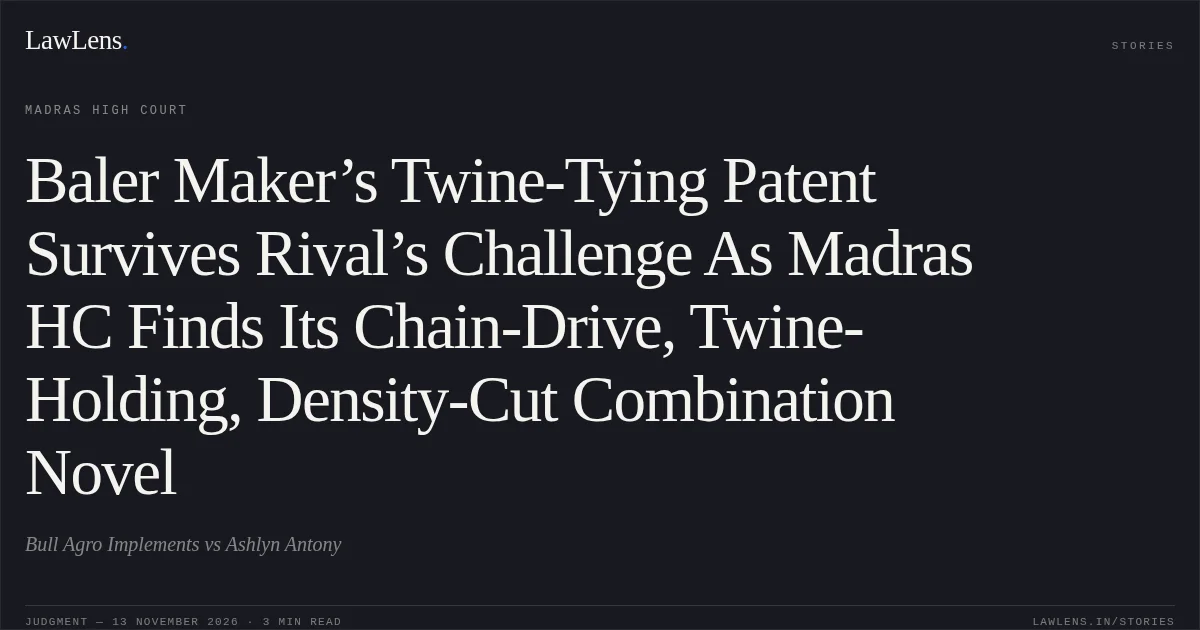
The petitioners sought revocation under Section 64 of the Patents Act, 1970, of Patent No. 458805, granted to the first respondent on 12 October 2023 for a “Baler for tying round blade using twine.”
pp. 2–3, 6–7After the first respondent issued a cease-and-desist notice alleging infringement, the petitioners challenged the patent, relying on 12 prior-art references and alleging lack of novelty and inventive step, public knowledge, and insufficient disclosure.
pp. 2–3, 6–7The first respondent maintained that the patent claimed a novel combination, including a chain drive on a link plate, a side backstop clutch holding the twine for the next cycle, and a blade beneath the clutch that cuts at a set bale density.
pp. 4–5The Court framed six issues, including the asserted grounds for revocation, and the parties did not lead oral evidence.
p. 502Issues
i.1. Whether the invention was publicly known before the priority date of the claim.
p. 5ii.2. Whether the patent was liable to be revoked for lack of novelty.
p. 5iii.3. Whether the patent was liable to be revoked for lack of inventive step.
p. 6iv.4. Whether the complete specification insufficiently or unfairly described the invention.
p. 6v.5. Whether the petitioners were entitled to revocation or other relief.
p. 603Law Applied
The Court considered Section 64(1) of the Patents Act, 1970, including clauses (d), (f), (h) and (i), as the statutory grounds invoked for revocation: respectively, that the subject matter is not an invention, that the invention lacks an inventive step, that the complete specification does not sufficiently and fairly describe the invention, and that the claims are not sufficiently clear or are not fairly based on the disclosed matter.
pp. 7–8, 18–19It also referred to the definition of “invention” in Section 2(1)(j), requiring a new product or process involving an inventive step and capable of industrial application.
p. 5, 9On working of the patent, the Court considered Section 146(2) and Rule 131 of the Patents Rules, 2003, concerning periodic statements of commercial working.
pp. 10–11No judicial precedents were relied upon.
Provisions in the judgment · 4 · Linked ones open on LawLens
Patents Act, 1970 Section 2Section 64Section 85Section 146
04Reasoning
The Court compared the claimed combination with each of the 12 cited prior arts. It found that none disclosed the claimed arrangement as a whole—particularly the side backstop clutch holding twine for the next cycle, the blade mounted beneath it, and the density-triggered cut that stops twine movement.
pp. 13–17Although some individual features were known, the Court held that the claimed combination had novel and inventive technical features and was capable of industrial application; it therefore found no basis for revocation under Sections 64(1)(d) or (f).
p. 18It rejected the disclosure challenge because the petitioners’ own pleadings showed they understood the described structure and operation, and claims 1–7 set out the claimed features.
p. 19The Court also held that the allegation of non-working was premature under the applicable filing timetable and, in any event, non-working was not a ground for revocation under Section 64.
pp. 10–11, 19–2005Holding
The Court answered the revocation issues against the petitioners.
pp. 18–20It found no established ground to revoke Patent No. 458805 for prior public knowledge, lack of novelty or inventive step, insufficient disclosure, or lack of clarity/support.
pp. 18–20The original petition was dismissed, with no order as to costs.
pp. 18–20Original Court PDF
Bull Agro ImplementsvsAshlyn Antony
Click to open original judgment
Original judgment, available to read, download and summarize on LawLens.in