01Facts
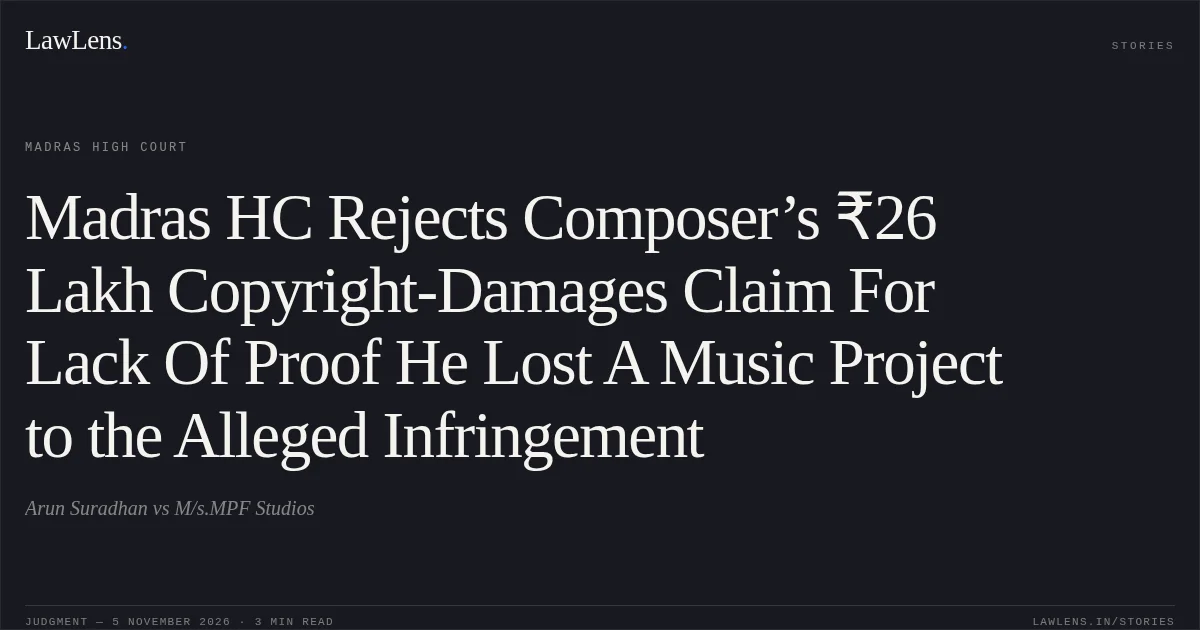
The plaintiff, a music composer, entered into a Commercial Music Contract Agreement (CMCA) with the first defendant, an advertising company, on 3 November 2014 to create music for an advertisement for the second defendant. An amended agreement dated 23 February 2015 expanded the permitted use to radio channels and limited the licence period to 3 November 2015. The plaintiff alleged that the defendants continued using the music after expiry, and claimed ₹26,00,000 in damages for copyright infringement and breach of contract.
pp. 2–3The first defendant denied breach and disputed the claimed loss.
pp. 4, 13–17The plaintiff and second defendant later settled: the second defendant paid ₹2,50,000 without admitting the plaint allegations, and the suit was partly decreed against it in accordance with the settlement. The court proceeded to determine the remaining dispute, principally the plaintiff’s claim against the first defendant.
p. 8, 1802Issues
i.Whether the plaintiff owned the copyright in the musical work.
p. 6 · ¶ 25ii.Whether the second defendant knew the terms of the agreement between the plaintiff and the first defendant, despite there being no privity of contract between the plaintiff and the second defendant.
pp. 6–7 · ¶ 26iii.Whether the plaintiff had condoned the alleged infringement by entering into the amended agreement and accepting further consideration.
p. 7 · ¶ 27–28iv.Whether the plaintiff proved actual loss and was entitled to ₹26,00,000 in damages and future interest.
p. 7 · issues 5–6 · ¶ 29–32v.Whether the first defendant was jointly and severally liable for the alleged infringement by the second defendant.
p. 7 · issue 7 · ¶ 29–3203Law Applied
The suit was brought under Section 57 and Section 62(2) of the Copyright Act, 1957, read with the relevant provisions of the Code of Civil Procedure; however, the judgment did not set out or apply a detailed statutory test under those provisions.
pp. 18–21Nor did the court rely on any precedent in its own reasoning. Its determination rested on the evidence concerning ownership and the agreements, and on whether the plaintiff had substantiated the alleged loss and its amount through the pleadings and evidence.
pp. 18–21Provisions in the judgment · 2 · Linked ones open on LawLens
Copyright Act, 1957 Section 57Section 62
04Reasoning
The court found ownership established because the first defendant’s witness admitted that the plaintiff owned the copyright in the licensed music.
¶ 25It also found that the second defendant obtained the work through the first defendant and was made aware of the agreement’s terms; the court therefore answered the knowledge issue in the plaintiff’s favour, while noting the absence of contractual privity.
¶ 26The court held that the plaintiff had not condoned post-expiry infringement by entering into the earlier amended agreement, and noted evidence that the first defendant had communicated with the second defendant to stop use after 3 November 2015.
¶ 27–28Nevertheless, the plaintiff failed to prove the claimed damages: the evidence from PW2 did not establish that the proposed project was lost because of the alleged infringement, the alleged ₹10,00,000 payment was not substantiated, and the relevant arrangement with Dazu Entertainment had not been pleaded and Ex.P17 was not among the plaint documents. The court accordingly found the damages claim unproved.
¶ 29–3205Holding
The court accepted the plaintiff’s ownership of the copyright and held that the earlier amended agreement did not amount to condonation of the alleged later infringement. However, it found that the plaintiff had not substantiated the claimed ₹26,00,000 loss or established a basis for the damages sought.
¶ 25, 28–33The suit was dismissed, with no order as to costs.
¶ 25, 28–33The second defendant’s earlier partial decree under the settlement dated 9 June 2022 remained recorded by the court.
¶ 8Original Court PDF
Arun SuradhanvsM/s.MPF Studios
Click to open original judgment
Original judgment, available to read, download and summarize on LawLens.in