01Facts
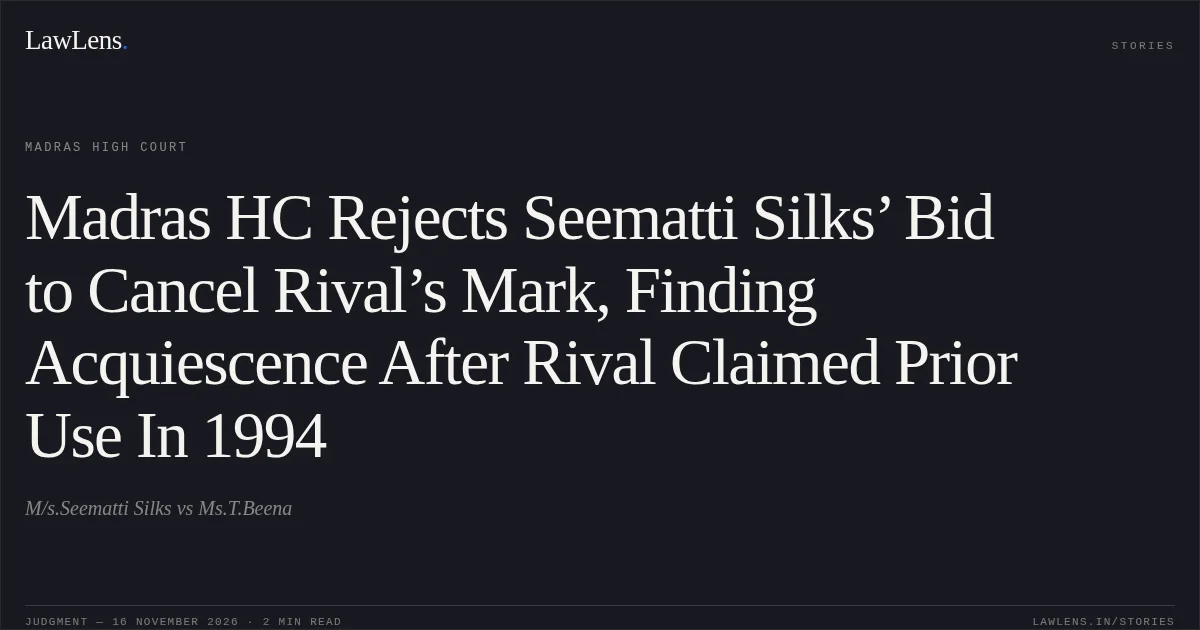
The petitioner sought rectification of the first respondent’s registration of the mark “SEEMATTI” in Class 35, alleging that the respondent had falsely claimed use from 1 June 1910 and that the petitioner was the prior adopter and user, having adopted the mark in 1986.
pp. 1–3The respondent relied on her predecessor’s use and registrations, including a registration obtained in 1963, and asserted that the petitioner knew of her claim to the mark from at least 1994, when the predecessor opposed the petitioner’s registration application.
pp. 3, 13–15The petitioner also relied on the respondent’s differing claimed dates of use in later applications; the respondent attributed those differences to variations in the marks’ styles.
pp. 6–8, 12The petitioner brought the rectification petition under Sections 47 and 57 of the Trade Marks Act, 1999.
pp. 1–2, 7–8The Court addressed acquiescence and good faith first and did not decide the remaining issues.
pp. 12–1602Issues
i.1. Whether the petitioner’s challenge to the registration was barred by acquiescence and waiver, having known of the respondent’s claim and use of the mark for several years.
pp. 12–15ii.2. Whether the respondent’s adoption and registration of the mark were in good faith, such that the petitioner could rely on the exception in Section 33 of the Trade Marks Act, 1999.
pp. 12–14iii.3. Whether, in light of those findings, the petition for rectification under Sections 47 and 57 should be dismissed without determining the other framed issues.
pp. 15–1603Law Applied
Section 33 of the Trade Marks Act, 1999 addresses the effect of acquiescence where the proprietor of an earlier trade mark knowingly allows a later registered trade mark to be used continuously for five years; the provision contains an exception where the later mark was not applied for in good faith.
p. 14The Court also considered the principles of acquiescence and waiver in assessing whether a party that knew of another’s use and registration could later seek rectification.
pp. 13–15Sections 47 and 57 were the statutory bases invoked for rectification, but the Court did not separately analyse their substantive grounds.
pp. 7–8, 15–16Provisions in the judgment · 4 · Linked ones open on LawLens
Trade Marks Act, 1999 Section 47Section 57Section 9Section 33
04Reasoning
The Court found that the respondent’s predecessor had claimed prior use when opposing the petitioner’s registration application in 1994, and that the respondent had the benefit of a registration dating from 1963.
pp. 13–15It held that the petitioner, having known of the respondent’s claim, should have acted diligently to challenge the respondent’s registration and, by allowing continued use, had acquiesced in it.
p. 15The Court further found that the petitioner had not substantiated its allegation that the respondent’s registration was obtained in bad faith; it therefore did not consider the Section 33 exception applicable.
pp. 13–14On that basis, it declined to examine the other issues, including the parties’ competing claims of adoption and use.
p. 1605Holding
The Court held that the rectification petition was barred by acquiescence and waiver.
pp. 15–16It dismissed the petition without costs.
pp. 15–16It did not determine the remaining framed issues, including whether the petitioner was a “person aggrieved” or which party was the prior user.
p. 16Original Court PDF
M/s.Seematti SilksvsMs.T.Beena
Click to open original judgment
Original judgment, available to read, download and summarize on LawLens.in