01Facts
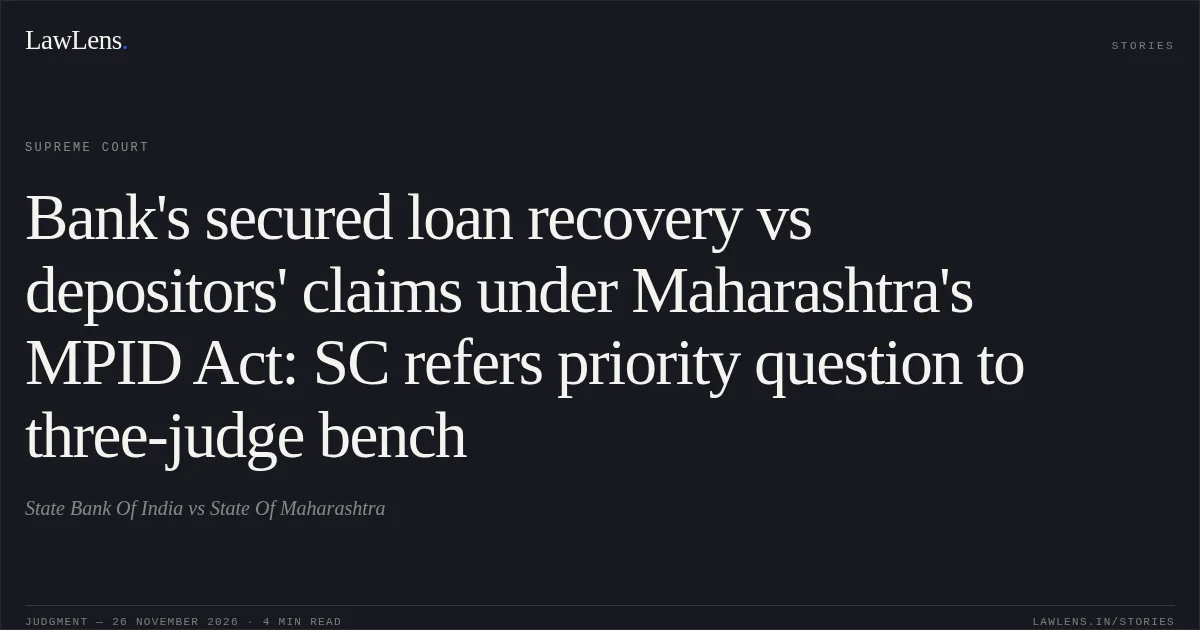
The appellant, State Bank of India, extended credit to Respondent No. 2 company, whose promoters (Respondents 3 and 4) mortgaged two properties on 16.09.2009.
¶ 3The account was classified as an NPA on 31.12.2012, with dues of about Rs. 67.82 crore, and the Bank initiated SARFAESI proceedings.
¶ 4In 2014 the Bank learned that the company was allegedly defrauding depositors under Sections 3 and 4 of the Maharashtra Protection of Interest of Depositors (in Financial Establishments) Act, 1999 (MPID Act). The State seized the properties on 29.06.2014.
¶ 5On the State's advice, the Bank applied to the Designated Court, which on 24.03.2015 permitted auction but directed that the sale proceeds be held in an FDR and not dealt with without further orders.
¶ 6The properties sold for Rs. 18.22 crore on 27.03.2015 (Rs. 19.43 crore including interest).
¶ 7The Designated Authority allowed Rs. 15.93 crore to be credited to the loan account and retained Rs. 3.5 crore in FDR, which matured to Rs. 5.51 crore.
¶ 8–9Meanwhile, the State attached the properties under the MPID Act on 16.05.2016.
¶ 10Ninety-two depositors claimed Rs. 4 crore; Rs. 1.13 crore has been paid.
¶ 11The Bank's application of 21.12.2023 to appropriate the Rs. 3.5 crore towards its dues was dismissed by the Sessions Court on 29.09.2025, relying on NSEL.
¶ 12–13The High Court dismissed the Bank's appeal on 09.12.2025 and directed transfer of the amount to the Competent Authority.
¶ 1402Issues
i.1. Whether there is a conflict between the SARFAESI Act and the MPID Act regarding the attachment of property secured under the SARFAESI Act.
¶ 44(i)ii.2. Whether the decision in National Spot Exchange Ltd. v. Union of India (2025) 8 SCC 393 ("NSEL") requires reconsideration insofar as it holds that attachment under the MPID Act prevails over the rights of secured creditors under the SARFAESI Act.
¶ 44(ii)iii.Counsel's broader framing (Art. 246(1), per incuriam, dominance, priority under s. 26E) is recorded at para. 29–31.
¶ 29–3103Law Applied
Section 13(4) of the SARFAESI Act, which empowers a secured creditor to take possession and sell secured assets without court intervention.
¶ 70–71Section 26E, which gives secured debts priority over "all other debts" and government dues after registration of security interest.
¶ 96–102Section 35 of the SARFAESI Act and Section 14 of the MPID Act, both non-obstante clauses.
¶ 76–79Sections 4 and 7 of the MPID Act, which permit attachment and vesting of property in the Competent Authority subject to Designated Court orders.
¶ 50–51, 71–72Article 246 and the doctrines of pith and substance, harmonious construction, and dominant legislation, drawn from Union of India v. Delhi High Court Bar Assn. (2002) 4 SCC 275.
¶ 60, 121–122ITC Ltd. v. Agricultural Produce Market Committee (2002) 9 SCC 232.
¶ 60, 118State of W.B. v. Committee for Protection of Democratic Rights (2010) 3 SCC 571 (as applied in UCO Bank v. Dipak Debbarma (2017) 2 SCC 585).
¶ 66, 119Kumaon Motor Owners' Union (1965).
¶ 80The rule that a later statute prevails absent repugnancy, per Solidaire India Ltd. (2001) 3 SCC 71.
¶ 81For priority: Jalgaon District Central Co-op. Bank (2025), Punjab National Bank v. Union of India (2022) 7 SCC 260, and Union of India v. SICOM Ltd. (2009) 2 SCC 121.
¶ 106–107, 109, 110–112K.K. Baskaran and Sonal Hemant Joshi, treated as settling the MPID Act's validity under Entries 1, 30 and 32 of List II.
¶ 64Provisions in the judgment · 22 · Linked ones open on LawLens
Maharashtra Protection of Interest of Depositors (in Financial Establishments) Act, 1999 Section 2Section 3Section 4Section 5Section 6Section 7Section 14Section 16
Securitisation and Reconstruction of Financial Assets and Enforcement of Security Interest Act, 2002 Section 2Section 13Section 17Section 18Section 34Section 35Section 37
Insolvency and Bankruptcy Code, 2016. Section 14Section 238
Recovery Of Debts And Bankruptcy Act, 1993 Section 2
Banking Regulation Act, 1949 Section 5
Chit Funds Act, 1982 Section 2
Central Excise Act, 1944 Section 11
Transfer of Property Act, 1882 Section 69
04Reasoning
NSEL was decided on "a peculiar conspectus of facts" and did not examine the attachment's effect on an individual secured creditor's security interest.
¶ 63(d)Attachment under the MPID Act does not bar the security interest, which runs with the property, but it creates a tangible conflict with recovery under SARFAESI.
¶ 88–92, 65Because the conflict was not resolved by the statutes' non-obstante clauses, the Court examined whether harmonious construction was possible.
¶ 79, 67–69On the Kumaon Motor tests, the Court found the later SARFAESI Act prevails, as its objective of speedy recovery by banks, as custodians of public money, outweighs the MPID Act's objective.
¶ 82(2)(c)–(d)Under s. 26E, a statutory first charge must be expressly created to displace secured debt priority, and the MPID Act creates none.
¶ 104–105, 113–114The Court disagreed with NSEL's view that deposits are not "debts" for s. 26E, and held that the MPID Act's depositors are unsecured creditors.
¶ 100–102, 114On the dominance test, recovery of dues is essential to banking under Entry 45 of List I, so Parliament is dominant and the MPID Act cannot be the dominant legislation.
¶ 122–124The Court expressly noted that its dominance analysis was "largely academic" given its harmonious-construction finding.
¶ 125The Court stated that its views on s. 26E and NSEL required authoritative resolution by a larger bench.
¶ 102–103, 127(d)–(e)05Holding
A conflict exists between the SARFAESI Act and the MPID Act.
¶ 68NSEL's conclusion that MPID attachment defeats secured creditors' priority cannot be sustained as a general proposition.
¶ 102, 127(d)–(e)The Court's provisional view is that s. 26E gives secured debt priority over MPID deposit claims and that SARFAESI is dominant. The appeal was not finally decided.
¶ 116, 125–126, 127(b)–(c)Three questions were referred to a three-judge bench: (i) whether MPID deposits fall within "all other debts" under s. 26E; (ii) whether harmonious construction favours SARFAESI recovery priority; and (iii) whether Parliament is dominant on recovery of dues.
¶ 128–129The Registry was directed to place the matter before the Chief Justice for constitution of that bench. Interim relief was granted: the State is restrained from transferring, utilising, appropriating or disbursing Rs. 5,51,59,816 pending final disposal.
¶ 130–131The Court recommended that Parliament amend s. 26E to define "all other debts", and directed that the judgment be forwarded to the Union Finance Ministry and the Attorney General.
¶ 133–134Original Court PDF
State Bank Of IndiavsState Of Maharashtra
Click to open original judgment
Original judgment, available to read, download and summarize on LawLens.in