Facts
The petitioner, a senior citizen earning salary and bank interest, was treated as a non-filer for Assessment Year 2015–16.
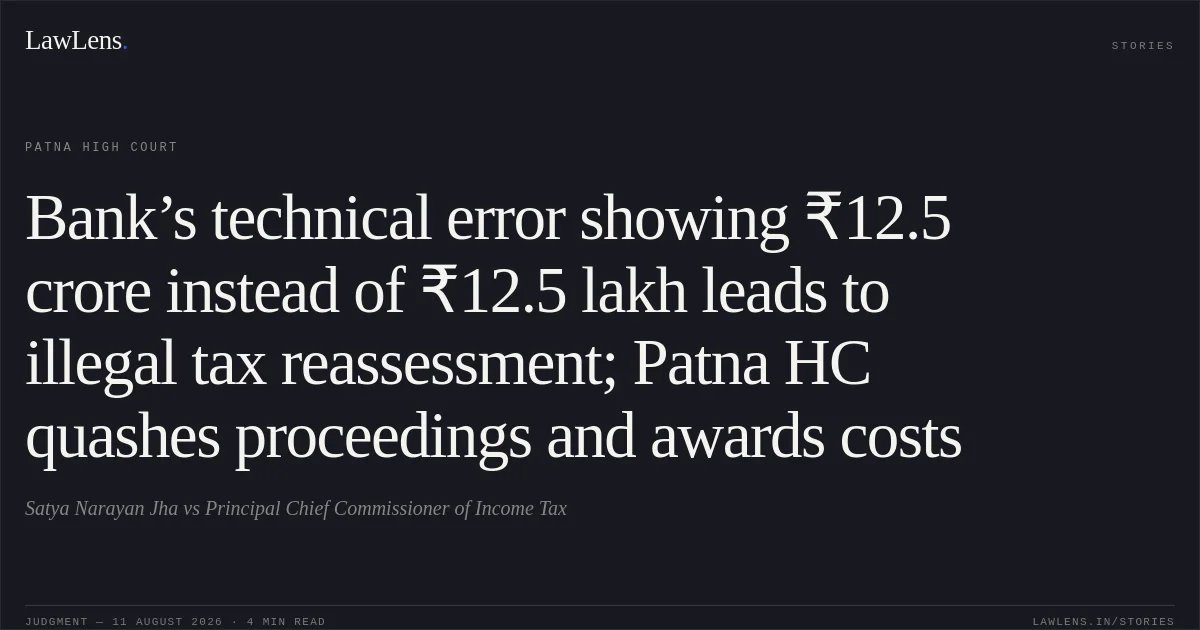
Source reference: paras. 3, 19; pp. 4, 13–14On the basis of information furnished by Union Bank of India under information code CIB-403, the Income Tax Department alleged that he had made a term-deposit investment of ₹12,50,00,000 during Financial Year 2014–15 and had received bank interest of ₹73,652.
Source reference: paras. 3, 19; pp. 4, 13–14The Assessing Officer issued a notice under Section 148A(b) of the Income-tax Act, 1961, dated 23 March 2022, followed by an order under Section 148A(d) and a notice under Section 148 dated 4 April 2022.
Source reference: paras. 3–5; pp. 2–5The petitioner did not respond to the notices, claiming that he was unaware of the electronic communications.
Source reference: para. 4; p. 4Ex parte reassessment proceedings culminated in an assessment order under Sections 147, 144 and 144B dated 12 February 2024, followed by penalty orders under Sections 271(1)(b), 271F and 271(1)(c).
Source reference: paras. 6–7; pp. 5–7Subsequently, Union Bank issued a certificate dated 26 September 2024 confirming that the petitioner’s actual fixed deposit was ₹12,50,000, not ₹12,50,00,000, and that the discrepancy resulted from a technical or system error.
Source reference: paras. 8, 20; pp. 6, 14–15The Department did not dispute the bank’s certificate or the factual position.
Source reference: paras. 19–23; pp. 13–22Issues
Whether the notice under Section 148A(b) dated 23 March 2022, having been issued on materially incorrect information supplied by the bank, was legally sustainable?
Source reference: paras. 19–23; pp. 13–22Whether reopening the assessment for A.Y. 2015–16 through the notice under Section 148 dated 4 April 2022 was barred by Section 149, since the alleged escapement of income was below ₹50,00,000 and the three-year limitation had expired?
Source reference: paras. 10–11, 22–23; pp. 7–8, 15–22Whether the subsequent order under Section 148A(d), reassessment order and consequential penalty orders could survive when the foundational proceedings under Sections 148A and 148 were invalid?
Source reference: paras. 5–7, 24; pp. 5–7, 22Whether the impugned proceedings were also defective for non-compliance with the faceless reassessment procedure under Section 151A and the CBDT Notification dated 29 March 2022?
Source reference: paras. 12–13, 18; pp. 8–9, 12Law Applied
The Court applied Sections 147, 148, 148A, 149, 151, 151A, 144, 144B, 156, 271(1)(b), 271F and 271(1)(c) of the Income-tax Act, 1961.
Source reference: no citationSection 148A requires the Assessing Officer, before issuing a notice under Section 148, to conduct the prescribed inquiry where necessary, furnish the relevant information and material to the assessee, provide an effective opportunity of hearing, and pass a reasoned order after obtaining the requisite approval.
Source reference: paras. 12, 14; pp. 8–10Under Section 149, the ordinary period for issuing a reassessment notice is three years from the end of the relevant assessment year; the extended period of up to ten years is available only where the escaped income represented in the form of an asset is ₹50,00,000 or more.
Source reference: paras. 10–11, 22; pp. 7–8, 15–21The Court relied on Union of India v. Ashish Agarwal, (2023) 1 SCC 617, and Union of India v. Rajeev Bansal, (2024) 469 ITR 46 (SC), for the requirement that an effective Section 148A(b) notice must be accompanied by the relevant information and material.
Source reference: paras. 15, 22; pp. 10–22It also relied on Ankit Agarwal v. Principal Chief Commissioner of Income Tax, (2026) 487 ITR 541; 2025 SCC OnLine Pat 4394, holding that a defective or ineffective Section 148A(b) notice cannot be validated merely because the assessee failed to respond, and that reopening beyond three years requires satisfaction of Section 149(1)(b).
Source reference: paras. 15, 22; pp. 10–22The Court also considered Kankanala Ravindra Reddy v. Income Tax Officer, W.P. No. 25903 of 2022, concerning faceless reassessment under Section 151A and the CBDT Notification dated 29 March 2022.
Source reference: para. 13; p. 8Reasoning
The Court found that the entire reassessment was founded on the bank’s incorrect reporting of a ₹12,50,00,000 deposit, whereas the petitioner had only held a fixed deposit of ₹12,50,000.
Source reference: paras. 19–21; pp. 13–15The bank expressly confirmed that the discrepancy was caused by a technical or system error, and the Department did not contest that confirmation.
Source reference: paras. 20–23; pp. 14–22Consequently, the Section 148A(b) notice was based on wrong and unreliable information and could not constitute a valid foundation for reassessment.
Source reference: paras. 19–23; pp. 13–22Once the actual alleged escapement was considered, it was below the statutory threshold of ₹50,00,000 required for invoking the extended ten-year limitation under Section 149(1)(b); therefore, the ordinary three-year limitation applied and the notice issued in 2022 for A.Y. 2015–16 was time-barred.
Source reference: paras. 10–11, 22–23; pp. 7–8, 15–22The Court further accepted that the defective foundational notice rendered the subsequent order under Section 148A(d), notice under Section 148, reassessment order and consequential penalties unsustainable.
Source reference: paras. 5–7, 24; pp. 5–7, 22The Department’s Senior Standing Counsel ultimately fairly conceded that, in the circumstances, no notice under Section 148A(b) could validly have been issued on 23 March 2022.
Source reference: para. 23; p. 22Holding
The writ petition was allowed.
The Court set aside the impugned Section 148A(b) notice, the order under Section 148A(d), the notice under Section 148, the reassessment and demand order, and the consequential penalty orders under Sections 271(1)(b), 271F and 271(1)(c).
Source reference: para. 24; p. 22The Court held that the reassessment proceedings were initiated on erroneous bank information and beyond the permissible limitation under Section 149.
Source reference: para. 24; p. 22In view of the petitioner’s mental agony and litigation expenses caused by the bank’s incorrect reporting, Union Bank of India was directed to pay litigation costs of ₹25,000 to the petitioner within six weeks, failing which the amount would be recoverable in accordance with law.
Source reference: para. 25; p. 22Acts & Sections Cited
19 provisions across 1 statute referred to in this judgment. Linked provisions open on LawLens.
Income Tax Act, 1961
Original Court PDF
Satya Narayan JhavsPrincipal Chief Commissioner of Income Tax
Click to open original judgment
Original judgment, available to read, download and summarize on LawLens.in