01Facts
The plaintiff sued in O.S. No. 211 of 1999 (Principal Subordinate Court, Nagapattinam) for a permanent injunction against the defendants. She claimed that Survey No. 22/8 passed to her mother under a Will dated 04.09.1949 from her father, Muthukumarasamy Pillai, and that Survey No. 32/6 was purchased by her father under sale deeds dated 19.07.1973 and 04.09.1975.
p. 3 · ¶ 3She pleaded that the lands were temple (Sri Vedaranyeswara Temple) lands held on lease, that rent was paid to the temple, and that a patta had been granted to her grandfather.
pp. 3–4 · ¶ 3She alleged that on 03.08.1999 the defendants tried to interfere with her possession, which she prevented, and that a police complaint produced no action.
p. 4 · ¶ 3The defendants denied the interference and contended that the suit was not maintainable and was bad for non-joinder, since the plaintiff's brother Somasundaram was in possession and the second defendant acted as his manager.
p. 4 · ¶ 4 · p. 5 · ¶ 4The trial court framed four issues on possession, entitlement to injunction, non-joinder, and other relief, and dismissed the suit on 01.09.2003.
p. 5 · ¶ 5 · p. 6 · ¶ 7The First Appellate Court dismissed A.S. No. 82 of 2003 on 20.02.2004. The plaintiff then filed this second appeal.
p. 6 · ¶ 9The respondents did not appear at the hearing.
p. 8 · ¶ 1302Issues
i.1. Whether the judgment of the Lower Appellate Court is in consonance with Order 41 Rule 31 CPC.
p. 6 · ¶ 10ii.2. Whether the Courts below erred in dismissing the suit on the ground that the plaintiff had not come to court with clean hands.
pp. 6–7 · ¶ 10 · p. 11 · ¶ 17iii.3. Whether the Courts below erred in not considering the documents filed by the plaintiff to prove her possession.
pp. 6–7 · ¶ 10 · p. 11 · ¶ 1703Law Applied
The Court's reasoning rests on Section 100 CPC, under which the second appeal was entertained on substantial questions of law.
p. 1 · p. 6 · ¶ 10Order 41 Rule 31 CPC prescribes the content of appellate judgments and was framed as the first substantial question.
p. 6 · ¶ 10Where the defendant admits that the property belongs to the plaintiff's family, the burden lies on the defendant to establish the capacity in which he resists the suit.
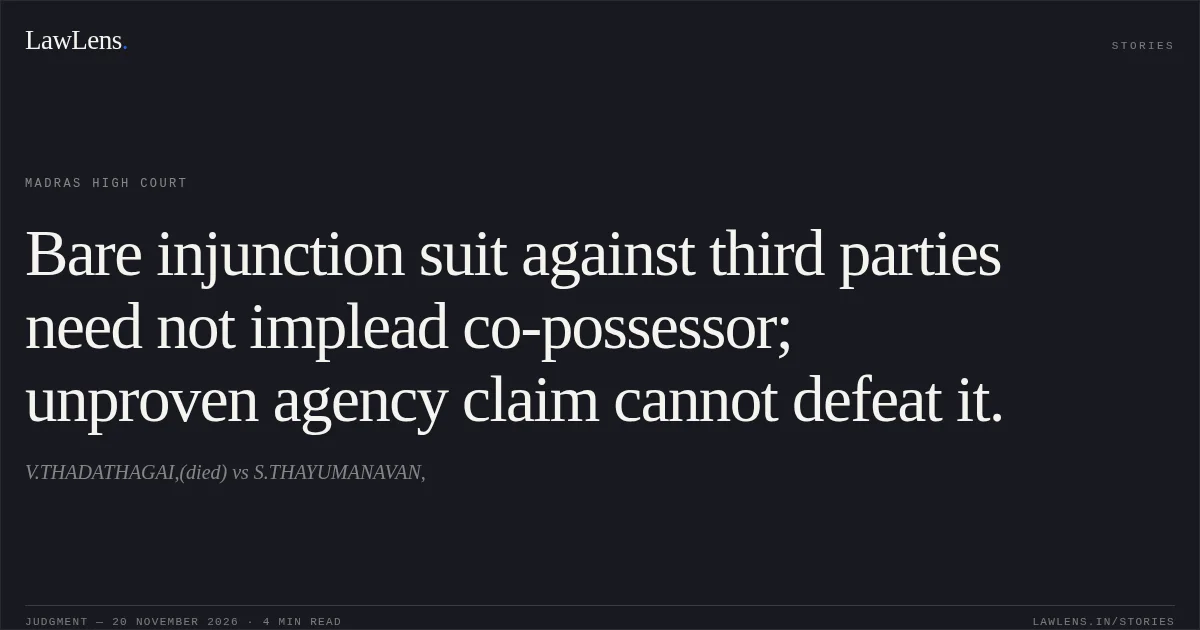
p. 8 · ¶ 15A party sued in an individual capacity, or in a bare injunction suit, need not implead a non-party whose rights a decree will not affect, and any dispute with such a person must be pursued separately.
p. 10 · ¶ 17A finding of "unclean hands" must rest on evidence, and alienation of temple property is a matter for the temple authorities, not a ground to deny the plaintiff's injunction.
pp. 10–11 · ¶ 17No precedents were cited in the judgment.
Provisions in the judgment · 1 · Linked ones open on LawLens
Code of Civil Procedure, 1908 Section 100
04Reasoning
The Court first noted that the defendants did not dispute that the properties belonged to the plaintiff's parents. Having made that admission, the defendants had to prove the capacity in which the second defendant claimed to act as manager of Somasundaram.
p. 8 · ¶ 15They produced no record of that management and did not examine Somasundaram as a witness, and their exhibits (Ex.B1 to Ex.B15) did not establish their own enjoyment of the property.
p. 9 · ¶ 16The Court held that the documents produced by the plaintiff showed that her parents held the lands as lessees of the temple and were in possession, so the possession of the plaintiff's family was established.
p. 9 · ¶ 16Because the suit was framed against the defendants in their individual capacity and sought only a bare injunction against third parties, Somasundaram was not a necessary party, and a decree against the defendants would not affect his rights.
p. 10 · ¶ 17The Court treated the "unclean hands" finding as unsupported by any documentary evidence, and held that any temple property alienated by the plaintiff was a matter for the temple authorities.
pp. 10–11 · ¶ 17The Court also found that the Courts below had not considered the plaintiff's documents on possession.
p. 11 · ¶ 17The judgment does not separately examine whether the First Appellate Court complied with Order 41 Rule 31 CPC. The question was answered together with the other two in the appellant's favour.
p. 11 · ¶ 1705Holding
The Court answered all substantial questions of law in favour of the appellant. It held that the Courts below erred in dismissing the suit on an unsupported finding of unclean hands and in failing to consider the plaintiff's possessory documents, and that Somasundaram's non-joinder was not fatal.
pp. 10–11 · ¶ 17The second appeal was allowed, the judgments and decrees of the trial court (O.S. No. 211 of 1999) and the First Appellate Court (A.S. No. 82 of 2003) were set aside, and the suit was decreed as prayed for, with no order as to costs.
p. 12 · ¶ 18–19Original Court PDF
V.THADATHAGAI,(died)vsS.THAYUMANAVAN,
Click to open original judgment
Original judgment, available to read, download and summarize on LawLens.in