01Facts
The 12th respondent (Saadhu Seva Samajam) had its lands acquired for expansion of National Highway-7 through a Section 4(1) notification in 1979, a Section 6 notification and an award in 1980 under the Land Acquisition Act, 1894.
¶ 2Enhanced compensation was allowed on the 12th respondent's reference petition.
¶ 3The unacquired remainder was sold to third parties, including the petitioners, who have accessed the highway through it since.
¶ 3A sale deed over the acquired land was declared fraudulent by the District Registrar on 22.11.2021, a finding upheld on appeal and in a writ petition.
¶ 4The petitioners obtained an easement decree against the Highways Department (dismissed against the 12th respondent), which was passed ex parte; an application to set it aside is pending before the civil court.
¶ 5, 20-21The 12th respondent's request for re-conveyance was rejected by G.O.(D) No. 9 dated 23.01.2025 after hearing the petitioners.
¶ 6A later representation led to G.O.(Ms) No. 01 dated 02.01.2026, re-conveying the land without reference to the earlier order or notice to the petitioners.
¶ 6The Collector's consequential order dated 07.01.2026 fixed the amount payable for re-conveyance.
¶ 7Of the 57 cents unutilised, 32 cents were retained and 25 cents re-conveyed.
¶ 17The petitioners challenged the G.O. and sought consequential mandamus in the other writs.
¶ 7-802Issues
i.1. Whether the petitioners, as beneficiaries of an ex parte easement decree, are "aggrieved persons" with locus standi to challenge the re-conveyance order.
¶ 10, 12, 20ii.2. Whether the Government could re-convey the acquired land after an earlier G.O. had rejected the same request, i.e., whether the authorities were functus officio.
¶ 8, 11iii.3. Whether the re-conveyance order, which cites no statutory provision, was validly made, given the repeal of the 1894 Act and the Division Bench ruling in A. Shanmugam (2026-2-L.W.-406) on Sections 16-B and 48-B.
¶ 9, 16-18iv.4. Whether the petitioners were entitled to notice and hearing before the re-conveyance order was passed.
¶ 8, 2203Law Applied
The Court relied on the Land Acquisition Act, 1894, and on Section 104 of the Right to Fair Compensation and Transparency in Land Acquisition, Rehabilitation and Resettlement Act, 2013, which expressly repealed the 1894 Act.
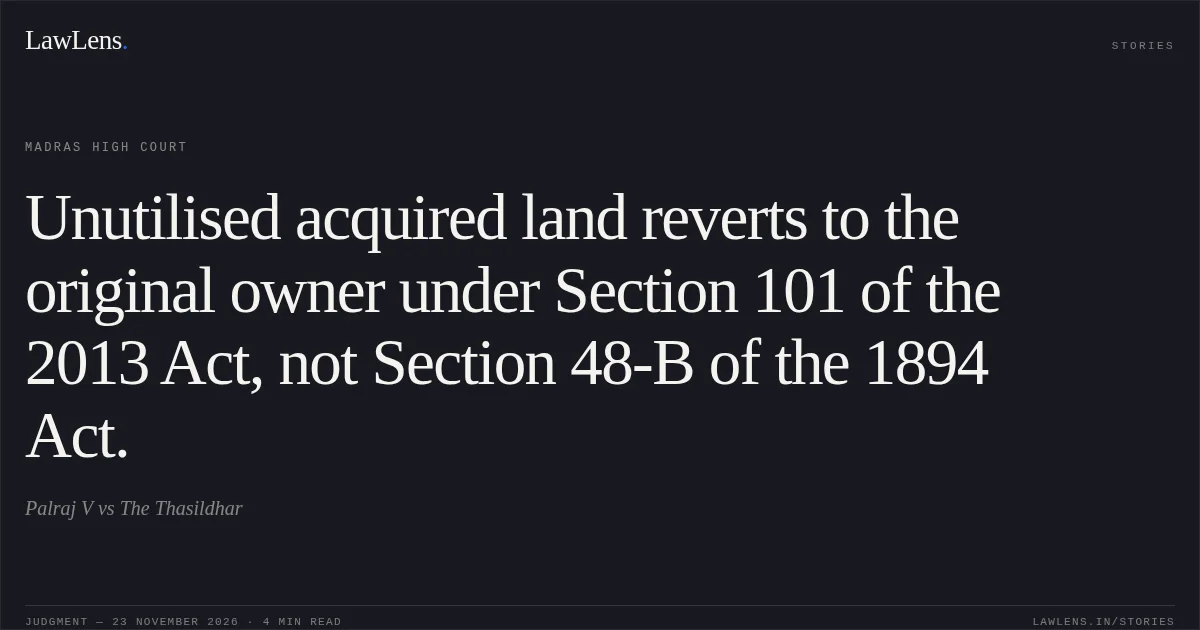
¶ 17Section 101 of the 2013 Act provides that land unutilised for five years from taking possession is returned to the original owner or its legal heirs, or to a land bank, in the manner prescribed.
¶ 17The Court followed the Division Bench in A. Shanmugam (2026-2-L.W.-406), holding that power under Section 48-B of the 1894 Act cannot be exercised without prior re-vesting under Section 16-B.
¶ 16A civil court's easement declaration continues with the successor-in-interest of the person against whom it was declared.
¶ 21No hearing is required on an application falling under Section 101 of the 2013 Act.
¶ 22The locus standi principle of "aggrieved person" applies such that a person benefited by the impugned order's underlying declaration cannot challenge it.
¶ 20Provisions in the judgment · 2 · Linked ones open on LawLens
Right to Fair Compensation and Transparency in Land Acquisition, Rehabilitation and Resettlement Act, 2013 Section 104Section 101
04Reasoning
The Court noted that the G.O. did not cite any enabling provision, so it treated the re-conveyance as made under Section 101 of the 2013 Act.
¶ 18Applying the statutory criteria, the Court found that the Department had reconsidered the earlier rejection, had concurred with the Superintending Engineer (Maintenance), and had retained 32 of 57 cents for future expansion.
¶ 18The Court further found that the enhanced compensation (about ₹27.26 lakh) was to be recovered and that the current value of the reverted land was payable to the exchequer, satisfying Section 101.
¶ 19On locus standi, the Court observed that the petitioners' claim rests on an easement declared in their favour, which they were not dwelling upon on merits.
¶ 20The Court held that the easement would continue against the Highways Department's successor (the 12th respondent) pending the ex parte set-aside application, so the petitioners were not aggrieved by an order traceable to Section 101.
¶ 21Because the order fell under Section 101 and the Department had decided not to use the land, no hearing for the petitioners was required.
¶ 22The Court did not separately decide the functus officio objection. It also did not reconcile the earlier reliance on Sections 16-B and 48-B with its ultimate reliance on Section 101, though its reasoning rests on the latter.
¶ 16-1805Holding
The Court held that the petitioners were not aggrieved persons entitled to challenge the re-conveyance order, which was traceable to Section 101 of the 2013 Act and satisfied its criteria, and that no notice to the petitioners was required.
¶ 21, 23W.P.(MD) No. 6720 of 2026 is dismissed, with the observation that the petitioners' easement rights are unaffected and remain subject to the pending set-aside application before the civil court. The connected writ petitions (W.P.(MD) Nos. 6479, 7874 and 18098 of 2026) are dismissed for want of merit, with no order as to costs, and the connected miscellaneous petitions are closed.
¶ 23Original Court PDF
Palraj VvsThe Thasildhar
Click to open original judgment
Original judgment, available to read, download and summarize on LawLens.in