01Facts
The petitioner's father owned Punja land, Survey No. 51/3, measuring 0.36.0 hectares (91 cents), in Echampottal Puthur Village, Tirunelveli District.
¶ 3The State sought to acquire it under Tamil Nadu Act 31 of 1978. Objections were filed but allegedly not considered, and the land was acquired.
¶ 3The acquisition dates to 1997.
¶ 14The petitioner remained in possession, and the compensation was never paid; it was kept in a treasury account.
¶ 3The petitioner's earlier writ petition, W.P.(MD) No. 10381 of 2017, sought reconveyance. A learned Single Judge dismissed it, held that the petitioner was not entitled to Section 24(2) of the RFCTLARR Act, 2013, and directed that he be treated as an encroacher.
¶ 3On intra-Court appeal, the petitioner withdrew the writ on his own endorsement. The Division Bench eschewed the Single Judge's observations and granted liberty to pursue remedies only regarding compensation.
¶ 4The petitioner then sought patta and compensation. The authorities rejected the claim by the impugned order dated 25.04.2023, citing issuance of patta to individuals and deposit of compensation in a revenue deposit.
¶ 5, 1The respondents contended that the petitioner had abandoned restoration, was not entitled to Section 24 relief, and could withdraw the deposited amount.
¶ 7–802Issues
i.1. Whether the petitioner, having withdrawn the earlier writ petition seeking reconveyance and having been granted liberty only as to compensation, is disentitled to the twin benefits under Section 24(2) of the 2013 Act, namely non-taking of possession and non-payment of compensation.
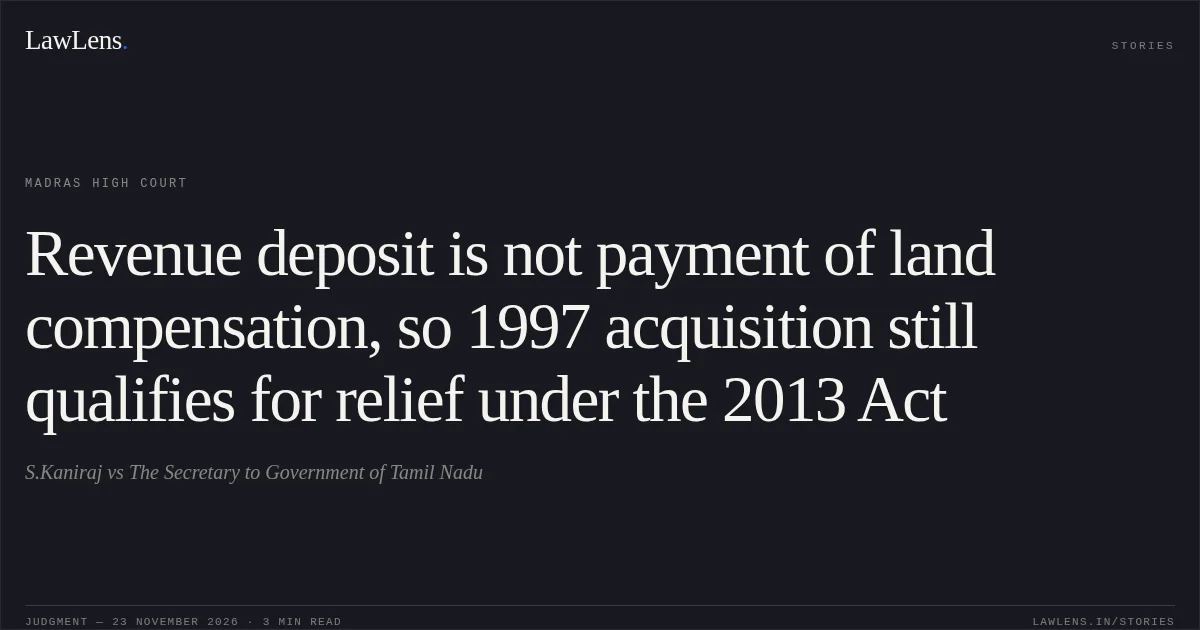
¶ 10ii.2. Whether the deposit of compensation in a "revenue deposit" constitutes payment of compensation for the purposes of Section 24(2).
¶ 11, 13iii.3. Whether the Revenue Standing Order (RSO) 15 Rule 19 has statutory force in Tamil Nadu so as to validate the revenue deposit.
¶ 12iv.4. Whether the petitioner is entitled to compensation under the proviso to Section 24(2).
¶ 1403Law Applied
Section 24(2) of the RFCTLARR Act, 2013 deems land acquisition proceedings under the 1894 Act lapsed where an award was made five years or more before commencement and possession has not been taken or compensation has not been paid. Its proviso entitles all beneficiaries to compensation under the 2013 Act where compensation for a majority of holdings has not been deposited in beneficiaries' accounts.
¶ 13Indore Development Authority v. Manohar Lal (2020) 8 SCC 129 (Constitution Bench) upheld revenue deposits where the relevant State Standing Order contemplates them.
¶ 11Padmavathi v. State of Tamil Nadu, 1991 LW 80 (Division Bench) holds that RSOs on land acquisition are not enforceable in Tamil Nadu because rules have been framed, so such RSOs lack statutory force.
¶ 12A deposit made without statutory authority, and not before the competent court, does not amount to payment.
¶ 13Provisions in the judgment · 1 · Linked ones open on LawLens
Right to Fair Compensation and Transparency in Land Acquisition, Rehabilitation and Resettlement Act, 2013 Section 24
04Reasoning
The petitioner, by withdrawing his reconveyance writ and accepting liberty limited to compensation, acquiesced in the State's continued possession. On that basis, the court considered the twin conditions of Section 24(2) unavailable as to possession.
¶ 10RSO 15 Rule 19 lacks statutory force in Tamil Nadu under Padmavathi. Because the authorities were bound to follow the Act and Rules, refused compensation had to be deposited before a competent court, which would also carry interest for the landowner. Treating the revenue deposit as invalid, the court held that compensation had not been paid.
¶ 12, 13Relying on the proviso, the court found that compensation had not been paid for over two decades since the 1997 acquisition, and so the petitioner was entitled to compensation under the proviso.
¶ 14The court's reasoning is internally in tension: it first holds that the possession limb fails through acquiescence, and then grants relief based on non-payment. The judgment does not expressly reconcile these holdings, and the grant rests on the proviso's compensation entitlement.
05Holding
The revenue deposit is not valid payment because the RSO lacks statutory force in Tamil Nadu, so compensation has not been paid, and the petitioner is entitled to compensation under the proviso to Section 24(2).
¶ 12–14The impugned order dated 25.04.2023 is set aside, and the matter is remanded to the Fifth Respondent (Special Tahsildar) to determine compensation for the acquired land in consonance with the proviso to Section 24(2). The writ petition is disposed of with no order as to costs.
¶ 15Original Court PDF
S.KanirajvsThe Secretary to Government of Tamil Nadu
Click to open original judgment
Original judgment, available to read, download and summarize on LawLens.in