01Facts
The petitioner (husband) and respondent (wife) married on 10.02.2006.
p. 2 · ¶ 3The respondent left the matrimonial home following a dispute.
p. 2 · ¶ 3She filed MC No. 239 of 2018 under Section 125 CrPC seeking maintenance.
p. 2 · ¶ 3The VI Additional Principal Family Court, Chennai, proceeded ex parte against the petitioner and, by order dated 27.12.2022, awarded maintenance of Rs. 7,000 per month.
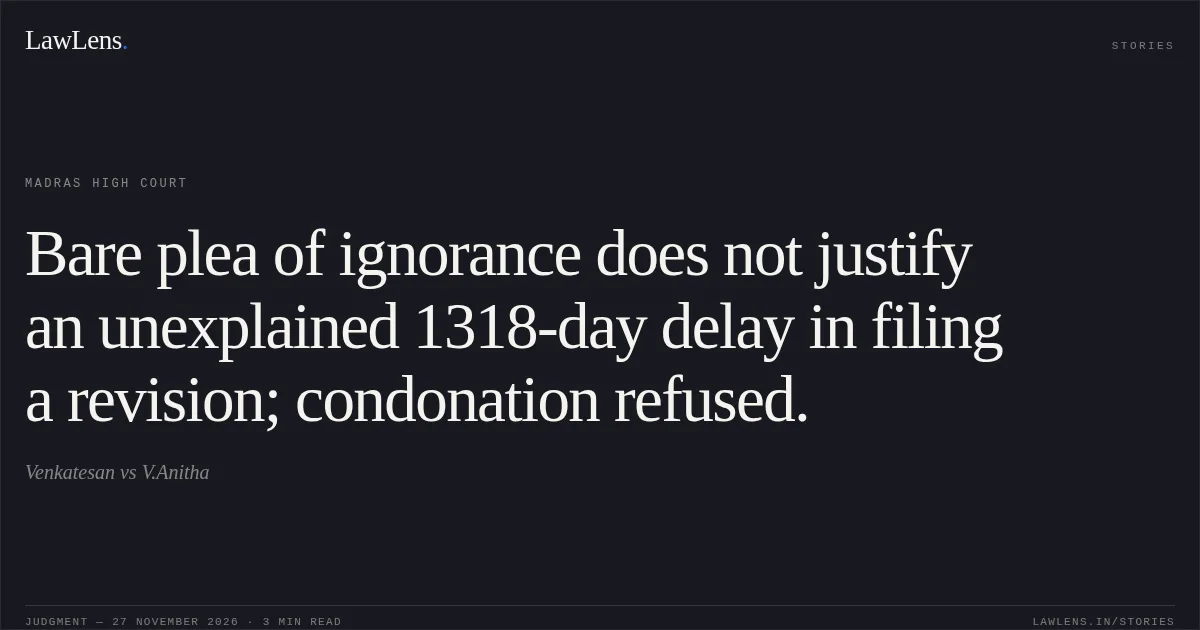
p. 2 · ¶ 3The petitioner filed Crl.RC.SR No. 75835 of 2026 under Sections 438 and 442 BNSS, along with Crl.MP No. 22579 of 2026 seeking condonation of a 1318-day delay.
pp. 1–2 · ¶ 1–3He explained that the delay arose from lack of knowledge of the ex parte order and was neither deliberate nor wilful.
p. 3 · ¶ 5The court noted that no specific material beyond this bare explanation was placed before it.
p. 4 · ¶ 9–1002Issues
i.1. Whether a delay of 1318 days in preferring a criminal revision under Sections 438 and 442 BNSS may be condoned under Section 5 of the Limitation Act, 1963, on the explanation of lack of knowledge of the ex parte order.
pp. 3–4 · ¶ 7–10ii.2. Whether the maintenance order of Rs. 7,000 per month warrants interference on merits.
pp. 10–11 · ¶ 2303Law Applied
Article 131 of the Limitation Act, 1963, prescribes a 90-day period for revision under Sections 438 and 442 BNSS.
pp. 3–4 · ¶ 8Section 5 of the Limitation Act, 1963, permits delay to be condoned only for "sufficient cause".
pp. 3–4 · ¶ 8"Sufficient cause" receives liberal construction but requires that the delay be bona fide, not the product of gross negligence, deliberate inaction or casual approach, and that total inaction without explanation weighs against the litigant.
p. 4 · ¶ 11 · pp. 6–7 · ¶ 14Collector, Land Acquisition v. Katiji, 1987 (2) SCC 107, establishes the primacy of substantial justice.
pp. 4–5 · ¶ 11P.K. Ramachandran v. State of Kerala, AIR 1998 SC 2276, holds that limitation is applied with rigour and courts lack power to extend it on equitable grounds.
p. 5 · ¶ 12Shakuntala Devi Jain v. Kuntal Kumari, AIR 1969 SC 575, and Brij Indar Singh v. Kanshi Ram, ILR (1918) 45 Cal 94 (reasonable diligence test), as reaffirmed in State of Nagaland v. Lipok AO, AIR 2005 SC 2191, govern the reasonable diligence standard.
pp. 7–8 · ¶ 16–17Vedabai v. Shantaram Baburao Patil, JT 2001 (5) SC 608, draws the distinction between inordinate and short delays.
p. 8 · ¶ 18Pundlik Jalam Patil v. Executive Engineer, (2008) 17 SCC 448, holds that delay defeats equity.
p. 8 · ¶ 19Maniben Devraj Shah v. Municipal Corporation of Brihan Mumbai, 2012 (5) SCC 157, holds that the bona fides of the explanation determine whether delay is condoned.
pp. 8–9 · ¶ 20Section 125 CrPC (Section 144 BNSS) is a provision to prevent vagrancy of a destitute wife.
pp. 10–11 · ¶ 23Provisions in the judgment · 6 · Linked ones open on LawLens
Limitation Act, 1963 Section 5Section 131
Bharatiya Nagarik Suraksha Sanhita, 2023 Section 438Section 442Section 144
Code of Criminal Procedure, 1973 Section 125
04Reasoning
The court held that the 1318-day delay was inordinate and that the petitioner's explanation, namely lack of knowledge of the ex parte order, was bare and unsupported by any particulars or documents. Applying Maniben and Pundlik Jalam Patil, it found no sincere attempt to pursue the remedy and no reason beyond the litigant's control. Because the explanation did not show a bona fide cause, the liberal approach in Katiji and Shakuntala Devi Jain could not be invoked, and the court treated the delay as a case of "complete careless and reckless" inaction.
p. 4 · ¶ 10 · pp. 8–9 · ¶ 19–20 · p. 10 · ¶ 22Having refused condonation, the court proceeded to observe, as an additional ground, that the petitioner did not dispute the marriage and that Rs. 7,000 per month was reasonable given current living costs. It found no valid ground to interfere with the quantum on merits. This merits observation was not necessary to the decision on limitation.
pp. 10–11 · ¶ 2305Holding
The court answered Issue 1 in the negative: no sufficient cause was shown, and the 1318-day delay could not be condoned under Section 5 of the Limitation Act.
p. 10 · ¶ 21–22 · p. 11 · ¶ 24The Crl.MP was dismissed as time-barred. Consequently, Crl.RC.SR No. 75835 of 2026 against the order dated 27.12.2022 in MC No. 239 of 2018 was also dismissed, with no order as to costs. On Issue 2, the court observed that the Rs. 7,000 maintenance was fair and that no ground for interference on merits had been raised, so the order stands.
p. 11 · ¶ 24 · pp. 10–11 · ¶ 23Original Court PDF
VenkatesanvsV.Anitha
Click to open original judgment
Original judgment, available to read, download and summarize on LawLens.in