Facts
Municipal Corporation, Mohali, a sovereign local body, permitted various parties to display advertisements on certain properties and collected amounts described as licence fee/advertisement tax.
Source reference: para. 2The Department alleged that these receipts constituted consideration for the taxable service of “Selling of Space for Advertisement” under Section 65(105)(zzzm) of the Finance Act, 1994.
Source reference: para. 2A show-cause notice dated 6 May 2014 demanded service tax of ₹5,29,597 for April–September 2012, invoking the extended limitation period, along with interest and penalties.
Source reference: para. 2The adjudicating authority dropped the demand for July–September 2012 on the ground that the service fell within the negative list under Section 66D, but confirmed a demand of ₹3,85,175 for April–June 2012 and imposed penalties under Sections 76 and 77.
Source reference: para. 2The Commissioner (Appeals) upheld the order, leading to the present appeal.
Source reference: paras. 1–2During the appeal, the Tribunal had already decided the identical issue in the Corporation’s own case for an earlier period and set aside the demand.
Source reference: paras. 4.1, 6–7Issues
1. Whether the Municipal Corporation, being a sovereign local body, was a “person” providing the taxable service of “Selling of Space for Advertisement” under Section 65(105)(zzzm) of the Finance Act, 1994, during April–June 2012?
Source reference: paras. 4.2, 6; quoted order, para. 72. Whether the amounts collected as licence fee/advertisement tax constituted taxable consideration for a service, or were statutory levies under Sections 90 and 122 of the Punjab Municipal Corporation Act?
Source reference: para. 4.3; quoted order, para. 83. Whether the extended period of limitation, interest, and penalties were sustainable when the demand itself concerned an interpretational issue involving a government local body?
Source reference: quoted order, paras. 9–10Law Applied
The Tribunal applied Section 65(105)(zzzm) of the Finance Act, 1994, which taxed the service of selling space or time for advertisement when provided by a “person” to another person.
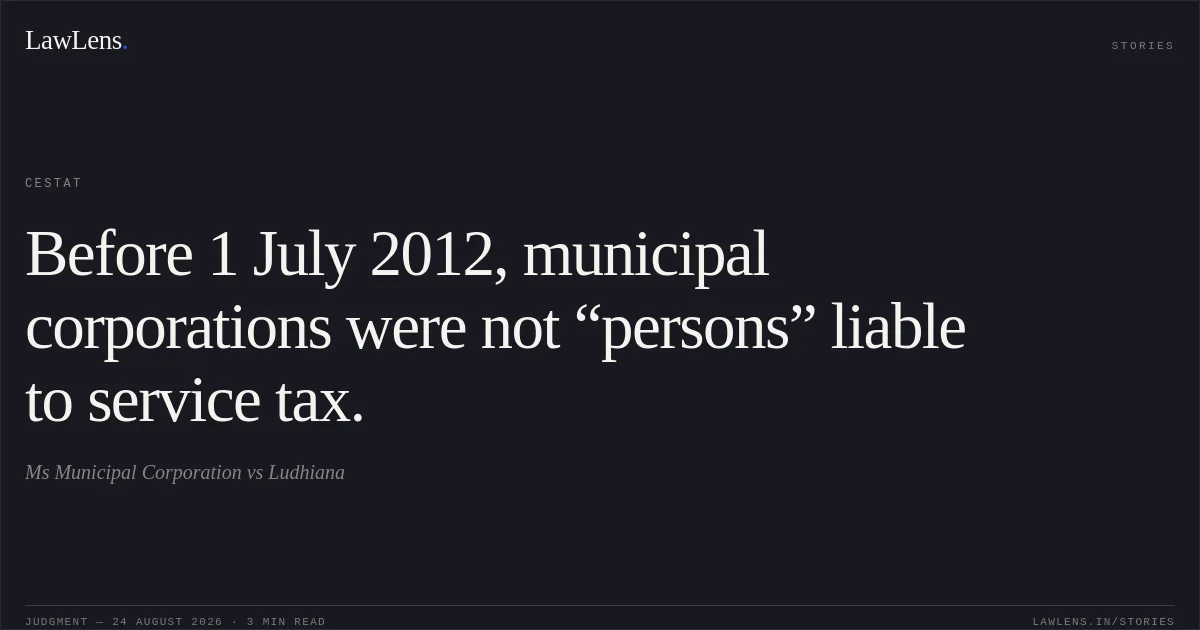
Source reference: paras. 2, 6For the period preceding 1 July 2012, where “person” was not defined in the Finance Act, the Tribunal relied on the principle that a sovereign government body or local authority was not covered by the expression “person” for this taxable-service provision.
Source reference: para. 4.2; quoted order, para. 7It followed Deputy Commissioner of Police, Jodhpur v. Commissioner of Central Excise and Service Tax, Jaipur-II, 2017 (48) S.T.R. 275 (Tri.–Del.), whose principle was stated to have been upheld by the Supreme Court, and Indian Red Cross Society, Final Order No. 60361/2025.
Source reference: quoted order, para. 7The Tribunal further relied on Sections 90 and 122 of the Punjab Municipal Corporation Act and Article 243X of the Constitution to hold that advertisement tax levied under statutory authority was a statutory levy rather than consideration for a taxable service.
Source reference: paras. 4.3, 6; quoted order, para. 8It also followed Karad Nagar Parishad, 2019 (20) GSTL 288 (Tri. Mumbai), on the non-taxability of statutory advertisement tax, and Commissioner of CGST, Jaipur v. Rajasthan Tourism Development Corporation Ltd., 2018 (15) GSTL 307 (Raj.), on the non-invocation of the extended period against a government public undertaking in an interpretational dispute.
Source reference: quoted order, paras. 8–9Reasoning
The Tribunal treated its earlier decision in the Corporation’s own case as directly applicable because the present appeal involved the same activity and legal question.
Source reference: paras. 4.1, 6–7Since the relevant period preceded the statutory definition of “person” and the Municipal Corporation was a sovereign local body, it was held not to fall within the charging description of the taxable service under Section 65(105)(zzzm).
Source reference: para. 4.2; quoted order, para. 7Independently, the amounts received were connected with advertisement tax/licence fees imposed under municipal statutory powers, including in respect of properties managed by the Corporation, and therefore represented statutory levies rather than contractual consideration for providing advertising space.
Source reference: quoted order, para. 8The Tribunal also accepted that the issue involved interpretation of the service-tax provisions and that suppression with intent to evade tax could not properly be attributed to a government local body; consequently, the extended limitation period was unavailable.
Source reference: quoted order, para. 9As the principal demand failed, the associated interest and penalties also could not survive.
Source reference: quoted order, para. 10Holding
The Tribunal held that the Municipal Corporation, Mohali was not liable to service tax on the impugned receipts under the category of “Selling of Space for Advertisement” for April–June 2012.
The amounts collected were treated as statutory advertisement tax/licence fees, and the extended period, interest, and penalties were unsustainable.
Source reference: quoted order, paras. 8–10The impugned Order-in-Appeal was set aside and the appeal was allowed with consequential relief, if any, in accordance with law.
Source reference: para. 7Acts & Sections Cited
8 provisions across 3 statutes referred to in this judgment. Linked provisions open on LawLens.
Finance Act, 19945
General Clauses Act, 18971
Punjab Municipal Corporation Act2
Original Court PDF
Ms Municipal CorporationvsLudhiana
Click to open original judgment
Original judgment, available to read, download and summarize on LawLens.in