Facts
The plaintiffs instituted Partition Suit No. 13 of 2018 before the Civil Judge (Junior Division), Additional Court, Berhampore, seeking partition of the suit properties.
Source reference: no citationThe defendants filed their written statement on 12 March 2019, asserting that Nanda Dulal Malakar had transferred his entire share in Plot No. 1749, and an 8-anna share in Plot No. 1750, to Panchanan Malakar by a registered gift deed dated 20 April 1976; the defendants claimed title through Panchanan Malakar
Source reference: para. 9–10On 1 September 2023, after substantial progress in the trial and recording of evidence, the plaintiffs applied under Order VI Rule 17 CPC to amend the plaint to challenge the validity of the gift deed.
Source reference: para. 11The Trial Court allowed the amendment by order dated 18 March 2025.
Source reference: no citationThe defendant Nos. 2 and 3 challenged that order in revision, contending that the amendment was filed after undue delay, violated the proviso to Order VI Rule 17 CPC, changed the nature of the suit, and prejudiced rights allegedly accrued through the existing pleadings and evidence.
Source reference: para. 1–5Issues
Whether the Trial Court erred in allowing the plaintiffs’ amendment application under Order VI Rule 17 CPC after commencement and substantial progress of the trial, without adequately satisfying the requirement of due diligence under the proviso.
Source reference: para. 1–2, 14Whether the proposed amendment, which introduced a challenge to the gift deed disclosed in the defendants’ written statement, altered the nature and character of the suit or defeated rights accrued to the defendants by lapse of time.
Source reference: para. 3–5, 13–18Whether the amendment was necessary for determining the real controversy and could nevertheless be permitted despite the delay.
Source reference: para. 6–8, 12–16Law Applied
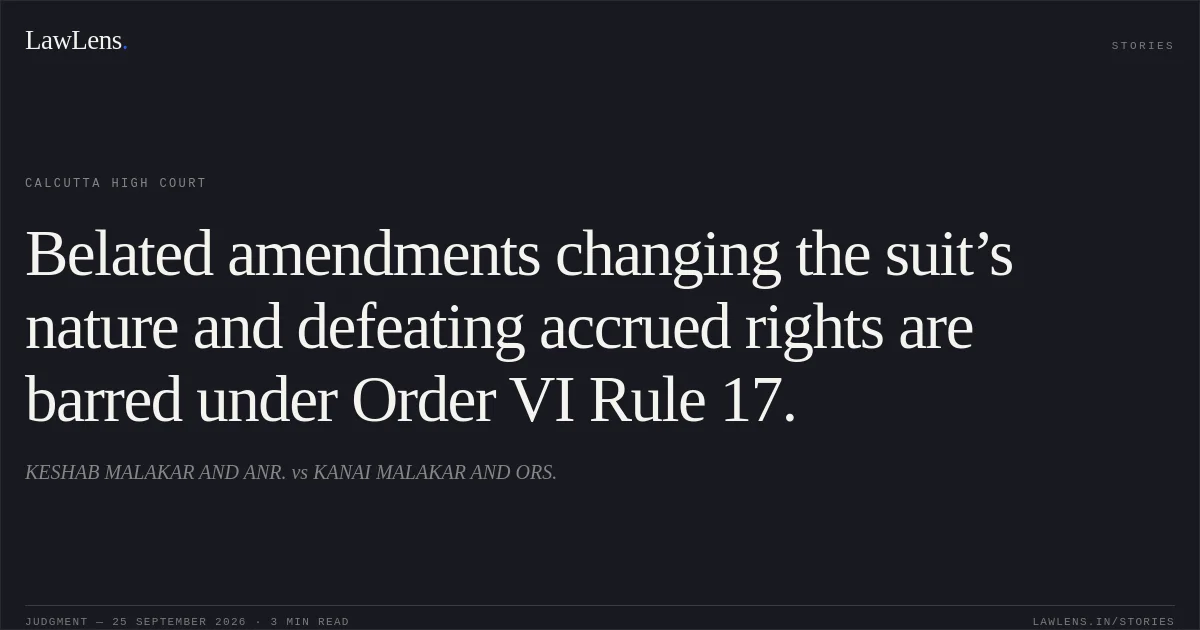
The Court applied Order VI Rule 17 CPC, under which amendments necessary for determining the real controversy may be allowed at any stage, but, after commencement of trial, only where the applicant establishes that despite due diligence the matter could not have been raised earlier.
Source reference: para. 1Relying principally on LIC v. Sanjeev Builders Pvt. Ltd., B.K. Narayana Pillai v. Parameswaran Pillai, Radhika Devi v. Bajrangi Singh, and Smt. Dipti Paik v. Sri Jogesh Chandra Roy, the Court held that amendments introducing a new cause of action, a new set of ideas, or a different case, or defeating a legal right accrued through lapse of time, should not ordinarily be allowed.
Source reference: para. 3–4, 12–17Although courts possess wide discretion to permit amendments in the interests of justice, that discretion must be exercised with care; delay may be compensated by costs, but not where the amendment causes irremediable prejudice or alters the original lis.
Source reference: para. 12The Court also noted the plaintiffs’ reliance on Prem Singh v. Birbal and Jagmail Singh v. Karamjit Singh, concerning challenges to void documents, but found those authorities unhelpful on the issue of the belated amendment in the present procedural context.
Source reference: para. 8, 16Reasoning
The Court found that the plaintiffs acquired knowledge of the gift deed when they received the defendants’ written statement in 2019, yet waited until September 2023—approximately four years later—to seek amendment.
Source reference: para. 14During this period, the parties proceeded with the trial and substantial evidence was recorded.
Source reference: no citationConsequently, the plaintiffs failed to demonstrate the due diligence required by the proviso to Order VI Rule 17 CPC.
Source reference: no citationAlthough the proposed challenge related to the defendants’ pleaded reliance on the gift deed and might assist in resolving the title dispute, the Court held that introducing the challenge at that advanced stage would materially alter the nature of the original partition proceedings, frustrate the defendants’ existing defence, and jeopardise rights accrued from the pleadings and evidence already placed on record.
Source reference: para. 13–16The Trial Court therefore failed to apply the settled restrictions governing belated amendments, resulting in gross illegality and material irregularity.
Source reference: para. 18Holding
The High Court answered the issues against the plaintiffs and held that the amendment was impermissibly delayed, unsupported by due diligence, and prejudicial to the defendants’ accrued rights.
It accordingly set aside the Trial Court’s order dated 18 March 2025 allowing the amendment in Partition Suit No. 13 of 2018.
Source reference: para. 19(i)The revision, C.O. 3542 of 2025, was allowed and disposed of, with the Trial Court directed to proceed expeditiously on the basis of the existing pleadings and evidence and to pronounce judgment.
Source reference: para. 19(ii)–20Original Court PDF
KESHAB MALAKAR AND ANR.vsKANAI MALAKAR AND ORS.
Click to open original judgment
Original judgment, available to read, download and summarize on LawLens.in