Facts
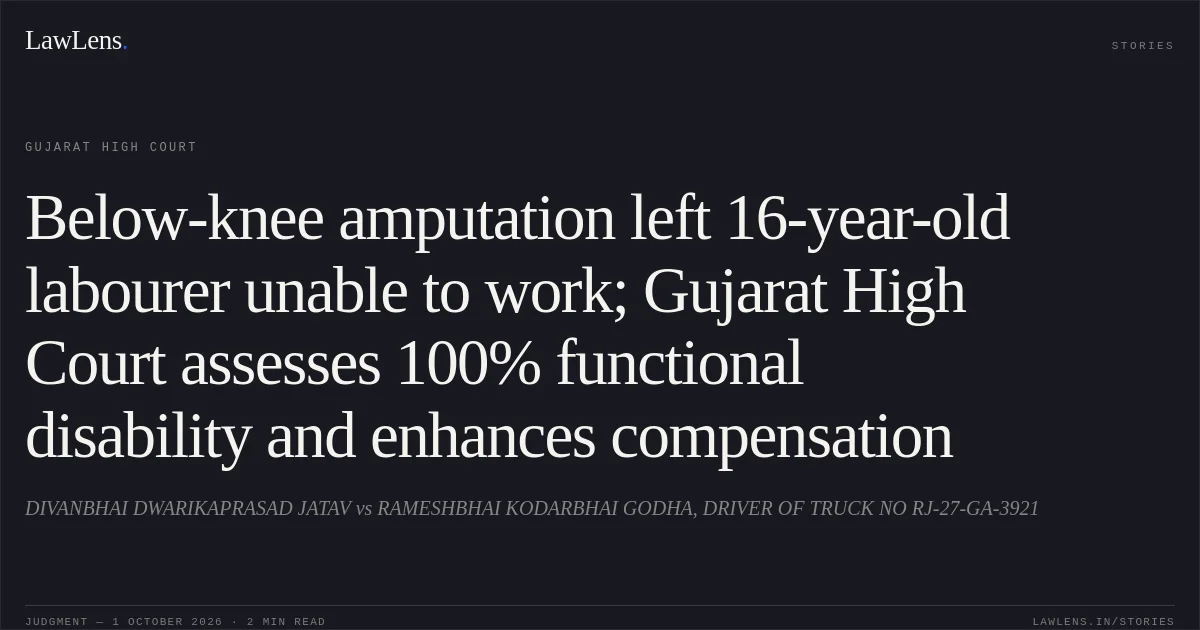
The claimant, aged about 16, was struck by a truck while walking on 31 May 2011.
Source reference: p. 1–2, 8He sustained injuries requiring amputation of his right leg below the knee and the loss of two toes on his left foot.
Source reference: p. 1–2, 8He filed a claim under Section 166 of the Motor Vehicles Act, 1988.
Source reference: p. 1–2, 8The Tribunal assessed whole-body disability at 50%, used an annual notional income of ₹15,000 and multiplier of 15, and awarded ₹1,59,500 with 9% interest.
Source reference: p. 1–2, 8The claimant appealed, seeking enhancement.
Source reference: p. 1–2, 8Issues
Whether the claimant’s functional disability and consequent loss of earning capacity should be assessed by reference to his injuries and pre-accident work, rather than by mechanically applying the physical-disability percentage.
Source reference: p. 3–8Whether the Tribunal’s assessment of income, multiplier and other heads of compensation required revision, and what enhanced compensation was just and reasonable.
Source reference: p. 8–12Law Applied
Under Sections 166 and 173 of the Motor Vehicles Act, 1988, compensation must be just and fair, and an appellate court may enhance an inadequate award.
Source reference: p. 4–7The principles in Raj Kumar v. Ajay Kumar (as quoted in the judgment) require the Tribunal to assess the effect of permanent disability on earning capacity; physical disability and loss of earning capacity are not automatically equivalent, and the latter depends on the claimant’s occupation and circumstances.
Source reference: p. 4–7The Court also relied on M. Paramesh v. VRL Logistics Ltd. & Anr. for the possibility that functional disability may exceed the assessed physical-disability percentage, and on Hitesh Nagjibhai Patel v. Bababhai Nagjibhai Rabari & Anr. for assessing a minor’s income by reference to the applicable minimum wage, with future prospects.
Source reference: p. 7–9It referred to Kajal v. Jagdish Chand and Hitesh Nagjibhai Patel in applying a multiplier of 18.
Source reference: p. 10Reasoning
The Court considered the below-knee amputation, loss of toes, and the claimant’s pre-accident labour work.
Source reference: p. 3, 8It held that the injuries prevented him from continuing that work and assessed his functional disability at 100%, rather than treating the Tribunal’s 50% physical-disability figure as determinative.
Source reference: p. 3, 8As the claimant was a minor, the Court adopted skilled-worker minimum wages of ₹4,600 per month, added 40% for future prospects and applied a multiplier of 18.
Source reference: p. 8–12It also found the Tribunal’s amounts for pain and suffering, loss of amenities, attendant and related expenses, and prosthetic-leg expenses inadequate, and revised the compensation under those heads.
Source reference: p. 8–12Holding
The appeal was partly allowed.
The Court modified the Tribunal’s award and directed payment of enhanced compensation of ₹10,98,220, over and above the Tribunal’s award, with interest at 9% per annum from the date of the claim petition until realization.
Source reference: p. 11–12It directed the Tribunal to disburse the amount to the claimant upon deposit.
Source reference: p. 11–12Acts & Sections Cited
3 provisions across 1 statute referred to in this judgment. Each provision opens on LawLens.
Motor Vehicles Act, 19883
Original Court PDF
DIVANBHAI DWARIKAPRASAD JATAVvsRAMESHBHAI KODARBHAI GODHA, DRIVER OF TRUCK NO RJ-27-GA-3921
Click to open original judgment
Original judgment, available to read, download and summarize on LawLens.in