Facts
The respondents issued e-Tender No. 01/ePROC/SGBP/2025-26 dated 20 August 2025 for providing sanitation services at Sanjay Gandhi Biological Park, Patna, for one year.
Source reference: p. 3–4The petitioner emerged as the lowest successful bidder, and a work order was issued on 20 January 2026.
Source reference: p. 3–4An agreement was executed on 31 January 2026 for the period from 1 February 2026 to 31 January 2027, after which the petitioner commenced the work by deploying personnel.
Source reference: p. 3–4During execution, the respondents alleged deficiencies in performance and issued communications dated 18 February 2026 and 14 March 2026 seeking explanations.
Source reference: p. 4By Letter No. 967 dated 18 May 2026, the respondents cancelled the work order, terminated the agreement, forfeited the bank guarantee of ₹6,64,111, and blacklisted the petitioner for three years from participating in departmental tenders.
Source reference: p. 4Issues
Whether the order dated 18 May 2026 blacklisting the petitioner for three years, cancelling the work order, terminating the agreement, and forfeiting the security deposit was passed in violation of the principles of natural justice?
Source reference: para. 12–15Whether the respondents’ decision was arbitrary, unreasonable, mala fide, disproportionate, or otherwise amenable to interference under Article 226 of the Constitution?
Source reference: para. 16–20Whether the High Court should reappreciate the respondents’ factual findings regarding the petitioner’s contractual performance in exercise of writ jurisdiction?
Source reference: para. 19–20Law Applied
The Court applied the principles governing judicial review of State action in contractual matters under Article 226 of the Constitution.
Source reference: no citationIn Erusian Equipment & Chemicals Ltd. v. State of West Bengal, AIR 1975 SC 266, and Gorkha Security Services v. Government (NCT of Delhi), (2014) 9 SCC 105, the Court recognised that blacklisting has serious civil consequences and ordinarily requires a fair opportunity of hearing through a notice that adequately indicates the proposed action.
Source reference: para. 10, 18Under Patel Engineering Ltd. v. Union of India, (2012) 11 SCC 257, the State possesses the power to blacklist in public interest, even without a specific statutory provision, but must exercise that power fairly, rationally, and for a legitimate purpose.
Source reference: para. 16Kulja Industries Ltd. v. Chief General Manager, Western Telecom Project, BSNL, (2014) 14 SCC 731, further establishes that blacklisting is subject to natural justice, proportionality, and judicial review for arbitrariness, mala fides, or procedural impropriety.
Source reference: para. 17Applying Tata Cellular v. Union of India, (1994) 6 SCC 651, the Court held that judicial review examines the legality and fairness of the decision-making process—not the merits of the administrative decision or the correctness of factual findings as an appellate court.
Source reference: para. 19Reasoning
The Court found that the petitioner had been repeatedly informed of the alleged deficiencies and was called upon to furnish explanations.
Source reference: para. 14–15The Court therefore held that the petitioner had not been denied an effective opportunity of hearing and could not claim a right to repeated opportunities merely because its explanations were not accepted.
Source reference: para. 15Although blacklisting carries serious civil and commercial consequences, the Court concluded that the respondents’ communications and show-cause process sufficiently apprised the petitioner of the allegations and the possibility of blacklisting.
Source reference: para. 18The impugned order recorded the alleged defaults, considered the petitioner’s explanations, and supplied reasons for the contractual and punitive actions.
Source reference: para. 14, 20Since no procedural unfairness, arbitrariness, mala fides, irrationality, or statutory violation was established, the Court declined to reassess the factual findings concerning the petitioner’s performance or substitute its own view for that of the competent authority.
Source reference: para. 19–20Holding
The Court answered the issues against the petitioner and held that the order dated 18 May 2026 did not suffer from illegality, arbitrariness, or violation of natural justice.
The challenge to the petitioner’s three-year blacklisting, cancellation of the work order, termination of the agreement, and forfeiture of the ₹6,64,111 bank guarantee was rejected.
Source reference: no citationThe writ application was dismissed, and any pending applications were also disposed of.
Source reference: para. 21–23Original Court PDF
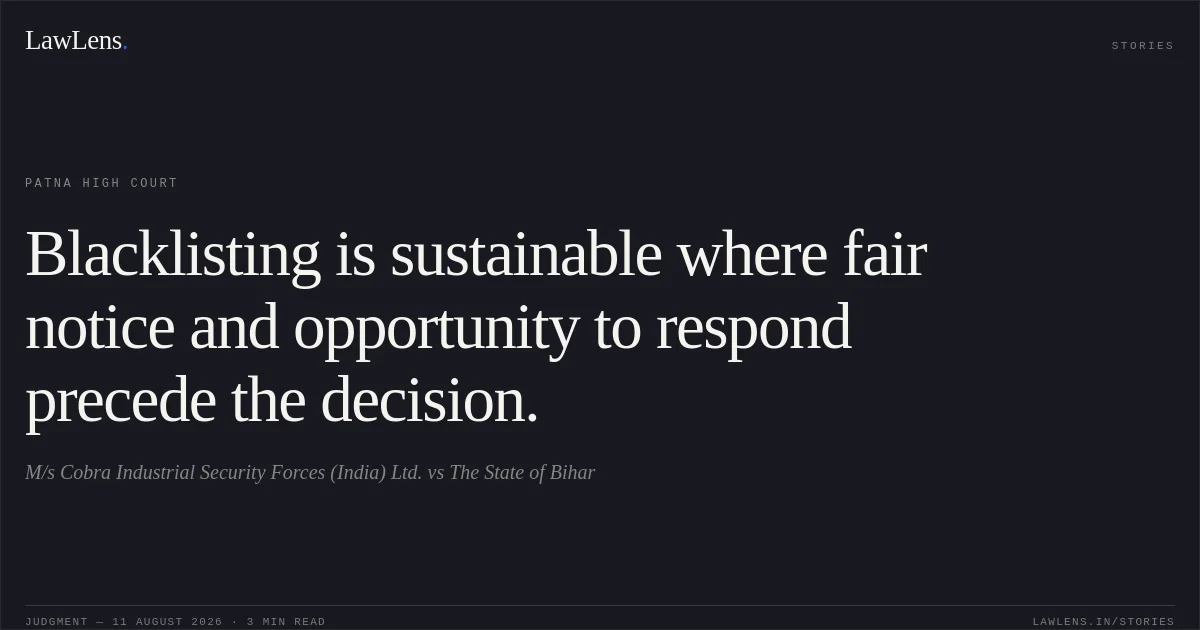
M/s Cobra Industrial Security Forces (India) Ltd.vsThe State of Bihar
Click to open original judgment
Original judgment, available to read, download and summarize on LawLens.in