Facts
The petitioners were successful bidders for several water supply projects under the "Jal Jeevan Mission".
Source reference: p. 19After work orders were issued, Respondent authorities alleged that the petitioners had submitted a fake technical experience certificate purportedly issued by Respondent No. 6 (M/s Vijay V. Salunkhe/Municipal Council, Karad).
Source reference: p. 19, 25Following a previous round of litigation where show-cause notices were quashed for pre-determination, the Apex Committee conducted a fresh hearing on 02.12.2025.
Source reference: p. 21, 27The Committee maintained the cancellation of the contracts and blacklisted the petitioners for three years, citing the use of fabricated documents.
Source reference: p. 21, 28The petitioners challenged these orders, contending they were ready to complete the remaining 30-50% of the work and that there was conflicting evidence regarding the genuineness of the certificates in related criminal proceedings.
Source reference: p. 23, 33Issues
1. Whether the respondents were justified in terminating the contracts based on the alleged submission of fake experience certificates.
Source reference: p. 38, para. 222. Whether the penalty of blacklisting the petitioners for a period of three years was proportionate and legally sustainable in the absence of a conclusive finding of deliberate fraud.
Source reference: p. 39, para. 233. Whether the High Court should adjudicate contractual disputes regarding measurements and payments under Article 226.
Source reference: p. 42, para. 29Law Applied
The Court primarily applied the principles of administrative law regarding fairness and proportionality in blacklisting, as established in *Gorkha Security Services v. Government (NCT of Delhi)* (2014), which characterizes blacklisting as "civil death".
Source reference: p. 41, para. 26It further relied on *UMC Technologies Pvt. Ltd. v. Food Corporation of India* (2021) to emphasize the requirement of a particularized show-cause notice and the severe stigmatic consequences of debarment.
Source reference: p. 41, para. 27The Court also applied the doctrine that fraud vitiates a bidding process, justifying contract termination even if the discovery occurs post-award.
Source reference: p. 38, para. 22Reasoning
The Court reasoned that once the eligibility of a bidder is found to be based on misrepresentation (confirmed by the Municipal Council, Karad's denial of issuance), the employer is justified in cancelling the contract to protect the sanctity of public procurement.
Source reference: p. 38, para. 22However, regarding blacklisting, the Court found the State’s action disproportionate.
Source reference: p. 40, para. 24-25It noted that the petitioners claimed they relied on the certificate in good faith and that the Apex Committee failed to record a definitive finding of *mens rea* or deliberate fabrication by the petitioners themselves.
Source reference: p. 40, para. 24-25As the termination of the contract already neutralized the advantage gained from the doubtful certificate, the additional three-year debarment lacked a solid foundation of established culpability and failed the test of proportionality.
Source reference: p. 41, para. 28Regarding contractual dues and measurements, the Court determined these were factual disputes governed by the arbitration/dispute resolution clause (Clause 29) of the agreement, making writ jurisdiction inappropriate.
Source reference: p. 42, para. 29Holding
The Court partly allowed the petitions.
It upheld the respondents' decision to annul the contracts and proceed with re-tendering.
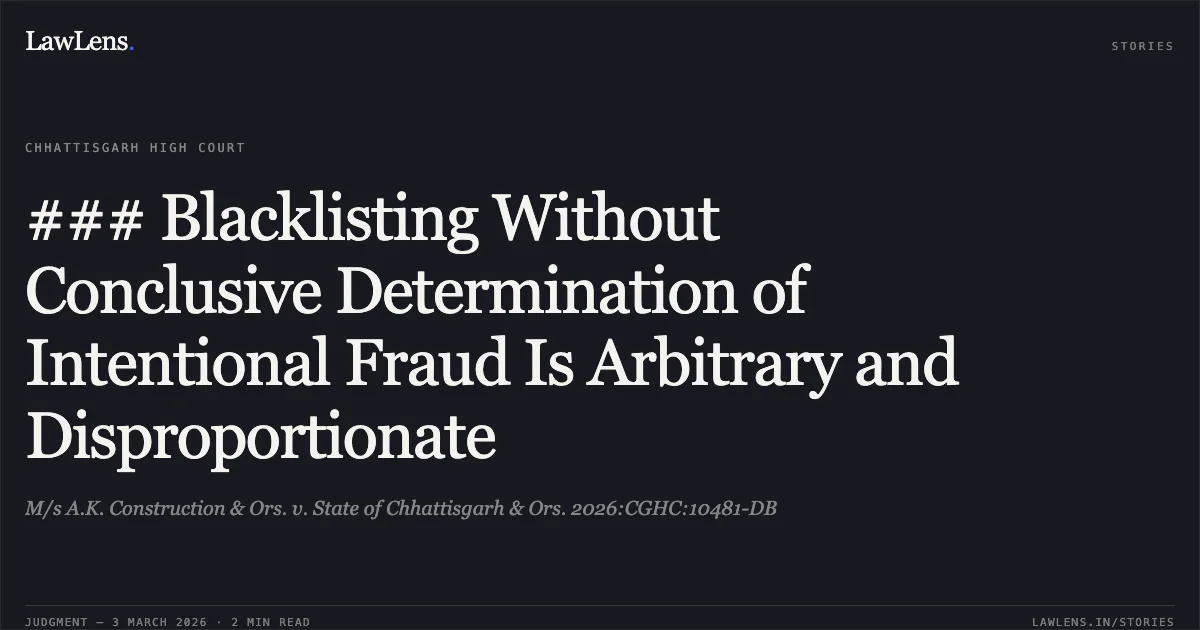
Source reference: p. 42, para. 28However, the Court quashed the direction blacklisting the petitioners for three years, holding it to be disproportionate in the absence of a conclusive finding of fraud.
Source reference: p. 42, para. 28All other contractual claims regarding payments and work valuation were left open for the petitioners to pursue via civil court or the internal dispute resolution mechanism.
Source reference: p. 43, para. 29Acts & Sections Cited
4 provisions across 1 statute referred to in this judgment. Each provision opens on LawLens.
Indian Penal Code, 18604
Original Court PDF
M/s A.K. Construction & Ors. v. State of Chhattisgarh & Ors. 2026:CGHC:10481-DB
Click to open original judgment
Original judgment, available to read, download and summarize on LawLens.in