Facts
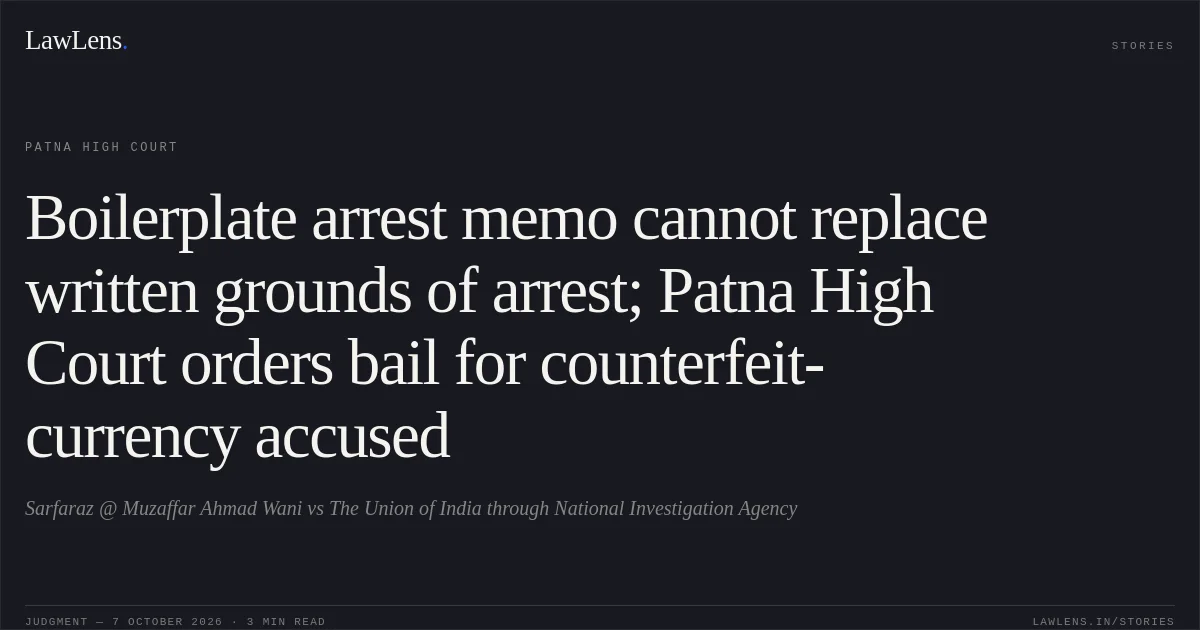
The appellant challenged the Special Judge, NIA’s rejection of his regular-bail application in a case concerning alleged counterfeit Indian currency and related offences.
Source reference: paras. 2–5; pp. 2–5He was arrested in Jammu and Kashmir on 12 September 2024; the arrest memo stated that he had been informed of the grounds of arrest and his legal rights, but the NIA could not produce any written grounds of arrest served on him.
Source reference: paras. 16–18; pp. 12–13After the High Court initially dismissed his appeal, the Supreme Court set aside that order and remitted the matter for consideration of the claim that written grounds of arrest had not been furnished.
Source reference: paras. 11–13; pp. 7–10On remand, the appellant relied on that non-furnishing; the hearing was confined to that issue.
Source reference: paras. 14–15; pp. 10–11Issues
Whether the appellant’s arrest and subsequent remand were rendered illegal because written grounds of arrest were not furnished to him in the time and manner required by Article 22(1) of the Constitution
Source reference: paras. 15, 36–40; pp. 11, 26–29Whether the alleged non-compliance entitled the appellant to release on bail notwithstanding the statutory restrictions applicable to the case
Source reference: paras. 20, 36, 40–41; pp. 14–15, 26, 29Law Applied
Article 22(1), read with Article 21 of the Constitution, requires that an arrested person be effectively informed of the grounds of arrest; where non-compliance is alleged, the investigating agency bears the burden of proving compliance, and established non-compliance vitiates the arrest and remand and may justify release despite statutory bail restrictions (Vihaan Kumar v. State of Haryana, as quoted at para. 20, pp. 14–15).
Source reference: para. 20; pp. 14–15The Court applied the rule in Mihir Rajesh Shah v. State of Maharashtra that written grounds must be furnished within a reasonable time and, in any event, at least two hours before production for remand; a pro forma arrest-memo statement that grounds were explained does not itself establish compliance.
Source reference: paras. 28–31, 36–37; pp. 20–23, 26–28The Court also relied on Ahmed Mansoor v. State to distinguish State of Karnataka v. Sri Darshan, which concerned different facts, including evidence that the accused knew the reasons for arrest and had promptly sought bail.
Source reference: paras. 27, 32–35; pp. 18–20, 24–26The judgment further referred to Section 50 of the CrPC and the corresponding BNSS provisions, Sections 47 and 48.
Source reference: para. 36(i), (iii); p. 27Reasoning
The arrest memo contained only a standard-form assertion that the appellant had been informed of the grounds of arrest; the NIA produced no separate written grounds despite being given time to do so.
Source reference: paras. 16, 18, 37–38; pp. 12–13, 27–28The transit-remand record likewise did not show that written grounds had been served before production, and the Magistrate had not verified compliance with the constitutional safeguard.
Source reference: para. 39; p. 28The Court found that the State had not established that the appellant understood the grounds or had an effective opportunity to oppose remand; it therefore distinguished Sri Darshan, where the record showed awareness of the accusations and prompt legal action.
Source reference: paras. 32–35; pp. 24–26Applying Mihir Rajesh Shah, the Court concluded that the arrest could not be sustained.
Source reference: paras. 37–40; pp. 27–29Holding
The Court held that the appellant had established a basis for interference because written grounds of arrest had not been shown to have been furnished in accordance with the constitutional mandate.
It allowed the appeal, set aside the impugned order, and directed that the appellant be released on bail forthwith upon furnishing bail bonds to the satisfaction of the trial court, which could impose appropriate conditions to secure his attendance.
Source reference: paras. 41–43; pp. 29–30Acts & Sections Cited
25 provisions across 6 statutes referred to in this judgment. Each provision opens on LawLens.
National Investigation Agency Act, 20081
Bharatiya Nyaya Sanhita, 2023
Unlawful Activities (Prevention) Act, 19674
Bharatiya Nagarik Suraksha Sanhita, 20233
Code of Criminal Procedure, 19732
Indian Penal Code, 18602
Original Court PDF
Sarfaraz @ Muzaffar Ahmad WanivsThe Union of India through National Investigation Agency
Click to open original judgment
Original judgment, available to read, download and summarize on LawLens.in