01Facts
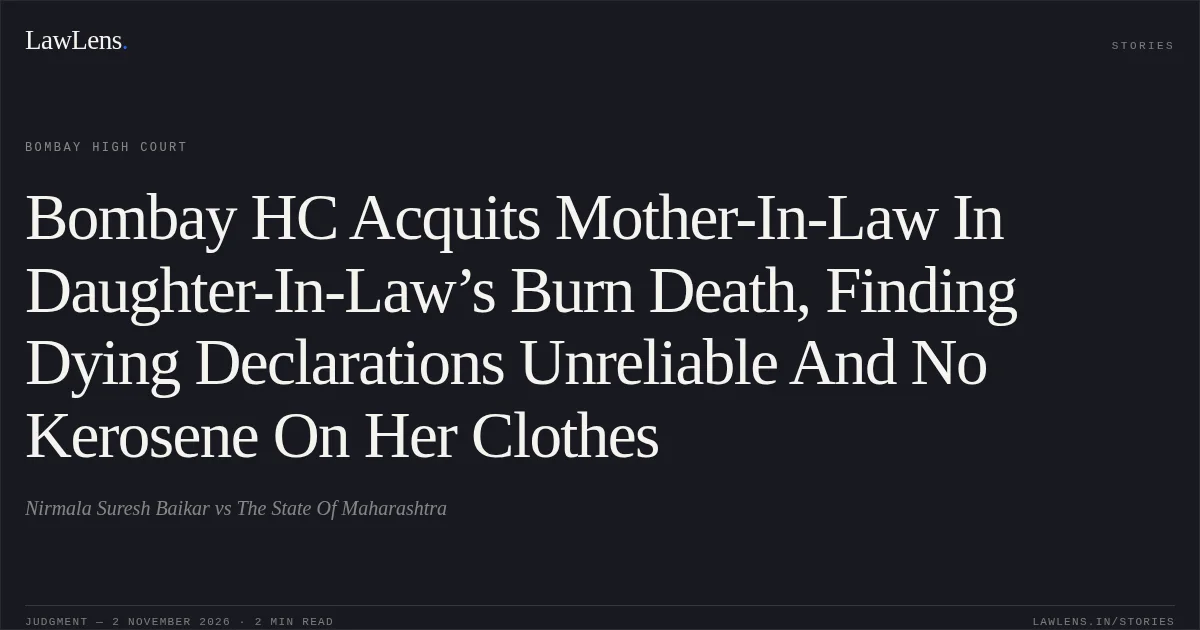
The appellant was convicted under Section 302 of the Indian Penal Code (IPC) for allegedly setting her daughter-in-law, Priyanka, on fire, and sentenced to life imprisonment.
pp. 1–3The appellant’s son, who was also charged, was acquitted.
pp. 1–3The prosecution relied principally on two written dying declarations recorded on the day of the incident, both implicating the appellant.
pp. 1–3A later video-recorded statement implicated both the appellant and her son; the trial court disbelieved it.
pp. 1–3The High Court also considered the evidence of a neighbour who saw the victim after the incident, medical evidence, and chemical analysis showing no kerosene traces on the appellant’s clothes.
pp. 8–9 · pp. 14–1702Issues
i.1. Whether the written dying declarations were sufficiently reliable to sustain the appellant’s conviction under Section 302 IPC
pp. 18–20 · pp. 21–24ii.2. Whether the evidence as a whole proved the appellant’s guilt beyond reasonable doubt
pp. 23–2503Law Applied
The Court considered the offence of murder under Section 302 IPC and the prosecution’s obligation to prove guilt beyond reasonable doubt.
p. 1 · p. 25In assessing the dying declarations, it examined whether the declarant was fit to make a statement and whether the declarations were credible and consistent; the Court treated a medical endorsement that a patient could give a “verbal statement” as insufficient, in the circumstances, to establish mental fitness.
pp. 21–23The final release direction referred to Section 481 of the Bharatiya Nagarik Suraksha Sanhita, 2023, requiring a bond in case an appeal against acquittal is preferred.
p. 26Provisions in the judgment · 4 · Linked ones open on LawLens
Code of Criminal Procedure, 1973 Section 428
Indian Penal Code, 1860 Section 307Section 34
Bharatiya Nagarik Suraksha Sanhita, 2023 Section 481
04Reasoning
The Court declined to rely on the first written declaration because its detailed narrative and repetition of the account, including the naming of persons allegedly present, indicated that it was not recorded in the victim’s exact words.
pp. 20–21It found the second declaration unreliable because the doctor’s endorsement did not establish the victim’s mental fitness or specify when the endorsement was made, and the SEM did not record an independent assessment of fitness.
pp. 22–23The account in that declaration was also inconsistent with the neighbour’s evidence that the appellant’s son was present and the appellant was not seen, and the absence of kerosene on the appellant’s clothes further supported reasonable doubt.
pp. 23–25The Court agreed with the trial court’s rejection of the video-recorded declaration and considered the relatives’ oral declarations unsafe to rely on, given the relatives’ involvement and the concerns surrounding the video statement.
pp. 20–2105Holding
The High Court held that the prosecution had not proved the appellant’s guilt beyond reasonable doubt and allowed the appeal.
p. 25It set aside the conviction and sentence, acquitted the appellant, and directed her release forthwith unless required in another case.
p. 26Before release, she was to execute a ₹15,000 bond under Section 481 of the BNSS, 2023, for appearance if an appeal against acquittal was preferred.
p. 26Original Court PDF
Nirmala Suresh BaikarvsThe State Of Maharashtra
Click to open original judgment
Original judgment, available to read, download and summarize on LawLens.in