Facts
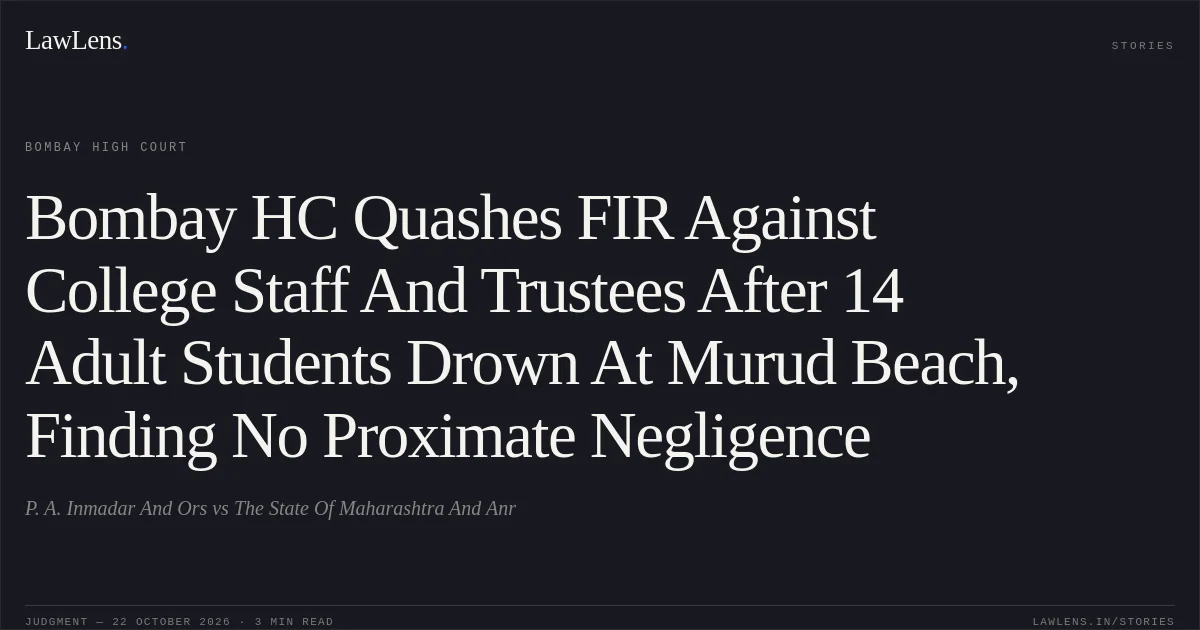
On 1 February 2016, Abeda Inamdar Senior College organised a picnic to Murud beach for 116 students and accompanying staff. Forty-one third-year students later entered the sea; 14 drowned.
Source reference: para. 2–3.1Following an initial accidental-death inquiry, Murud Police registered FIR No. 24 of 2016 under Sections 304A and 34 of the Indian Penal Code against college trustees and employees approximately 80 days after the incident.
Source reference: para. 2–3.1The applicants sought quashing of the FIR under Section 482 of the Code of Criminal Procedure.
Source reference: para. 3The applicants included trustees and the in-charge Principal, staff who accompanied first- and second-year students, and staff who accompanied the third-year students.
Source reference: para. 5.1–5.2, 9–11Issues
Whether the FIR disclosed a prima facie offence under Section 304A IPC against the trustees, Principal and staff who accompanied the first- and second-year students, given their alleged lack of a direct or proximate role in the deaths.
Source reference: para. 9–10, 34Whether the staff accompanying the third-year students could be criminally liable under Section 304A IPC for the students’ drowning, having regard to the students’ age, the alleged omissions in supervision, and the requirement of gross negligence and direct causal connection.
Source reference: para. 11–13, 22, 27Whether the State should take measures to improve safety at public beaches to prevent similar incidents.
Source reference: para. 23, 28–32Law Applied
Section 482 CrPC empowers the High Court to quash criminal proceedings where the allegations and material do not disclose an offence or continuation of the proceedings would amount to abuse of process; the Court referred to the categories in State of Haryana v. Bhajan Lal.
Source reference: para. 4.1Section 304A IPC requires a rash or negligent act that is the direct and proximate, or causa causans, cause of death; criminal negligence must be gross or of a very high degree, beyond the negligence sufficient for civil liability, as explained in Emperor v. Omkar Rampratap, Kurban Hussein Mohamedalli Rangawalla v. State of Maharashtra and Jacob Mathew v. State of Punjab.
Source reference: para. 19, 24The Court also considered M.S. Grewal v. Deep Chand Sood on duty of care and vicarious liability, including the relevance of the relationship and course of employment, and Melvin Kumar v. K.S. Harisha concerning deaths at a swimming facility.
Source reference: para. 20–22, 25–26.1The Court distinguished the heightened supervision owed to minors from the supervision expected in this case, where the students were adults.
Source reference: para. 15–16, 22, 27Reasoning
The Court found no material connecting the trustees and Principal with a specific negligent act that directly or proximately caused the deaths; their absence from the picnic was relevant to that conclusion.
Source reference: para. 9.1It likewise found no basis to attribute negligence to staff accompanying first- and second-year students, who were supervising different groups.
Source reference: para. 10As to the third-year students’ accompanying staff, the Court acknowledged that they had not gone with the students to the beach when the group revisited it, but concluded that the record did not establish a specific grossly negligent act with the necessary causal connection to the drownings.
Source reference: para. 11–13, 17–18, 33It treated the students’ adulthood and their decision to enter the sea as material to the degree of supervision required, and characterised the deaths as an accident rather than the direct and proximate result of criminal negligence by the applicants.
Source reference: para. 12–13, 27, 33Separately, the Court emphasised the need for public-beach warnings, lifeguards, rescue facilities and other safety measures.
Source reference: para. 28–32Holding
The Court held that the material did not establish a prima facie case of criminal negligence under Section 304A IPC against any applicant and allowed all four applications.
It quashed and set aside FIR No. 24 of 2016 under Section 304A read with Section 34 IPC.
Source reference: para. 34–36The Court also directed that a copy of the judgment be sent to the State Chief Secretary and requested consideration of the beach-safety measures discussed in the judgment.
Source reference: para. 29, 32Acts & Sections Cited
3 provisions across 3 statutes referred to in this judgment. Each provision opens on LawLens.
Code of Criminal Procedure, 19731
Indian Penal Code, 18601
Motor Vehicles Act, 19881
Original Court PDF
P. A. Inmadar And OrsvsThe State Of Maharashtra And Anr
Click to open original judgment
Original judgment, available to read, download and summarize on LawLens.in