01Facts
The appellant sought probate of her mother Shantaben Ambalal Patel’s Will dated 24 May 1989, which left her estate to the appellant and excluded the deceased’s son, Prithviraj, and his family.
¶ 4–8Prithviraj challenged the Will’s execution and alleged forgery, undue influence and unnatural disposition; he also propounded a later Will dated 9 March 1990.
¶ 4–8The Single Judge dismissed both probate suits, finding the later Will unproved and rejecting the appellant’s claim concerning the 1989 Will as suspicious and unnatural.
¶ 9, 22–28The appellant appealed the dismissal of her suit; the finding against the 1990 Will was not appealed and had attained finality.
¶ 29, 4502Issues
i.1. Whether the circumstances surrounding execution of the 24 May 1989 Will were suspicious.
¶ 44(I)ii.2. Whether the Will was validly executed.
¶ 44(II)iii.3. Whether the appellant procured the Will by undue influence, coercion or fraud.
¶ 44(III)iv.4. Whether exclusion of Prithviraj and his family made the Will unnatural or raised suspicion about its execution.
¶ 44(IV)v.5. Whether the Single Judge’s judgment and decree dismissing the appellant’s suit required appellate interference.
¶ 44(V)03Law Applied
Section 59 of the Indian Succession Act, 1925 permits a person of sound mind, not a minor, to dispose of property by Will; under Section 61, a Will is void if its making was caused by fraud, coercion or importunity that takes away the testator’s free agency. Illustrations (vii) and (viii) to Section 61 establish that persuasion, attention or flattery does not invalidate a Will if the testator retains free judgment and volition.
¶ 31–32, 51A Will required by law to be attested must be proved in accordance with Section 68 of the Indian Evidence Act, 1872, by calling at least one available attesting witness.
¶ 19, 33, 46Exclusion of natural heirs, without more, is not a suspicious circumstance; the propounder must dispel real and germane suspicious circumstances, and the Court must assess the cumulative effect of relevant factors to determine whether the Will represents the testator’s free wish [*Uma Devi Nambiar v. T.C. Sidhan*, para. 57; *Parvathi Nairthi v. Laxmi Nairthy*, para. 56; *Kavita Kanwar v. Pamela Mehta*, para. 61].
¶ 56–61Influence or persuasion is not “undue” absent loss of testamentary capacity or fraud or coercion [*Naresh Charan Das Gupta v. Paresh Charan Das Gupta*].
¶ 55Provisions in the judgment · 2 · Linked ones open on LawLens
Indian Succession Act, 1925 Section 59Section 61
04Reasoning
The attesting witness, an advocate who knew the testatrix, gave evidence that she independently instructed him, that the Will was read and explained to her in Gujarati, and that he witnessed her sign it; the Court found his evidence credible and sufficient to prove execution.
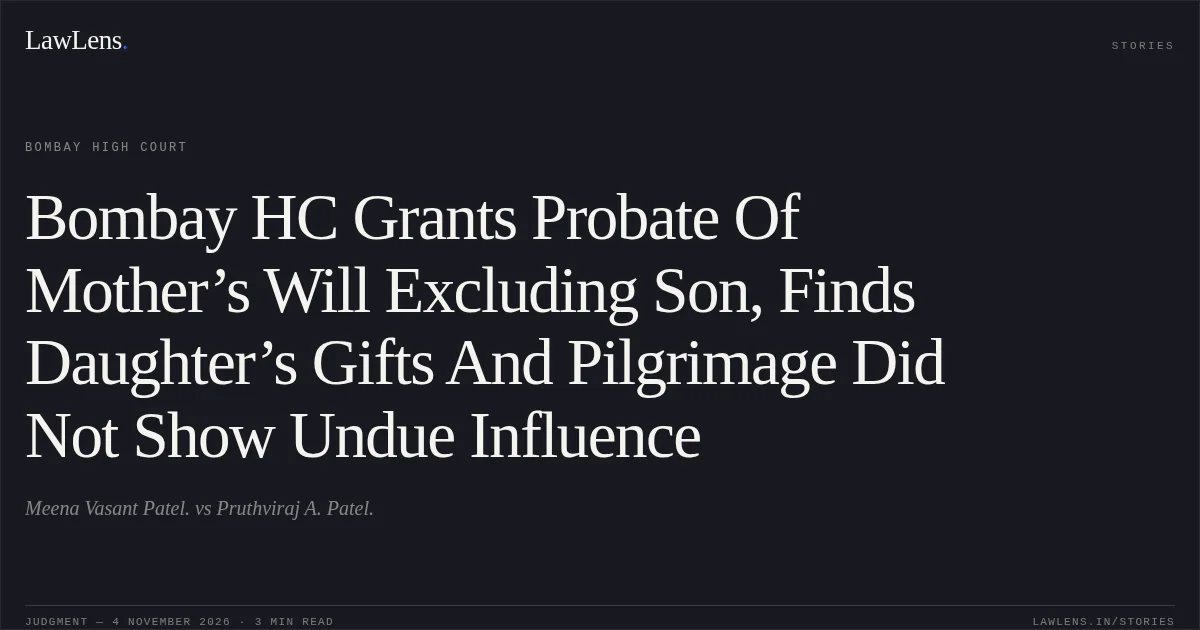
¶ 46–49The appellant’s presence at the solicitor’s office, gifts to her mother, pilgrimage with her and assistance in obtaining a passport did not establish pressure or interference in preparation or execution of the Will. Applying Section 61 and its illustrations, the Court held that such conduct did not negate the testatrix’s free agency.
¶ 50–55The testatrix’s stated reasons for excluding her son were her own reasons; the appellant was not required to prove their factual correctness. Exclusion of the son and grandchildren, without other circumstances undermining genuineness or execution, did not invalidate the Will.
¶ 56–6205Holding
The Court held that the Will was validly executed, that its execution was not surrounded by suspicious circumstances, and that the appellant had not procured it by undue influence, coercion or fraud.
¶ 63It allowed the appeal, set aside the decree dismissing Testamentary Suit No. 48 of 1990, and granted probate of Shantaben’s Will dated 24 May 1989.
¶ 64Original Court PDF
Meena Vasant Patel.vsPruthviraj A. Patel.
Click to open original judgment
Original judgment, available to read, download and summarize on LawLens.in