01Facts
MUDA’s officer lodged a complaint alleging that land in Sy. No. 97, Nachanahalli, had been acquired by MUDA and that the title documents offered by the borrower, Shivayogi, for a loan were therefore invalid.
pp. 3–7HDFC had advanced a loan against the property, later enforced its security under the SARFAESI Act, and auctioned the property after default.
pp. 3–7The complaint led to registration of Crime No. 24/2021 under Sections 420, 468 and 471 IPC against the petitioners and two others.
pp. 3–7HDFC and its authorised officer sought to quash the complaint and FIR insofar as they were concerned, submitting that they had relied on title documents and a legal opinion
pp. 3–702Issues
i.1. Whether the criminal proceedings under Sections 420, 468 and 471 IPC should be quashed against HDFC and its authorised officer where the bank had relied on documents depicting the borrower’s title and had enforced its security in good faith.
pp. 8–10ii.2. Whether the competing claims concerning acquisition of the land and the validity of the borrower’s title should be determined in the criminal proceedings or before the jurisdictional Civil Court.
pp. 8–903Law Applied
The petition invoked Articles 226 and 227 of the Constitution and Section 482 of the CrPC as the bases for seeking quashing of the complaint and FIR.
pp. 2–3The alleged offences were under Sections 420, 468 and 471 IPC, while the bank’s enforcement and auction were undertaken under the SARFAESI Act.
pp. 3–6The Court treated the dispute over acquisition and title as one for determination by the jurisdictional Civil Court and held, on the circumstances before it, that the bank’s good-faith reliance on documents depicting title and its resort to statutory recovery measures did not warrant continuation of the criminal proceedings against the petitioners.
pp. 8–10Provisions in the judgment · 4 · Linked ones open on LawLens
Code of Criminal Procedure, 1973 Section 482
Indian Penal Code, 1860 Section 420Section 468Section 471
04Reasoning
The Court considered it premature to determine whether Dasabhovi had been notified before acquisition of the land and whether the security was consequently invalid; those questions required adjudication by the Civil Court.
pp. 8–9However, the documents placed before HDFC, together with the legal opinion, depicted title in Dasabhovi.
pp. 9–10The Court found that HDFC had acted in good faith by accepting the property as security and enforcing it under the SARFAESI Act, and that its recovery action could not, on those facts, be characterised as criminal conduct attracting the alleged offences.
pp. 9–10The authorised officer was acting on behalf of the bank and was likewise not to face the proceedings.
pp. 9–1005Holding
The petition was allowed, and the FIR in Crime No. 24/2021 was quashed insofar as HDFC and its authorised officer were concerned.
p. 10The order did not preclude proceedings against the remaining accused or prevent MUDA from pursuing its rights concerning the acquired land before the jurisdictional Civil Court.
pp. 10–11Original Court PDF
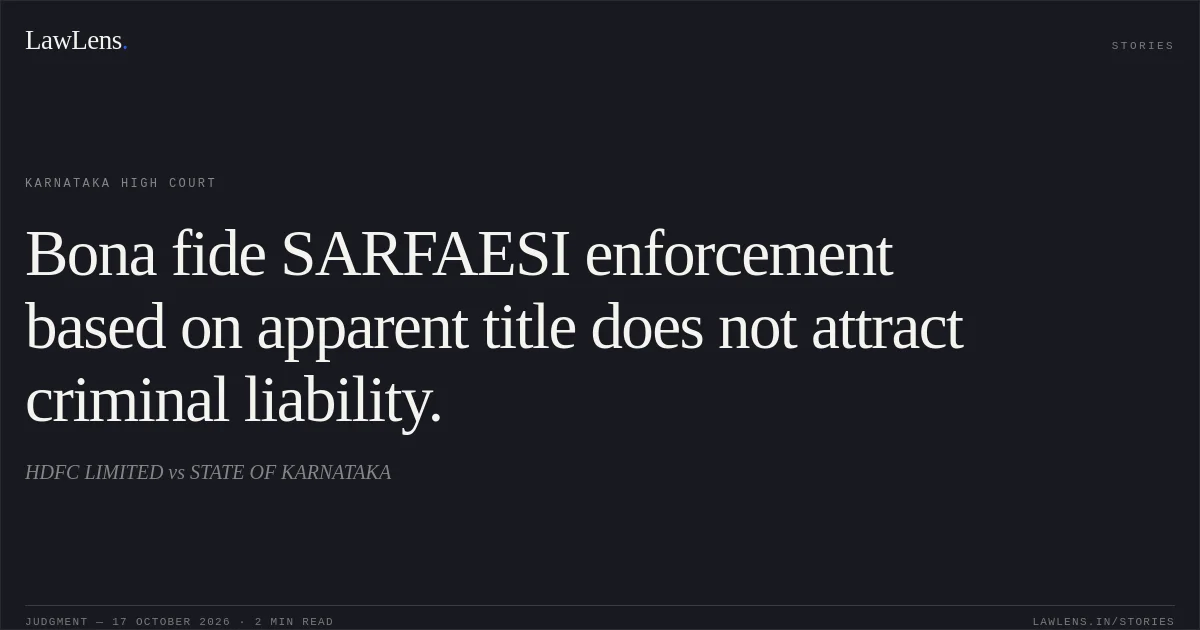
HDFC LIMITEDvsSTATE OF KARNATAKA
Click to open original judgment
Original judgment, available to read, download and summarize on LawLens.in