01Facts
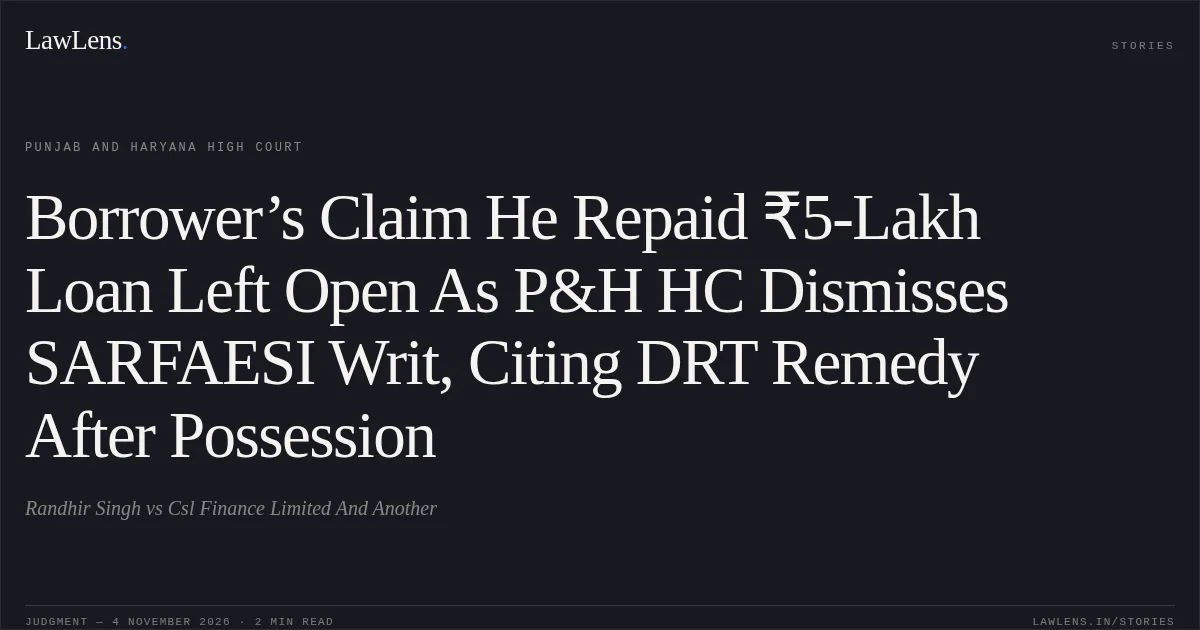
The petitioner and two co-borrowers obtained a secured loan of ₹5,00,000 from CSL Finance Limited in 2018, secured by a mortgage over the petitioner’s residential property.
pp. 2–4After the account was classified as a non-performing asset, the respondents issued a demand notice under Section 13(2) of the SARFAESI Act seeking payment of ₹21,55,689.
pp. 2–4The petitioner disputed the amount, asserting that the loan had been repaid and raising objections concerning payments, interest, charges, limitation, and missing loan records.
pp. 2–4The writ petition was filed against the demand notice before any measure under Section 13(4) had been taken.
pp. 2–4During its pendency, the respondents issued a possession notice recording that symbolic possession had been taken.
pp. 2–4The petitioner’s application to place that notice on record was allowed.
p. 202Issues
i.Whether the petitioner’s challenge to the SARFAESI demand notice was maintainable under Articles 226/227 when the statutory remedy under Section 17 was available.
pp. 4–7ii.Whether the petitioner had established exceptional circumstances warranting writ-court interference, given that symbolic possession had since been taken and the petitioner’s objections could be raised before the Tribunal.
p. 703Law Applied
Section 13(2) of the SARFAESI Act provides for a demand notice to the borrower, while measures taken under Section 13(4) may be challenged through an application under Section 17 before the Debts Recovery Tribunal.
pp. 4–6The availability of this efficacious statutory remedy ordinarily weighs against entertaining a writ petition challenging a secured creditor’s SARFAESI action.
pp. 4–6Relying on Phoenix ARC Private Limited v. Vishwa Bharati Vidya Mandir, (2022) 5 SCC 345, the Court reiterated that a borrower aggrieved by action under the Act should ordinarily pursue the remedy under Section 17 rather than invoke Article 226.
pp. 4–6Provisions in the judgment · 3 · Linked ones open on LawLens
Securitisation and Reconstruction of Financial Assets and Enforcement of Security Interest Act, 2002 Section 13Section 17
Negotiable Instruments Act, 1881 Section 138
04Reasoning
Although the petition initially challenged only the Section 13(2) demand notice, the respondents took symbolic possession during its pendency, making the Section 17 remedy available to the petitioner.
p. 7The petitioner’s objections about repayment, calculation of dues, and limitation required examination of the loan record and could be adjudicated by the Tribunal.
p. 7The dismissal for non-prosecution of earlier proceedings did not, by itself, establish that the loan had been discharged.
p. 7The Court found no exceptional circumstance justifying writ intervention and left the merits open for consideration through the statutory process.
p. 705Holding
The Court held that no exceptional basis for exercising its extraordinary writ jurisdiction had been shown and dismissed the writ petition because the petitioner had not pursued the statutory remedy before the Tribunal.
p. 7All questions on the merits were left open.
p. 7Original Court PDF
Randhir SinghvsCsl Finance Limited And Another
Click to open original judgment
Original judgment, available to read, download and summarize on LawLens.in