01Facts
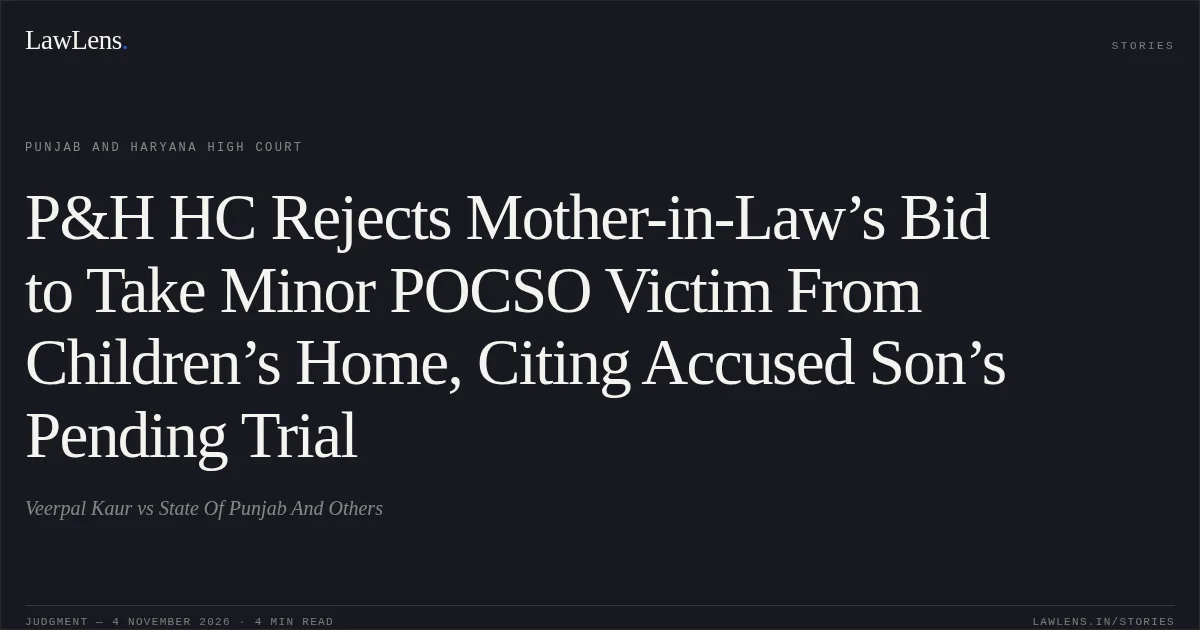
The petitioner sought a writ of habeas corpus for release of a minor girl and her infant daughter from Gandhi Vanita Ashram, Jalandhar, where they had been placed by the Child Welfare Committee (CWC).
pp. 2–5The girl, whose school record recorded her date of birth as 12 May 2009, was recovered with the petitioner’s son, against whom charges had been framed under Section 64 of the Bharatiya Nyaya Sanhita, 2023 (BNS) and Section 6 of the Protection of Children from Sexual Offences Act, 2012 (POCSO Act), among other provisions.
pp. 2–5The petitioner claimed that the girl had married her son, wished to live with the petitioner, and had expressed that wish both to the CWC and to the High Court.
pp. 2–5The petitioner filed the petition more than seven months after the CWC’s placement order; she did not produce that order or seek its quashing, and had not appealed under the Juvenile Justice (Care and Protection of Children) Act, 2015 (JJ Act).
pp. 2–5, 9–10The girl remained a child under the JJ Act and POCSO Act and was due to attain majority on 12 May 2027.
p. 502Issues
i.Whether habeas corpus could issue where the minor was residing in a Children Home pursuant to a CWC order, absent a showing that the order was without jurisdiction or wholly illegal.
pp. 5–10ii.Whether, notwithstanding the girl’s stated wish to live with the petitioner, her custody should be transferred to the petitioner in the girl’s best interests.
pp. 10–1403Law Applied
Under Articles 226 and 227 of the Constitution, habeas corpus is available to secure release from illegal detention; it ordinarily does not lie where custody rests on an order of a competent authority unless that order is prima facie without jurisdiction, mechanical, or wholly illegal (*Manubhai Ratilal Patel through Ushaben v. State of Gujarat*, (2013) 1 SCC 314).
pp. 6–7Under the JJ Act, the CWC has statutory responsibility for children in need of care and protection: Sections 27 and 29 establish its constitution and authority; Section 2(14) includes sexually abused or at-risk children; and Section 37 permits protective placement after inquiry, taking account of the child’s wishes where the child is sufficiently mature. An aggrieved person may appeal under Section 101.
pp. 6–9The child’s welfare and safety are paramount under Section 3 of the JJ Act; the child’s wishes merit consideration but are not determinative.
p. 11The Full Bench ruling in *Km. Rachna v. State of U.P.*, AIR 2021 Allahabad 109 (FB), held that placement by a CWC cannot be treated as illegal detention for habeas purposes and that the child’s wishes must be considered within the Section 37 framework.
pp. 7–9The Court also relied on *Harish v. State of Haryana*, CRWP-1381-2025, decided 15 February 2025, concerning custody under a CWC order.
p. 9Provisions in the judgment · 20 · Linked ones open on LawLens
Bharatiya Nyaya Sanhita, 2023 Section 61Section 64Section 87Section 137
Protection of Children from Sexual Offences Act, 2012 Section 2Section 6Section 8Section 19
Bharatiya Nagarik Suraksha Sanhita, 2023 Section 183
Code of Criminal Procedure, 1973 Section 164
Juvenile Justice (Care and Protection of Children) Act, 2015. Section 2Section 3Section 27Section 29Section 37Section 101
Indian Penal Code, 1860 Section 363Section 365Section 379Section 506
04Reasoning
The girl was under 18, and her placement in the Children Home rested on an order of the competent CWC. The petitioner neither established that the order was jurisdictionally defective or wholly illegal nor pursued the statutory appeal; the alleged failure to provide a copy did not itself make the placement unlawful.
pp. 9–10The Court considered the girl’s wish to live with the petitioner but held that it did not displace the statutory best-interests inquiry.
pp. 10–14The petitioner was the mother of the accused, who lived with her, and the girl was the victim and a material witness in a pending POCSO trial. The Court found the State’s concern that the girl could be influenced if returned to the accused’s family to be substantial.
pp. 10–14No material established the alleged marriage, and even if one were assumed, it would not remove the girl from the JJ Act’s protective scheme. The circumstances therefore differed materially from *Preeti* and *Chhalo Rani*, where custody had been transferred to a mother-in-law.
pp. 10–14The record did not indicate that the girl or her infant was being denied proper care in the Children Home.
p. 1205Holding
The Court dismissed the habeas petition as devoid of merit.
pp. 14–16It directed the Children Home to provide the girl and her infant daughter proper care, medical attention, counselling, and education or vocational training.
pp. 14–16The petitioner or the girl may seek review before the CWC or appeal under Section 101 of the JJ Act; any such proceeding must consider the girl’s wishes, the Social Investigation Report, and other relevant circumstances, including the pending trial.
pp. 14–16On attaining majority, the girl may decide her place of residence in accordance with law. The Court made no observation on the merits of the criminal trial.
pp. 14–16Original Court PDF
Veerpal KaurvsState Of Punjab And Others
Click to open original judgment
Original judgment, available to read, download and summarize on LawLens.in