01Facts
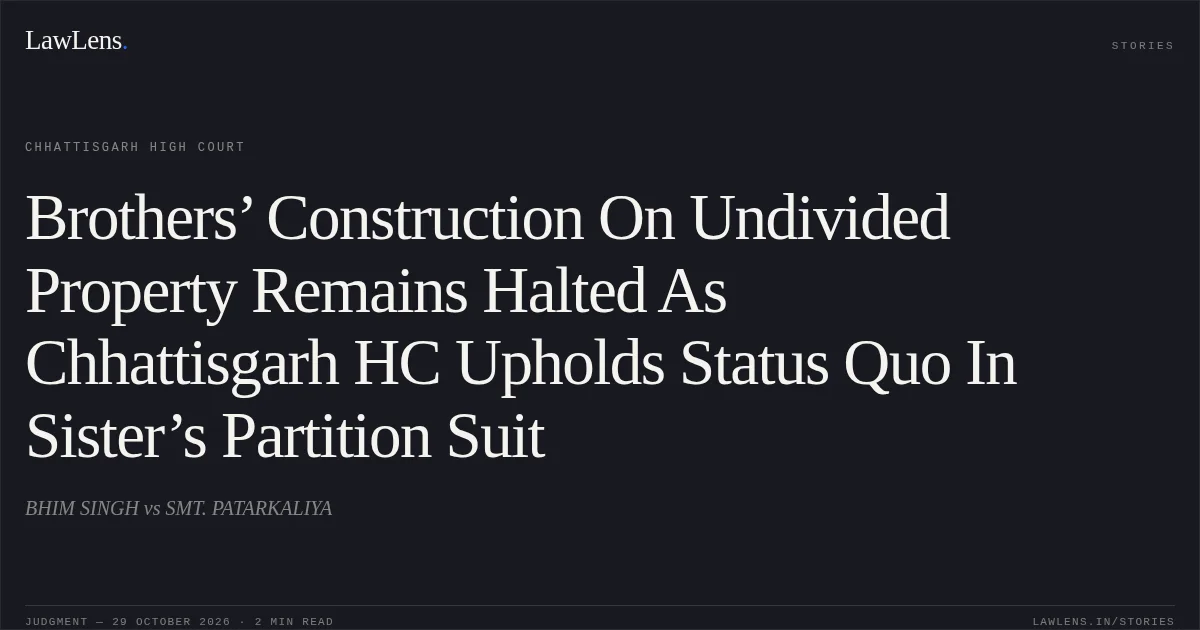
Respondent No. 1 brought a civil suit seeking declaration of title, partition, separate possession of her claimed one-seventh share in ancestral property, and permanent injunction.
¶ 2–4Petitioners, defendants No. 1 to 3 and co-sharers, began residential construction on part of the property. The trial court rejected the plaintiff’s application under Order 39 Rules 1 and 2 CPC; on appeal, the Principal District Judge partly allowed the appeal and directed the parties to maintain status quo over the suit property. The petitioners challenged that order under Article 227, seeking to complete the ongoing construction
¶ 2–402Issues
i.Whether the appellate court’s direction to maintain status quo over the suit property warranted interference under Article 227
¶ 2, 6ii.Whether the petitioners could continue construction on a specific part of the undivided property before partition by metes and bounds
¶ 3–4, 603Law Applied
Article 227 of the Constitution permits supervisory interference with a subordinate court’s order where there is, among other grounds, jurisdictional error; it does not warrant interference merely because another view might be possible.
¶ 2, 6Under Order 39 Rules 1 and 2 CPC, interim injunction relief is considered to protect the subject matter and the parties’ interests pending suit.
¶ 2, 6Where property remains undivided, a co-sharer cannot claim entitlement to a specific portion before partition by metes and bounds; construction on such a portion may complicate determination of the parties’ rights. No precedent was cited by the Court
¶ 2, 604Reasoning
The plaintiff claimed a share in ancestral property, and the parties’ respective shares and entitlement to specific portions had not yet been determined through partition. The Court therefore considered that permitting construction on a particular part could complicate the eventual decision in the suit.
¶ 3, 6–7The appellate court’s status quo direction protected the property and the parties’ interests, and the High Court found no infirmity or jurisdictional error justifying supervisory interference. It nevertheless addressed the petitioners’ asserted hardship by directing expedited trial proceedings
¶ 3, 6–705Holding
The High Court declined to interfere with the appellate court’s status quo order and disposed of the writ petition.
¶ 6–9It directed the trial court to expedite Civil Suit No. 06A/2024 and decide it as early as possible, preferably within six months from the next date fixed before it, in accordance with law and after giving the parties a proper opportunity of hearing
¶ 6–9Original Court PDF
BHIM SINGHvsSMT. PATARKALIYA
Click to open original judgment
Original judgment, available to read, download and summarize on LawLens.in