01Facts
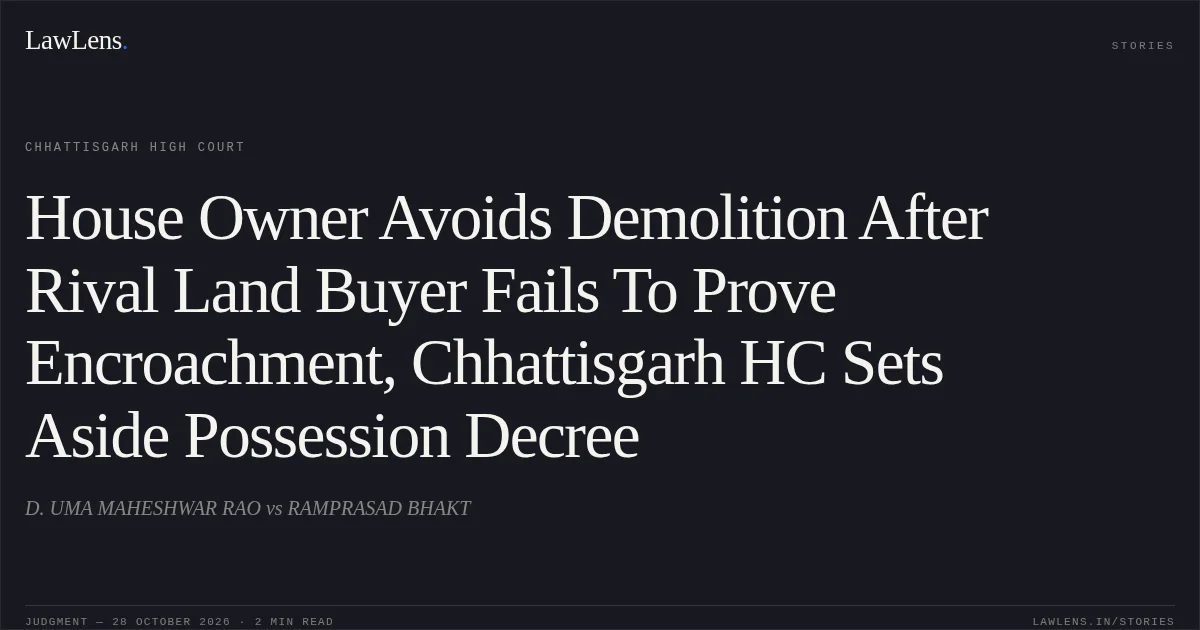
The plaintiff claimed to have purchased 1,755 sq. ft. of land bearing Khasra No. 67/10 under a registered sale deed dated 22 April 2004. He alleged that the defendant had encroached on that land by constructing a house. The defendant maintained that his house stood on a different parcel, Khasra No. 67/15, which he had purchased under a registered sale deed dated 23 August 2006.
¶ 3–6The trial court decreed the suit, declaring the plaintiff’s title and ordering vacant possession after demolition of the house, as well as permanent injunction. The defendant appealed under Section 96 CPC.
¶ 10 · ¶ 102Issues
i.Whether the defendant constructed his house on, and thereby encroached upon, the plaintiff’s land bearing Khasra No. 67/10.
¶ 11, 22ii.Whether the plaintiff was entitled to vacant possession after demolition of the house and to permanent injunction.
¶ 11iii.Whether the trial court’s judgment and decree warranted appellate interference.
¶ 1103Law Applied
Under Sections 101–103 of the Indian Evidence Act, 1872, the party seeking relief bears the burden of proving its own case; a weakness in the opposing party’s case does not, by itself, establish entitlement to relief (Vasavi Co-operative Housing Society Ltd. v. Union of India, (2014) 2 SCC 269).
¶ 24–27A first appeal under Section 96 read with Order XLI Rule 31 CPC permits rehearing on fact and law and requires the appellate court to independently assess the evidence and record reasoned findings (Shasidhar v. Ashwini Uma Mathad, (2015) 11 SCC 269).
¶ 23A claimant seeking possession based on alleged encroachment must establish that the defendant occupies the specific land claimed; the identity and extent of the alleged encroachment must be proved by reliable evidence.
The judgment also considered Order VII Rule 7 CPC in relation to pleading the extent of the alleged encroachment.
¶ 45Provisions in the judgment · 1 · Linked ones open on LawLens
Code of Civil Procedure, 1908 Section 96
04Reasoning
The Court accepted that the plaintiff had produced a sale deed for Khasra No. 67/10, but held that this did not establish that the defendant’s house stood on that parcel.
¶ 27, 46The vendor evidence did not reliably identify the land, and the plaintiff’s vendor acknowledged that the land had been purchased without survey or adequate verification.
¶ 30–33The demarcation material was also insufficient: the defendant had not been shown to have received notice, no actual measurement of the occupied area was made, and the report proceeded on the land identified by the plaintiff.
¶ 38–39The Court further found discrepancies between the boundaries in the plaintiff’s vendors’ deeds and noted the absence of specific pleading or measurement of the alleged encroachment.
¶ 40–45Applying the rule that the plaintiff had to prove his own case, the Court concluded that the evidence did not establish the defendant’s occupation of the plaintiff’s land.
¶ 24–27, 45–4605Holding
The Court held that the plaintiff failed to prove that the defendant had encroached upon the land covered by the plaintiff’s sale deed and was therefore not entitled to possession or the consequential reliefs granted by the trial court.
¶ 46–47The appeal was allowed, the trial court’s judgment and decree were set aside, and the parties were ordered to bear their own costs.
¶ 48Original Court PDF
D. UMA MAHESHWAR RAOvsRAMPRASAD BHAKT
Click to open original judgment
Original judgment, available to read, download and summarize on LawLens.in