01Facts
The Appellant, a Section 25 company under the Companies Act, 1956, promotes gems and jewellery exports and organises the annual India International Jewellery Show ("IIJS") and "IIJS Signature" exhibitions in Mumbai.
¶ 1–2The Appellant's case is that these are pure business-to-business ("B2B") events, closed to the general public, where entry requires a scrutinised application and payment of an entry fee.
¶ 9Police licensing rules required an NOC from the Additional Collector under the Bombay Entertainments Duty Act, 1923 ("1923 Act").
¶ 3.1The Appellant paid sums under protest for IIJS 2011 and IIJS Signature 2012 while contending the events were outside the Act.
¶ 3.1–3.2The Additional Collector's Order dated 31.07.2012 held the Appellant liable for ₹97,09,500 for IIJS 2011, including a penalty on 919 surplus exhibitor passes.
¶ 4The Divisional Commissioner's Order dated 30.11.2012 held the events taxable under Section 2(a), recalculated the duty at ₹45,40,125, and ordered a partial refund.
¶ 6The Bombay High Court dismissed the Appellant's writ petition (W.P. No. 653 of 2013).
¶ 7, 9The Appellant then appealed to the Supreme Court.
02Issues
i.1. Whether the pure B2B trade exhibitions organised by the Appellant under the IIJS and IIJS Signature banners fall within the definition of "entertainment" under Section 2(a) of the Bombay Entertainments Duty Act, 1923, and are therefore exigible to duty under Section 3.
¶ 8ii.2. Whether the Appellant's entry-screening procedure and B2B character remove the events from the statutory net, given that entry is conditioned on payment.
¶ 9, 11, 12, 2003Law Applied
The Court applied the plain-meaning rule for taxing statutes and the principles on inclusive definitions.
Section 2(a) of the 1923 Act defines "entertainment" inclusively to cover "any exhibition, performance, amusement, game or sport to which persons are admitted for payment," subject to specified exclusions.
¶ 16Under Commissioner of Sales Tax v. Union Medical Agency, a definition clause governs unless the context repugnantly requires otherwise.
¶ 17(A)Under Bharat Coop. Bank v. Coop. Bank Employees Union, "includes" enlarges rather than exhausts the term, so the ordinary meaning is retained and extended.
¶ 17(B)Forest Range Officer v. P. Mohammed Ali holds that an inclusive definition should be applied to ambiguous words and does not displace the plain meaning of words that are clear.
¶ 18Geeta Enterprises v. State of U.P. holds that "entertainment" bears its popular sense, that "includes" widens the term, and that a charge for admission is decisive even where the activity has an educational or commercial element and the person paying does not derive direct amusement.
¶ 15(A)–(F)The Court noted the principle in Godfrey Phillips (as recorded in the High Court's findings) that Entry 62, List II is confined to luxury, leisure and pleasure.
¶ 14(H)Section 3 of the 1923 Act levies duty on admission payments to entertainment.
¶ 20Provisions in the judgment · 6
Companies Act, 1956 Section 25
Bombay Entertainments Duty Act, 1923 Section 2Section 3Section 6
Rules for Licensing and Controlling Places of Public Amusement (excluding Cinemas) and Performances of Public Amusement, including Melas and Tamashas, 1960 Section 2Section 3
04Reasoning
The Court first set out the literal construction of Section 2(a), which yields five limbs covering exhibitions, performances, amusements, games and sports admitting persons on payment.
¶ 19The Court treated the words "to which persons are admitted for payment" as the decisive test.
¶ 20The Court distinguished Geeta Enterprises on its facts, but held that the case there supports the principle that a fee for access attracts the levy even without a direct gratification of the kind claimed by the Appellant.
¶ 20On the facts, entry to IIJS and IIJS Signature was conditional on payment of an entry fee, and the exhibitions showcased traders' merchandise.
¶ 20The Court held that the B2B character of the events does not remove them from the definition once entry is on payment.
¶ 20The Court rejected the screening procedure as a basis for escaping the statute, noting that an application form may serve security or other purposes and cannot be used to "wriggle out" of a plain reading of the provision.
¶ 20The Court found it unnecessary to decide the parties' disputes over the four Geeta Enterprises tests or the High Court's turnover-based "monetary gratification" reasoning, and expressed full agreement with the High Court's treatment of the Appellant's activity as a course of exhibitions.
¶ 20The Court's reasoning rests on the admission-payment element and does not expressly adopt the High Court's gratification or scale-based findings.
¶ 14(D)–(E), 2005Holding
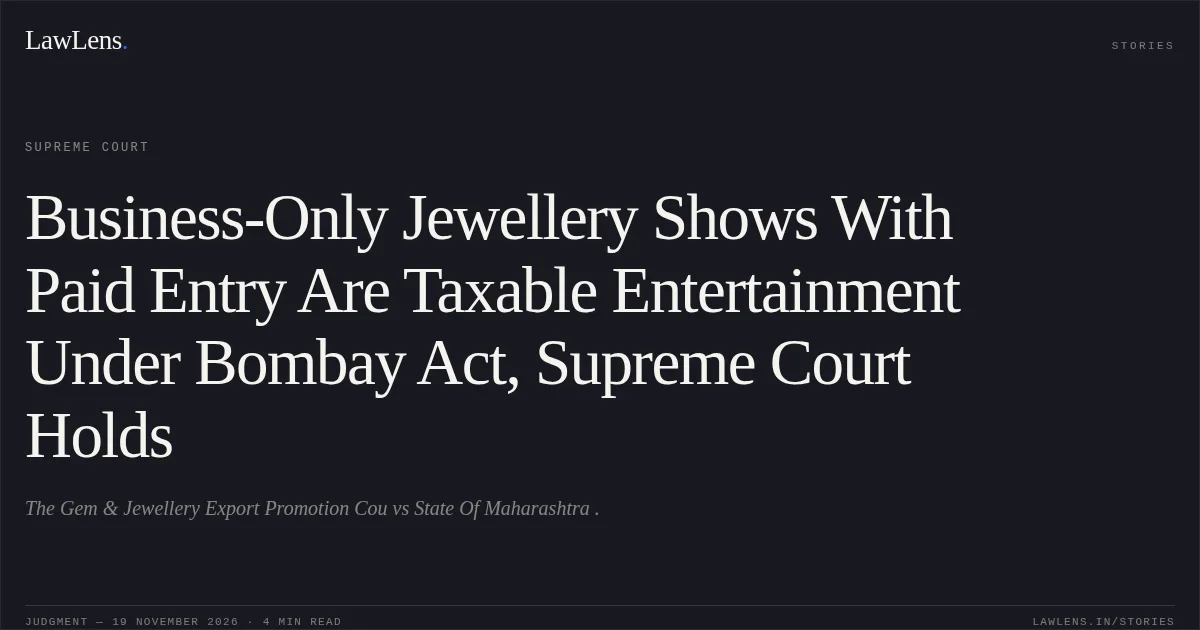
The Court answered the first issue in the affirmative: the IIJS and IIJS Signature exhibitions, being events to which persons are admitted for payment, fall within "entertainment" under Section 2(a) and attract the levy in Section 3 of the 1923 Act.
¶ 20The second issue was resolved against the Appellant, as the screening procedure and B2B character do not displace the statutory test.
¶ 20The Civil Appeal is dismissed and the judgment of the Bombay High Court dated 04.03.2013 is affirmed; pending applications stand disposed of.
¶ 21Original Court PDF
The Gem & Jewellery Export Promotion CouvsState Of Maharashtra .
Click to open original judgment
Original judgment, available to read, download and summarize on LawLens.in