01Facts
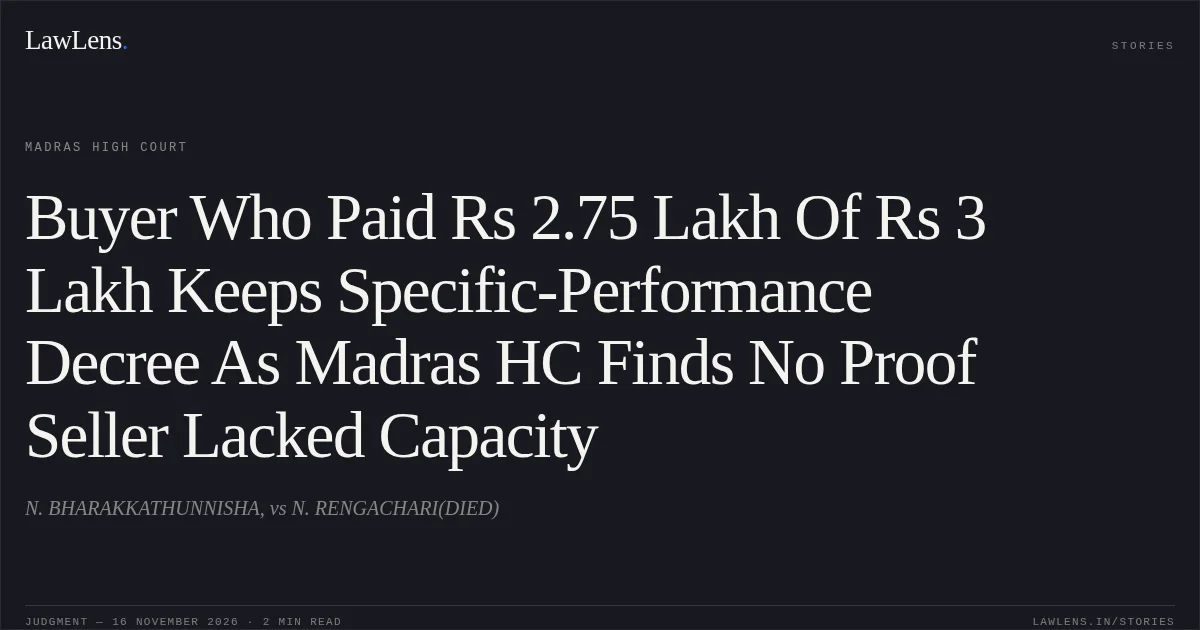
Nagoormeera allegedly agreed to sell the suit property to the plaintiff for ₹3,00,000 under an agreement dated 6 August 2003, receiving ₹2,75,000 as advance.
pp. 3–6After Nagoormeera’s death, the plaintiff called on his legal heirs to execute the sale deed; they denied the agreement and alleged fabrication, including that Nagoormeera lacked mental capacity when it was made.
pp. 3–6The trial court decreed specific performance, and the first appellate court affirmed.
pp. 3–6The defendants’ second appeal challenged, among other matters, the proof of readiness and willingness and Nagoormeera’s capacity to contract.
pp. 3–602Issues
i.1. Whether the plaintiff’s institution of the suit towards the end of the limitation period, coupled with an alleged failure to prove readiness and willingness, warranted dismissal of the specific-performance claim
p. 6ii.2. Whether pleading readiness and willingness, without proving it through oral and documentary evidence, was sufficient to decree specific performance
p. 603Law Applied
A plaintiff seeking specific performance must establish readiness and willingness to perform his contractual obligations; the mere fact that a suit was brought towards the end of the limitation period does not, by itself, defeat the claim if the suit is within the prescribed period.
pp. 2, 15–17In a second appeal, concurrent factual findings are not disturbed absent perversity or other infirmity.
pp. 2, 15–17The judgment does not expressly identify a statutory provision governing readiness and willingness or apply the cited precedents as part of its reasoning; Section 100 CPC is identified as the basis of the second appeal.
pp. 2, 15–17Provisions in the judgment · 1 · Linked ones open on LawLens
Code of Civil Procedure, 1908 Section 100
04Reasoning
The Court found the agreement and payment of the substantial advance supported by the attesting witness’s evidence, Nagoormeera’s admitted signature, and the plaintiff’s possession of the original parent documents.
pp. 11–15The medical evidence related to an earlier period and did not establish that Nagoormeera lacked capacity on the date of the agreement; the treating doctor had not examined him at or near that date and testified that he could understand simple matters and sign documents.
pp. 11–15The Court also considered the substantial advance, the balance of only ₹25,000, and the plaintiff’s legal notice as supporting readiness and willingness.
pp. 15–17It held that the timing of the suit, by itself, did not negate that case, and found no perversity in the concurrent findings below.
pp. 15–1705Holding
The Court answered both substantial questions of law against the appellants, held that the plaintiff had established the agreement and payment of substantial consideration, and found no basis to interfere with the concurrent findings.
p. 17The second appeal was dismissed, the decrees for specific performance were confirmed, and there was no order as to costs.
p. 17Original Court PDF
N. BHARAKKATHUNNISHA,vsN. RENGACHARI(DIED)
Click to open original judgment
Original judgment, available to read, download and summarize on LawLens.in