01Facts
The first defendant (owner of the suit property) agreed on 21.07.2005 to sell it for ₹59 lakhs.
pp. 2–3 · ¶ 3.aHe received ₹10 lakhs as advance by cheque, and the balance ₹49 lakhs was payable within 90 days.
pp. 2–3 · ¶ 3.a · ¶ 12The property was mortgaged to Bank of India, and the title deeds were with the bank.
p. 3 · ¶ 3.aThe plaintiffs contended that the vendor had represented that the advance would be used to redeem the mortgage.
p. 3 · ¶ 3.aThe defendant's case was that a further ₹10 lakhs was to be paid by the purchasers before registration to clear the mortgage, and that the plaintiffs had been shown copies of the title documents and told the originals were with the bank.
pp. 5–6 · ¶ 3.c · ¶ 13The plaintiffs issued a legal notice on 26.02.2006, and the defendant replied that the agreement had been terminated.
pp. 3–4, 6–7 · ¶ 3.eThe defendant forfeited ₹2 lakhs and tendered ₹8 lakhs, which was refused.
pp. 3–4, 6–7 · ¶ 3.eThe defendant sold to D2 and D3 by sale deed dated 08.12.2008, and D2 and D3 settled the property on D4 in 2011.
p. 4 · ¶ 3.bThe plaintiffs filed C.S. No. 82 of 2007 for specific performance.
p. 9 · ¶ 3.hThe learned Single Judge framed seven issues.
p. 9 · ¶ 3.hPW1, the power agent, was the only witness for the plaintiffs, and neither plaintiff entered the witness box.
pp. 25–26 · ¶ 20The learned Single Judge dismissed the suit for specific performance but directed the first defendant to pay ₹10 lakhs with 7.5% interest on ₹2 lakhs from 07.12.2005 until deposit.
p. 10 · ¶ 3.jThe plaintiffs appealed under Clause 15 of the Letters Patent and Order XXXVI Rule 9 OS Rules.
p. 2 · ¶ 102Issues
i.1. Whether the plaintiffs proved continuous readiness and willingness to perform the contract, entitling them to specific performance.
p. 16 · ¶ 11(a) · pp. 22–23 · ¶ 17ii.2. Whether the first defendant agreed to produce the original documents immediately upon receipt of the ₹10 lakh advance.
p. 16 · ¶ 11(b) · pp. 17–18 · ¶ 13iii.3. Whether the first defendant committed breach of contract.
p. 16 · ¶ 11(c) · pp. 24–25 · ¶ 19iv.4. Whether time was of the essence of the contract.
p. 9, Issue 1 · pp. 23–24 · ¶ 18v.5. Whether the subsequent purchasers (D2 and D3) were bona fide purchasers without notice, and whether the doctrine of lis pendens applies.
p. 9, Issue 6 · p. 25 · ¶ 1903Law Applied
A plaintiff seeking specific performance must establish readiness and willingness, which must "sail together" with the capacity to mobilise funds, citing Kalawati v. Rakesh Kumar (2018) 3 SCC 658 and U.N. Krishnamurthy v. A.M. Krishnamurthy (2022).
p. 23 · ¶ 17Capacity to pay must be established first, citing Acharya Swami Ganesh Dassji v. Sita Ram Thapar (1996) 4 SCC 526.
p. 19 · ¶ 14Continuous readiness from contract to hearing is required, citing A. Kantamani v. Narseen Ahmed (2017) 4 SCC 654.
p. 15 · ¶ 10(b)Specific performance is discretionary, citing R. Kandasamy v. T.R.K. Saraswathy (2025) 3 SCC 513.
p. 15 · ¶ 10(e)Time must be expressed as essential in clear language, citing I.S. Sikandar v. K. Subramani (2013) 15 SCC 27.
pp. 23–24 · ¶ 18Time is not ordinarily of the essence in immovable property contracts but a specified period cannot be ignored, citing Chand Rani v. Kamal Rani (1993) 1 SCC 519 and K.S. Vidyanadam v. Vairavan (1997) 3 SCC 1.
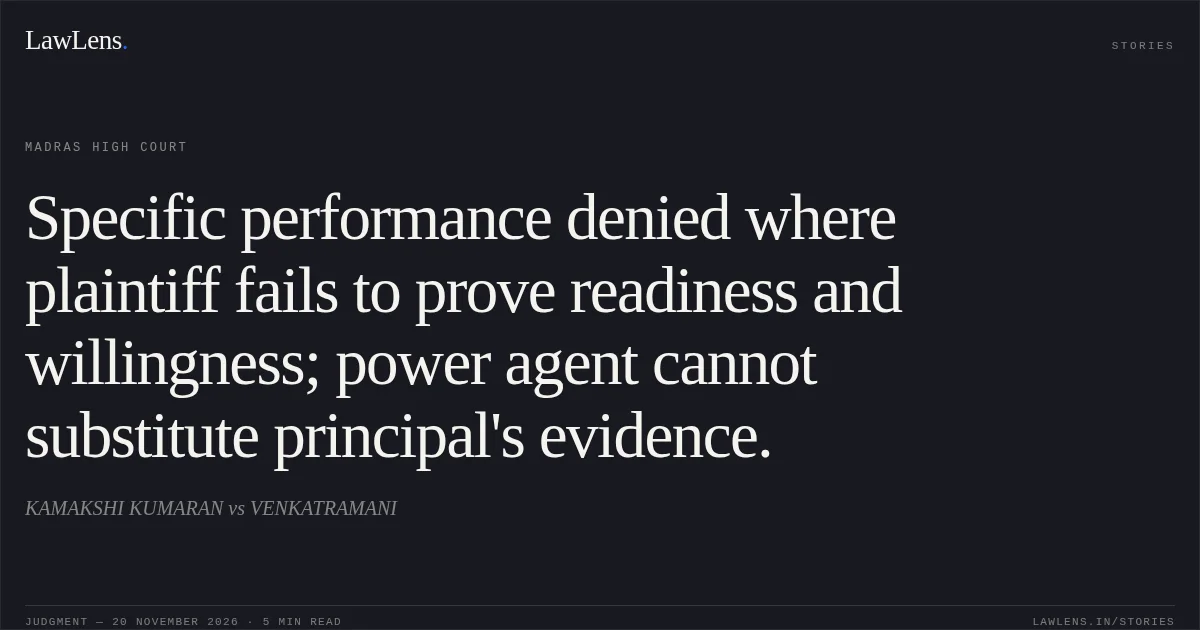
pp. 23–24 · ¶ 18A power of attorney holder cannot substitute for the principal's personal knowledge, citing Janki Vashdeo Bhojwani v. IndusInd Bank (2005) 2 SCC 217 and Man Kaur v. Hartar Singh Sangha (2010) 10 SCC 512.
p. 22 · ¶ 16See also Rajesh Kumar v. Anand Kumar (2024) 13 SCC 80.
p. 15 · ¶ 10(c)Pendente lite purchasers take subject to the result of the suit, citing Thomson Press (India) Ltd. v. Nanak Builders (2013) 5 SCC 397.
p. 25 · ¶ 19The limitation principle under Article 54 of the Limitation Act, 1963, as stated in Valliammai v. K.P. Murali (2024) 20 SCC 363, was cited by the respondent.
pp. 15–16 · ¶ 10(d)The appellant relied on Chandnee Widya Vati Madden v. C.L. Katial (1963) and on Section 13(c) of the Specific Relief Act, which places the duty to clear a mortgage on the vendor.
pp. 11–12 · ¶ 5–6The judgment does not expressly apply Section 16(c) of the Specific Relief Act by number.
Provisions in the judgment · 1 · Linked ones open on LawLens
Specific Relief Act, 1963 Section 13
04Reasoning
The Court held that the plaintiffs failed the threshold test of capacity to pay. The bank statements produced showed negligible balances, with the highest balance of about ₹5.6 lakhs in October 2005 and balances of ₹1,804 and ₹15,431 in other accounts.
pp. 18–19 · ¶ 13PW1 could not state the financial status of the second plaintiff, who was to purchase a 2/3rd share, and the second plaintiff's documents (Exs. P8, P20, D8) indicated that he had parted with no money and had nominated or relinquished his interest.
pp. 19–20 · ¶ 14On the mortgage, the Court read the agreement as silent on redemption and as requiring only the production of an encumbrance certificate. Since the plaintiffs knew of the ₹8–10 lakh mortgage and had inspected the documents, they could have paid the balance and insisted on redemption.
pp. 20–21 · ¶ 15On time, the Court reasoned that the ₹2 lakh forfeiture clause showed the parties intended time to be essential, so the plaintiffs could not rely on the defendant's delay in redeeming the mortgage. This reasoning is in tension with the Court's own statement that time was not essential.
pp. 23–24 · ¶ 18The Court found that the defendant had suffered hardship (the daughter's marriage alliance and the lost plot purchase) and that the bank had initiated coercive steps under Ex. D24.
p. 22 · ¶ 16 · p. 25 · ¶ 19The defendant's repeated tender of the refund (₹8 lakhs, then a pay order) was refused, which the Court took as showing the defendant did not intend to retain the money.
p. 25 · ¶ 19The later sale to D2 and D3 did not confer a right to specific performance, since the purchasers took subject to the suit's outcome.
p. 25 · ¶ 19The plaintiffs' failure to examine either plaintiff in the witness box weighed against them. PW1 had no personal knowledge of the transaction.
p. 22 · ¶ 16 · pp. 25–26 · ¶ 2005Holding
The Court held that the plaintiffs had not proved readiness and willingness, so the equitable remedy of specific performance could not be granted.
p. 23 · ¶ 17 · p. 25 · ¶ 20The learned Single Judge's dismissal of the specific performance claim and the alternate money decree of ₹10 lakhs with interest at 7.5% on ₹2 lakhs from 07.12.2005 until deposit were affirmed.
p. 26 · ¶ 21The appeal was dismissed with no order as to costs. The connected C.M.P. was closed.
p. 26 · ¶ 21Original Court PDF
KAMAKSHI KUMARANvsVENKATRAMANI
Click to open original judgment
Original judgment, available to read, download and summarize on LawLens.in