01Facts
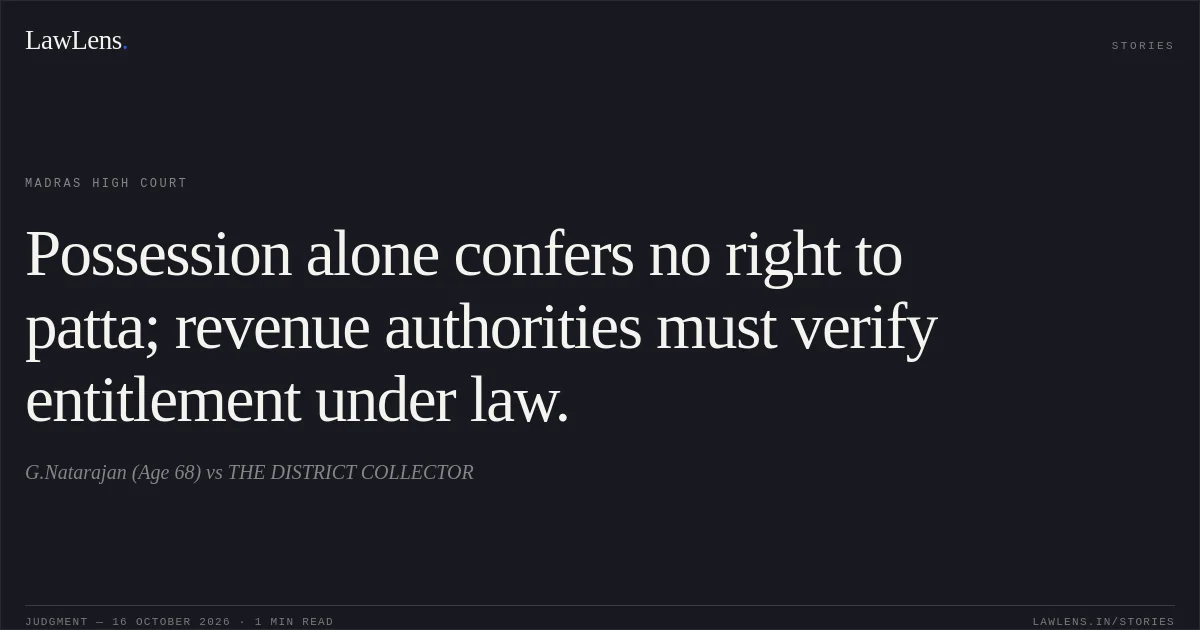
The petitioners were subsequent purchasers and patta holders of lands originally assigned free of cost to poor and landless persons in 2006.
¶ 2–5, 9–10, 15, 17–18The assignment terms prohibited alienation for 30 years.
¶ 2–5, 9–10, 15, 17–18After finding that the original assignees had transferred the lands within that period, the Sub-Collector cancelled the assignments and ordered resumption.
¶ 2–5, 9–10, 15, 17–18The petitioners challenged those orders, arguing, among other things, that the Sub-Collector lacked jurisdiction, that cancellation was barred by a three-year limitation, and that they were bona fide purchasers who had relied on mutated revenue records.
¶ 2–5, 9–10, 15, 17–1802Issues
i.Whether the Sub-Collector had authority to resume the assigned lands and whether the petitioners were deprived of an appeal by the orders being made at that level.
¶ 9–14ii.Whether G.O.Ms.No.2555, Revenue Department, dated 14 May 1973, barred resumption because more than three years had elapsed since assignment.
¶ 15–16iii.Whether subsequent purchasers could rely on bona fide purchase or mutation of revenue records as a basis to prevent resumption for breach of the 30-year prohibition on alienation.
¶ 17–2003Law Applied
Under RSO No.15(3)(2)(xi), the Tahsildar is competent to resume non-valuable assigned land, while the Revenue Divisional Officer is competent to resume valuable land; “valuable” lands are described in RSO No.15(3)(2)(vi), and specially valuable lands are addressed in RSO No.15(22).
¶ 11–12RSO No.15(15) provides an appeal from a Tahsildar’s decision to the Divisional Officer, from a Divisional Officer’s decision to the Collector, and from the Collector’s decision to the Commissioner of Land Administration.
¶ 13–14The three-year period under G.O.Ms.No.2555 applies to cancellation for material irregularity in the assignment procedure or decision, not to resumption for a subsequent breach of assignment conditions.
¶ 15–16The Court distinguished T. Tirumalai Gounder v. State of Tamil Nadu, P. Mohanavalli v. Revenue Divisional Officer and K. Chinnapandi v. Alagarsamy, which concerned assignments permitting transfer with official permission; mutation was treated in those cases as implied permission.
¶ 6, 19–20That principle did not apply to an assignment imposing a total prohibition on alienation during the lock-in period.
¶ 6, 19–2004Reasoning
The Court held that the Sub-Collector’s authority depended on whether the lands were valuable: the sale deeds in most cases described the lands as dry and recorded a value exceeding ₹1,000 per acre, supporting treatment as valuable lands and the Sub-Collector’s jurisdiction.
¶ 11–14Even if any land were non-valuable, the Sub-Collector was a superior authority, and RSO No.15(15) preserved an appeal to the Collector; the petitioners were therefore not deprived of an appeal.
¶ 11–14The three-year limit did not apply because the proceedings addressed later breaches of the assignment conditions, rather than irregularities in the original assignments.
¶ 15–16Nor could the petitioners rely on mutation or bona fide purchase: the 30-year restriction imposed a total ban on alienation, unlike the permission-based conditions considered in the cited cases, and purchasers were expected to verify the original assignment terms.
¶ 18–2005Holding
The Court rejected the challenges to the Sub-Collector’s authority, the asserted three-year limitation, and the petitioners’ reliance on bona fide purchase and mutation.
¶ 21Finding no valid reason to interfere with the resumption orders, it dismissed all writ petitions, made no order as to costs, and closed the connected miscellaneous petitions.
¶ 21Original Court PDF
Geetha SvsThe District Collector
Click to open original judgment
Original judgment, available to read, download and summarize on LawLens.in