Facts
The minor child, Amit Das, was born prematurely on 24 February 2023 at M.R. Bangur Hospital, Kolkata, and remained admitted in the SNCU for approximately twenty-five days.
Source reference: paras. 2–3After discharge, the biological parents handed the child to the petitioners, who thereafter cared for him and retained his custody.
Source reference: paras. 2–3The parties executed a notarised Deed of Adoption—identified in the judgment as dated 3 April 2023 and elsewhere as 23 April 2023—without following the statutory adoption procedure under the Juvenile Justice (Care and Protection of Children) Act, 2015 (“JJ Act”) and the Adoption Regulations, 2022.
Source reference: paras. 2–3, 16When the petitioners sought the child’s birth certificate and proposed school admission, they were directed to approach the Child Welfare Committee (“CWC”).
Source reference: para. 4On 18 February 2026, the petitioners approached the CWC, which took the child into its custody and did not return him to the petitioners.
Source reference: para. 4The petitioners filed the writ petition seeking disclosure of records relating to the child and contended that there was no allegation of abuse, neglect, exploitation, trafficking or mistreatment against them.
Source reference: paras. 1, 5–8The State submitted that the private adoption arrangement had no legal recognition and that the CWC was required to examine the child’s circumstances under the JJ Act.
Source reference: paras. 9–15Issues
1. Whether the CWC had statutory jurisdiction to take and retain custody of the child when the child was neither orphaned nor abandoned and did not fall within the definition of a “child in need of care and protection” under Section 2(14) of the JJ Act.
Source reference: paras. 18–21, 242. Whether the notarised Deed of Adoption and the petitioners’ prolonged care and custody conferred a legal right to retain the child despite non-compliance with the statutory adoption procedure.
Source reference: paras. 9–17, 21, 27–283. Whether, having regard to the child’s best interests and the principles under Section 3 of the JJ Act, custody should be restored to the petitioners pending appropriate proceedings for legal recognition of the adoption.
Source reference: paras. 22–26Law Applied
The Court applied Section 2(14) of the JJ Act, which limits the jurisdiction of the CWC to children who fall within the statutory definition of “children in need of care and protection,” including children who are orphaned, abandoned, surrendered, abused, neglected, exploited, or whose parents or guardians are found unfit or incapacitated.
Source reference: para. 18Sections 56–58 of the JJ Act and the Adoption Regulations, 2022 require adoptions covered by the statutory framework to be processed through the prescribed mechanism, including the recognised adoption system and competent authorities; a private or notarised adoption arrangement does not, by itself, constitute a valid statutory adoption.
Source reference: paras. 9–11, 17, 21Section 3 of the JJ Act requires authorities to apply, inter alia, the principles of best interest, family responsibility, safety, positive measures, institutionalisation as a last resort, repatriation and restoration, and natural justice.
Source reference: para. 22The Court also recognised that the Hindu Adoptions and Maintenance Act, 1956 and the Guardians and Wards Act, 1890 did not validate the impugned private arrangement in the circumstances of the case.
Source reference: paras. 17, 21Reasoning
The Court held that the absence of compliance with the statutory adoption procedure meant that the petitioners could not rely solely on the notarised Deed of Adoption to claim a legally established adoptive status or an absolute right to custody.
Source reference: paras. 16–17, 21However, non-compliance with adoption formalities did not automatically bring the child within Section 2(14) of the JJ Act.
Source reference: paras. 16–17, 21On the facts, the child was neither orphaned nor abandoned, and there was no finding that the petitioners had abused, neglected, exploited or otherwise endangered him.
Source reference: paras. 3, 5–8, 21, 24The child had remained continuously with the petitioners since infancy and had been cared for by them for approximately three years.
Source reference: paras. 3, 5–8, 21, 24Accordingly, the CWC lacked lawful authority to assume custody merely because the private adoption process was procedurally defective.
Source reference: paras. 21, 24Applying the statutory principles of best interest, family responsibility, safety, restoration and institutionalisation as a last resort, the Court concluded that removal from the established caregiving environment was not justified.
Source reference: paras. 22–24Holding
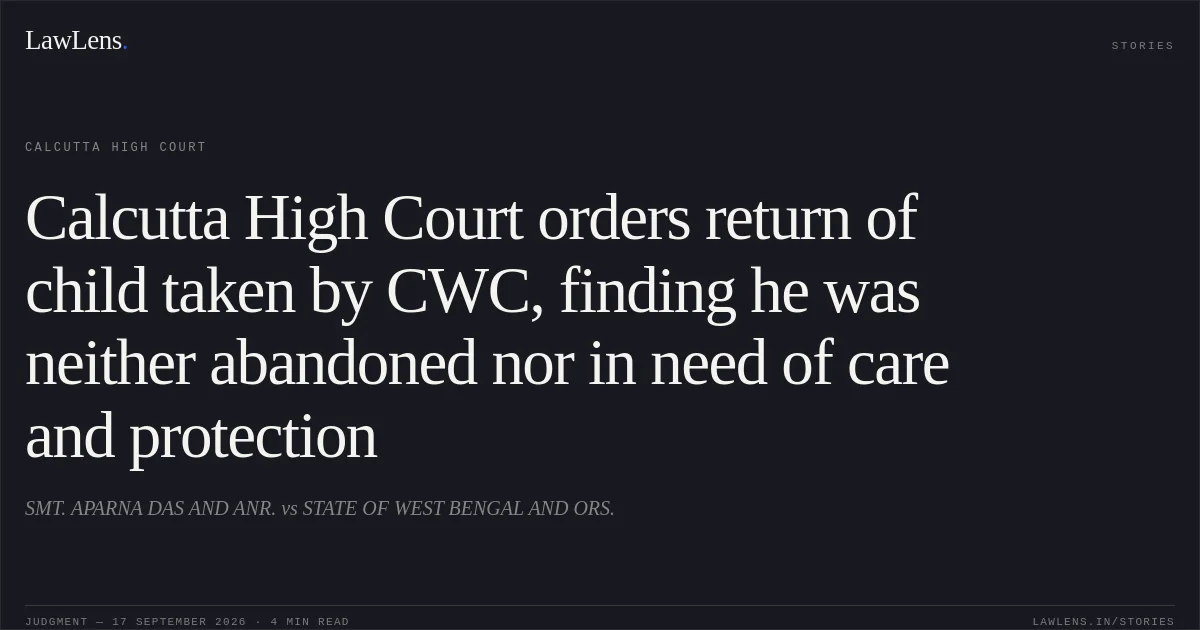
The Court held that the child did not fall within the category of a “child in need of care and protection” under Section 2(14) of the JJ Act and that the CWC’s assumption of custody was not in accordance with law.
The CWC was directed to hand over the child to the petitioners by 18 September 2026 at 4:00 p.m.
Source reference: para. 25The Member Secretary of the District Legal Services Committee, South 24 Parganas, was directed to obtain quarterly welfare and progress reports concerning the child from December 2026 and was authorised to arrange inspection of the petitioners’ residence through a Child Welfare Expert.
Source reference: para. 26The petitioners were directed to approach the appropriate court for a declaration regarding their status as the child’s adoptive parents.
Source reference: para. 28The writ petition was accordingly disposed of.
Source reference: para. 29Acts & Sections Cited
5 provisions across 1 statute referred to in this judgment. Each provision opens on LawLens.
Juvenile Justice (Care and Protection of Children) Act, 2015.5
Original Court PDF
SMT. APARNA DAS AND ANR.vsSTATE OF WEST BENGAL AND ORS.
Click to open original judgment
Original judgment, available to read, download and summarize on LawLens.in